Hot Tub Foundation Requirements: What You Need to Know Before Installation
Getting hot tub foundation requirements right before your tub arrives is one of the most important steps most buyers completely overlook — and it can be the difference between a spa that lasts decades and one that cracks, shifts, or voids its warranty in the first year.
Here’s the thing: a hot tub filled with water and people can weigh anywhere from 3,000 to 6,000 pounds depending on the size. Your backyard deck, your patio pavers, your gravel path — none of those were designed with that kind of sustained load in mind. The foundation is the one part of your hot tub setup you genuinely cannot undo easily or cheaply after the fact, which is why it deserves serious attention before anything else.
Heads up: Some links in this post are affiliate links. If you buy through them, we may earn a small commission at no extra cost to you. We only link to products we’d actually use.
✦ Quick Snapshot
- A hot tub needs a stable, level base capable of supporting its full operating weight
- Reinforced concrete is a common foundation option, but always follow the manufacturer’s installation requirements
- Existing concrete may work if it is level, sound and suitable for the specific hot tub
- Deck installations require assessment of the structure for the tub’s concentrated load
- Gravel, pavers and prefab spa pads may work for some models when properly prepared and manufacturer-approved
- Good drainage and ground preparation are important for long-term stability
- Foundation and permit requirements vary by installation and location
- Check the hot tub manufacturer’s requirements before preparing or paying for the base
Table of Contents
- Why Hot Tub Foundation Requirements Matter
- What Does a Hot Tub Actually Weigh?
- The Real Cost of Getting Your Foundation Right
- Installation — What the Process Actually Looks Like
- Maintenance and Long-Term Care of Your Base
- Pros and Cons of Each Foundation Type
- Foundation Type Comparison
- Helpful Gear
- FAQ
- Final Verdict
Why Hot Tub Foundation Requirements Matter
A hot tub is not patio furniture. It doesn’t sit gently on a surface — it bears down on it, constantly, in all weather conditions, year after year. The structural demands are closer to those of a small garden shed or a loaded vehicle parked in one spot permanently.
The core reason hot tub foundation requirements exist is load distribution. When water fills a 400-gallon tub, you’re adding over 3,300 pounds of water alone before a single person climbs in. Add the cabinet and shell weight — typically 500 to 900 lbs for a mid-size spa — and two to four adults, and you’re comfortably in the 5,000–6,000 lb range for a larger model. That weight needs to go somewhere, and it needs to go somewhere predictable and stable.
What happens if your foundation isn’t adequate? An undersized or improperly prepared foundation causes the hot tub shell to flex unevenly as the ground beneath it shifts. This leads to cracked acrylic shells, broken plumbing fittings, and warped cabinet panels — all typically excluded from manufacturer warranties if foundation failure is identified as the cause. Many warranty documents explicitly require a “structurally sound, level, continuous solid surface” as a baseline condition.
The secondary concern is level. Hot tubs are precision-engineered with internal plumbing that assumes a flat orientation. A base that’s even slightly off — more than 1/8 inch across the footprint — can cause jets to underperform, water to pool unevenly, and seals to fail prematurely.
What Does a Hot Tub Actually Weigh? The Numbers That Drive Foundation Design
Understanding the load is the first step to choosing the right base.
A small two-person spa (around 200 gallons) might top out at 2,800 lbs fully loaded. A standard four to five-person hot tub (350–450 gallons) lands in the 4,000–5,500 lb range. Larger eight-person party tubs can push 7,000 lbs or more.
Translated into pressure per square foot — which is what your foundation material actually experiences — most hot tubs exert between 100 and 150 lbs per square foot. Standard residential concrete is rated for around 3,000 psi in compression, so the issue isn’t the concrete itself; it’s the soil beneath it settling, heaving, or washing away if the pad isn’t properly installed.
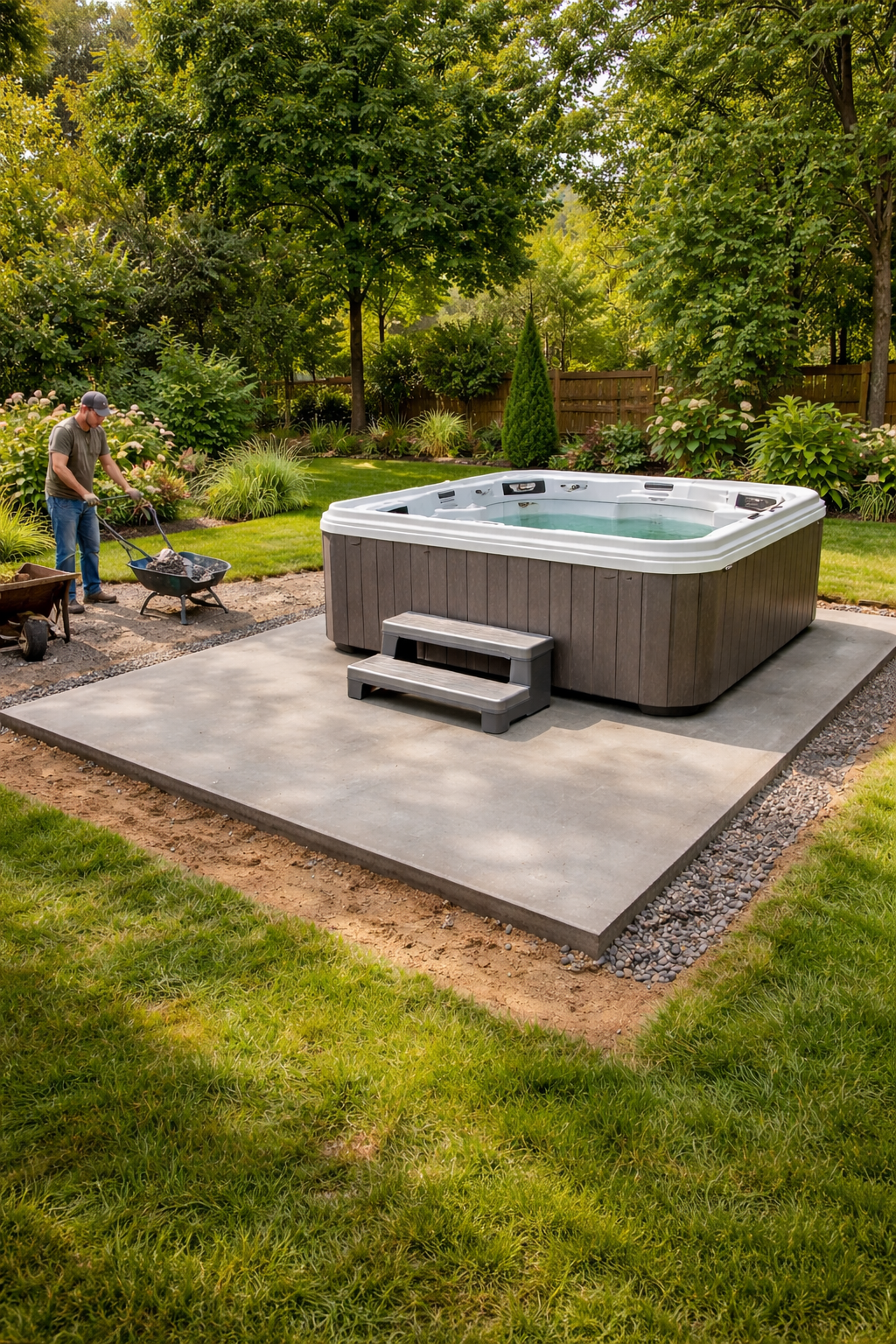
A reinforced concrete pad is a common hot tub foundation, but the required thickness, reinforcement and base preparation depend on the specific hot tub, soil/site conditions and manufacturer requirements. Always follow the installation manual and applicable local requirements.
The Real Cost of Hot Tub Foundation Requirements
Let’s talk money, because this is where a lot of buyers get surprised.
Concrete pad (most common): A typical 10×10 ft concrete pad, 4 inches thick with rebar reinforcement, poured professionally, runs $800–$1,800 depending on your region, soil conditions, and access to the site. Add $200–$500 if the area needs significant excavation or grading first.
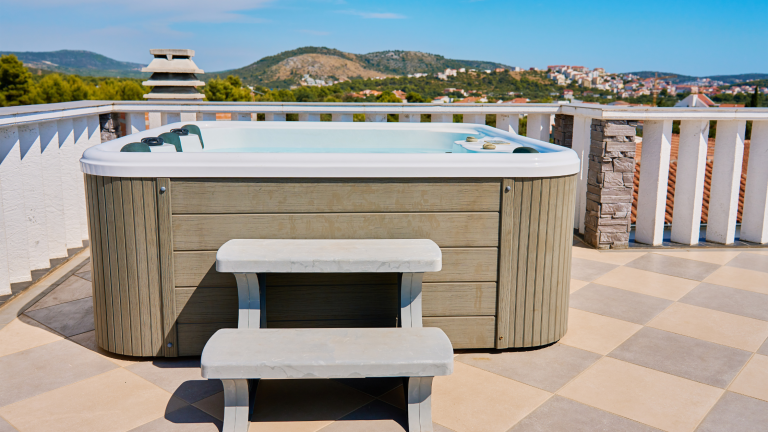
Existing concrete patio (best case): If you already have a solid, level concrete patio that’s 4+ inches thick and in good condition, your foundation cost may be zero. Have it assessed for level and integrity — a contractor can do this in under an hour.
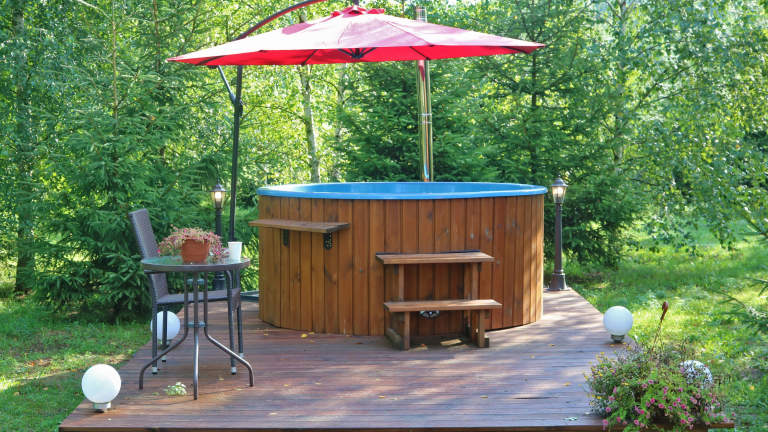
Composite decking (variable): A properly engineered composite or wood deck can work, but you’ll likely need a structural engineer to sign off on it, especially for larger tubs. Engineering assessments run $300–$700. Deck reinforcement — adding extra joists, blocking, and posts — can add $500–$2,000 on top.
Prefab spa pads: Products like DURABASE or similar interlocking plastic pad systems have become popular for buyers who want to avoid concrete. These run $200–$600 for materials and can be DIY-installed. They work well in stable, well-draining conditions but aren’t universally accepted by all manufacturers.
Permits: Many municipalities require a permit for new concrete pads or deck modifications. Budget $50–$300 for permit fees, plus time.
The honest summary: budget at minimum $500–$800 for foundation prep even in the best-case scenario, and assume $1,500–$2,500 as a realistic mid-range if you’re starting from bare ground.For the wider costs beyond the foundation itself, see our Hot Tub Installation Cost in 2026 guide.
Installation — What the Process Actually Looks Like
The installation process for a proper hot tub foundation is more involved than most buyers realize going in.
Site assessment first. Before anything is poured or built, you need to understand your soil type. Clay-heavy soil expands and contracts with moisture and temperature. Sandy or loamy soil drains well but can shift. Rocky soil is usually ideal. A landscaper or contractor can assess this quickly.
Excavation and base preparation. For a new concrete pad, the ground needs to be properly prepared before the concrete is poured. This may involve excavation and a compacted aggregate base, depending on the soil, drainage, climate and slab design. The required depth and base preparation should follow the contractor’s specifications, local requirements and the hot tub manufacturer’s installation guidance.
Reinforcement. Concrete pads may use rebar, welded wire reinforcement or other reinforcement depending on the slab design and site conditions. The appropriate thickness and reinforcement should be determined for the specific installation rather than assumed. Follow the hot tub manufacturer’s requirements and your contractor’s or engineer’s specifications.
Cure time. Concrete needs time to gain sufficient strength before a hot tub is placed and filled on it. The required waiting period depends on the concrete mix, slab design and site conditions, so follow your concrete contractor’s guidance and the hot tub manufacturer’s installation requirements rather than assuming a fixed number of days.
Access consideration. Hot tubs are large and heavy before they’re even filled. You need a clear path from the delivery truck to the installation site — typically at least 4 feet wide with no steps the tub needs to be navigated over. Plan your foundation location with delivery logistics in mind.
Electrical rough-in coordination. If your hot tub requires a hardwired electrical supply, coordinate the electrical route with the foundation work before the pad is poured. Voltage, amperage, circuit and disconnect requirements vary by model, so follow the manufacturer’s specifications and applicable electrical code. Hot tub installations commonly require GFCI protection, and electrical work should be completed by a qualified electrician in accordance with local requirements.
Maintenance and Long-Term Care of Your Foundation
A good foundation shouldn’t require much ongoing attention — but it does need periodic checks.
Annual inspection. Once a year, inspect the pad for new or worsening cracks, movement or uneven settlement. Small surface cracks aren’t necessarily a structural problem, but widening cracks, vertical displacement or noticeable movement should be assessed by a qualified professional.
Water drainage. Make sure the area around your pad drains away from the foundation. Pooling water that finds its way under the slab accelerates freeze-thaw damage in cold climates. A slight grade away from the pad — even 1% — makes a meaningful difference.
Leveling checks. Periodically check that the hot tub remains level and fully supported. If you notice movement, uneven support or a change from its original position, investigate the foundation before the problem worsens.
Deck foundations. If your tub sits on a deck, inspect the support posts and joist connections annually for rot, insect damage, or loosened hardware. Decks are dynamic structures that move with temperature and moisture in ways concrete doesn’t, so the hot tub connections deserve regular attention.
Pros and Cons of Each Foundation Type
Pros and Cons of Each Foundation Type
Reinforced Concrete Pad
Pros: Stable, durable and suitable for many hot tub installations when properly designed and prepared.
Cons: Higher upfront cost, requires preparation and curing, and is difficult to relocate.
Existing Concrete Patio
Pros: May avoid the cost of building a new foundation if the existing slab is suitable.
Cons: Must be level, structurally sound and capable of supporting the specific hot tub. Existing damage or settlement may make it unsuitable.
Composite/Wood Deck
Pros: Can integrate the hot tub into an existing outdoor living area.
Cons: The structure must be assessed for the hot tub’s filled weight and may require reinforcement. Manufacturer requirements should also be checked.
Prefab Interlocking Spa Pad
Pros: Relatively quick to install, relocatable and doesn’t require concrete curing.
Cons: Suitability depends on the hot tub, ground preparation and manufacturer requirements.
Gravel Bed
Pros: Good drainage and relatively low installation cost.
Cons: Requires careful preparation and compaction, and a gravel base is not suitable for every hot tub. Check the manufacturer’s foundation requirements before using one.
Foundation Type Comparison Table
| Foundation Type | Avg. Cost | Load Capacity | DIY | Manufacturer Guidance | Relocatable |
|---|---|---|---|---|---|
| Reinforced Concrete | $800–$2,000 | Excellent when properly designed | No | Check manual | No |
| Existing Concrete | $0–$200 assessment | Depends on slab | Yes | If approved | No |
| Wood/Composite Deck | $500–$2,500 | Requires assessment | Partial | Check manual | No |
| Prefab Spa Pad | $200–$600 | Depends on product | Yes | Varies | Yes |
| Gravel Base | $100–$300 | Depends on preparation | Yes | Varies | Yes |
Helpful Gear
These are a few items that genuinely help during hot tub foundation prep and installation. Always verify current ratings and availability before purchasing.
1. KAPRO 770 Level 48-Inch Box Level A long, accurate level is essential for checking your pad and verifying your tub is sitting true. A 48-inch level gives you a much more reliable read than shorter options.
2.Confer Plastics Handi Spa Pad For buyers who want a solid, relocatable foundation without pouring concrete interlocking tiles are a well-reviewed option. Verify your manufacturer’s warranty terms before purchasing.
3. Marshalltown 16-Inch Magnesium Float If you’re finishing your own concrete pour (or smoothing out a DIY prefab pad perimeter), a hand float makes getting a level, smooth surface much easier.
FAQ
What is the minimum thickness for a hot tub concrete pad?
There isn’t one universal thickness for every hot tub installation. The required slab thickness, reinforcement and base preparation depend on the hot tub, site conditions and manufacturer requirements. Check the installation manual and use the specifications provided by your contractor or engineer where appropriate.
Can I put a hot tub on pavers?
Possibly. Some hot tubs can be installed on a properly prepared paver base, while others require a different foundation. The surface must remain level, stable and capable of supporting the filled tub. Check the manufacturer’s installation requirements before choosing pavers.
Do I need a permit to pour a hot tub pad?
Permit requirements vary by city, county and the type of work involved. A foundation, deck modification or electrical installation may require permits or inspections depending on your location. Check with your local building department before starting work.
The simple rule: If you wouldn’t park a loaded pickup truck on your proposed hot tub surface and feel confident about it, you need a better foundation.
Summary Snapshot
- Hot tub foundations need to provide stable, level support for the tub’s full operating weight
- Reinforced concrete is a common option, but slab design and preparation should follow the manufacturer’s requirements and site conditions
- Existing concrete may work if it is sound, level and suitable for the specific hot tub
- Deck installations require assessment for the tub’s filled weight and may need reinforcement
- Prefab spa pads and properly prepared gravel bases may be suitable for some hot tubs
- Good drainage and ground preparation help maintain long-term stability
- Coordinate electrical requirements with the foundation and installation work
- Check manufacturer instructions and local permit requirements before starting
Final Verdict
Hot tub foundation requirements aren’t the glamorous part of the buying journey — nobody gets excited about concrete thickness specs the way they get excited about jet configurations or LED lighting. But this is genuinely the part that determines whether your investment holds up or becomes an expensive headache within a few years.
If you’re planning a deck install, our hot tub on a deck guide covers structural loading and when an engineer may be required. The electrical run length is directly affected by where your foundation sits, so it’s worth reviewing hot tub electrical requirements before you finalise placement.