
Are Spa Aromatherapy Products Safe? What Hot Tub Owners Need to Know
- Most essential oils are NOT safe for hot tubs — they can clog filters and damage the shell
- Purpose-formulated spa aromatherapy products use water-soluble or emulsified ingredients
- Poorly chosen products can shift pH and reduce sanitiser effectiveness within 30 minutes
- Budget-friendly spa-safe aromatherapy products start around $10–$15 per bottle
- Fragrance crystals and spa drops are the most commonly used formats
- Certain ingredients — eucalyptus, citrus, pine — can cause respiratory irritation at high concentrations in an enclosed space
- Always check compatibility with your specific hot tub brand before purchasing
Are spa aromatherapy products safe? Some products are designed for hot tub use, but they must also be compatible with your specific spa and used according to their instructions. Do not add ordinary essential oils or household bath products directly to the water. Check your hot tub manual or ask the manufacturer before using a fragrance additive; a “spa-safe” label alone does not confirm compatibility.
This isn’t a scare piece. Aromatherapy can genuinely improve a hot tub session. The combination of heat, hydrotherapy pressure, and scent creates a sensory experience that’s hard to replicate any other way. But there’s a real gap between what’s marketed as “spa-safe” and what’s actually safe for your water, your shell, and your body.
If you’ve ever wondered why the instructions say keep oils out of the hot tub — this is the full picture.
As an Amazon Associate, Sunrise & Vitalize earns from qualifying purchases. If you buy through an affiliate link, we may earn a small commission at no extra cost to you.
Quick Snapshot
- Use only products designed for hot tubs and approved for your specific spa.
- Do not add ordinary essential oils, bath oils, bubble bath or household bath salts.
- Follow the product’s dose instructions for your tub’s water volume.
- Water-soluble does not automatically mean compatible with every hot tub.
- Fragrances can irritate sensitive skin or airways, even at the recommended dose.
- Aromatherapy does not replace sanitiser, water testing or filter maintenance.
- Compare the labelled dose and number of uses when judging value.

Table of Contents
- What Makes a Spa Aromatherapy Product Actually Safe?
- The Real Costs: What You’re Actually Paying For
- Getting It Into the Water: Application and Setup
- Maintenance Impact: What Aromatherapy Does to Your Water
- Pros and Cons of Hot Tub Aromatherapy
- How Different Product Types Compare
- Helpful Gear
- Frequently Asked Questions
- The Simple Rule
- Final Verdict
Are Spa Aromatherapy Products Safe? Here’s What the Label Won’t Tell You
Ordinary essential oils do not dissolve in water. They can leave an oily film and contribute to residue on the shell and filters. Do not pour them directly into your hot tub.
Products formulated for spas may disperse more readily, but water solubility alone does not prove compatibility. Check your hot tub manufacturer’s guidance as well as the product label, particularly if your spa uses a saltwater system or a dedicated fragrance dispenser.
Can you use regular essential oils in a hot tub? Do not add them directly to the water. If your spa has a manufacturer-approved aromatherapy system, use only the products specified for that system.
Liquid fragrances and crystals are common formats. Choose by compatibility, ingredients and labelled dose rather than assuming one format is always safer. Household bath salts and bubble bath are not substitutes for approved spa products.
Fragrances may irritate skin, eyes or airways. If a scent causes discomfort, stop using it and leave the water. Anyone with known fragrance allergies or scent-triggered asthma should avoid the triggering ingredients; a “natural” label does not make them harmless.
The Real Costs: What You’re Actually Paying For
Compare products by cost per labelled dose, rather than bottle price alone. Bottle size, concentration and your hot tub’s water volume determine how many sessions a product provides.
To estimate the cost per use, divide the purchase price by the number of doses the container provides for your tub. Prices change, so check the current listing and dosing instructions before buying.
Factor in maintenance too. An unsuitable additive may leave residue that requires extra cleaning or a water change. There is no reliable universal figure for how much aromatherapy shortens filter life; follow your spa and filter manufacturer’s cleaning and replacement guidance.
Getting It Into the Water: Application and Setup
First, confirm that your hot tub manufacturer permits the product. Then follow its label for your tub’s water volume, including whether to run the jets, where to add it and how long to wait before entering.
For crystals, follow the dissolution instructions. Do not assume that every product should be sprinkled directly into the tub or used through a dispenser.
What’s the correct dose for spa aromatherapy in a hot tub? Use the labelled dose for your water volume. If the label gives a range, start at its lower end. Capfuls and scoops vary between products, so there is no universal dose for a 400-gallon tub.
Check your spa manual and warranty terms before using an additive. If compatibility is unclear, ask the manufacturer or authorised dealer before adding it.
Maintenance Impact: What Aromatherapy Does to Your Water
The main maintenance concern with spa aromatherapy products safe for regular use is their cumulative effect on water balance. Most quality formulations are pH-neutral by design, but that doesn’t mean they’re chemistry-neutral. Some fragrance compounds interact with bromine at elevated temperatures and produce trace byproducts that push total dissolved solids (TDS) higher over time.
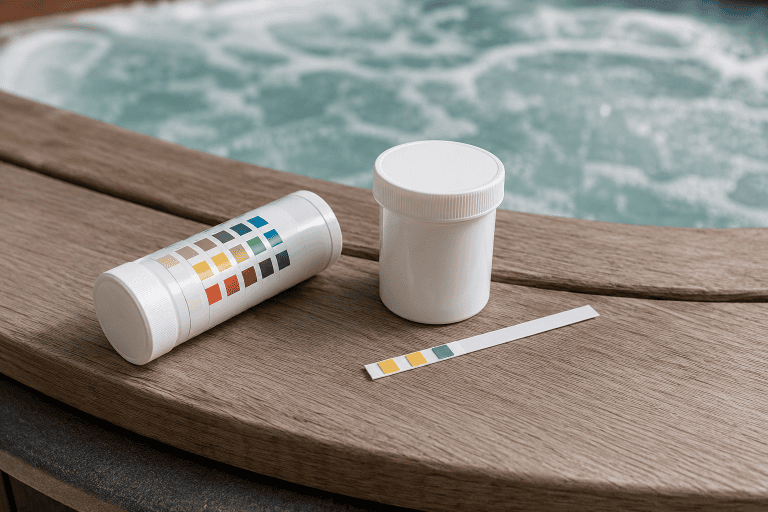
Test the water regularly whether or not you use aromatherapy. The CDC recommends checking chlorine and pH at least twice daily, and more often during heavy use. Aromatherapy does not replace your normal water-care routine. www.cdc.gov
The CDC recommends at least 3 ppm free chlorine or 4–8 ppm bromine, with pH between 7.0 and 7.8 for hot tubs. Check these levels before entering, and follow your spa and sanitiser instructions. If readings fall outside the recommended range, correct the water before use.
Filter rinsing frequency also increases with regular aromatherapy use. A quick rinse with a garden hose every two weeks — rather than monthly — is a reasonable adjustment for active users.
For help managing sanitiser and pH, see our guide to hot tub water chemistry basics.
Pros and Cons of Hot Tub Aromatherapy
Pros
Quality spa aromatherapy products safe for your water genuinely improve the sensory experience of a hot tub session. The combination of heat, jet pressure, and scent engages more of the senses simultaneously than heat alone — and there’s real evidence that aromatic compounds like lavender and eucalyptus have mild relaxing or clarifying effects at appropriate concentrations.
From a recovery standpoint, the heat plus jet pressure combination already does substantial work. Positioning on a powerful jet for 10–20 minutes — particularly targeting the belly of the muscle rather than the tendon attachment points — eases sore muscles effectively. Adding a calming or invigorating scent to that session can make it feel more intentional and extend the period of relaxation after you get out.
Some products are marketed with aloe or mineral ingredients, but that does not guarantee moisturising benefits. Choose by spa compatibility and your skin’s tolerance rather than promises of better skin.
Cons
Fully remove the cover from the bathing area before entering; do not bathe beneath a partially closed cover to retain heat. Keep indoor spa spaces properly ventilated. If fragrance causes eye, throat or breathing irritation, stop using it and leave the water. Lowering the dose does not make a triggering fragrance suitable for someone with an allergy or scent sensitivity.
The chemistry management burden increases — not dramatically, but it’s real. And for hot tub owners who are already stretched on time for maintenance, adding another variable isn’t always the right call.
How Different Product Types Compare
Not all formats of spa aromatherapy products safe for hot tub use behave identically in the water.
Liquid spa drops are the most controllable — easy to dose, fast to disperse, and the most widely available format. The main limitation is that cheaper liquid drops often contain carrier compounds that contribute to foaming at higher doses. If you’ve ever had unexpected foam in your hot tub, an overdose of a liquid aromatherapy product is one of the more common causes.
Fragrance crystals must dissolve according to the product instructions. Scent strength and duration vary by formulation, dose and jet use. Do not extend your soak just to make the fragrance last longer.
Use aromatherapy salts only if your hot tub manufacturer permits the specific product. Their effect on water balance depends on the ingredients and dose; not all salts increase calcium hardness or provide skin-conditioning benefits. Ordinary bath salts are not a substitute for an approved spa additive.
Avoid bubble bath and products designed to create foam unless your hot tub manufacturer explicitly approves them. They can cause excessive foaming and add to cleaning and water-care needs.

Comparison: Product Format at a Glance
| Product type | What to check before use |
|---|---|
| Liquid spa fragrance | Manufacturer compatibility and labelled dose for your water volume |
| Fragrance crystals | Compatibility, dose and dissolution instructions |
| Spa aromatherapy salts | Approval for the specific product; household bath salts are not substitutes |
| Foaming products | Avoid unless explicitly approved by your hot tub manufacturer |
| Ordinary essential oils | Do not add directly to hot tub water |
Helpful Gear
If you’re using aromatherapy regularly in your hot tub, a few supporting products are worth having:
Spa test strips — Essential for monitoring water balance when using any additives. More frequent testing is the realistic response to regular aromatherapy use.
Spa filter cleaner spray — Aromatherapy product residue builds up faster than standard use. A dedicated filter cleaner used monthly extends filter life meaningfully. Search: “hot tub filter cleaner spray.” Verify on Amazon before purchasing.
For help choosing and using a kit, see our hot tub water testing guide.
Frequently Asked Questions
Are essential oils safe to use in a hot tub? Standard essential oils are not safe for hot tubs. They are oil-based and will not dissolve in water — they float on the surface, coat the interior shell, and get drawn into the filter system where they cause blockages and residue buildup. Only products specifically formulated as water-soluble or hot tub-safe should be used to keep spa aromatherapy products safe for your equipment.
Is it worth buying spa aromatherapy products if I only use my hot tub twice a week? Yes, with one condition: keep the dose conservative. Twice-weekly use with a single capful of quality water-soluble drops is a very low chemistry burden — you won’t need to dramatically increase maintenance frequency. The sensory improvement to the session is real enough that most people who try it keep it in rotation. The risk is buying a format that’s more chemistry-intensive than your use level warrants — stick to liquid drops or crystals at low dose and the cost and management overhead stays minimal.
Can spa aromatherapy products cause skin irritation? They can, particularly products with synthetic fragrance compounds or high citrus content. Skin irritation from spa aromatherapy products is most common at overdose — using two to three times the recommended amount. At standard doses, reactions are uncommon in people without specific sensitivities. If you have a known fragrance allergy, avoid products containing your triggers, including natural essential oils such as lavender. For sensitive skin, fragrance-free water is the simplest option; “natural” does not mean non-irritating.
The Simple Rule
If the label doesn’t specifically say it’s formulated for hot tubs or spas, don’t put it in your water.
Summary Snapshot
- Choose a product your hot tub manufacturer permits.
- Follow the labelled dose for your tub’s water volume.
- Do not add ordinary essential oils or household bath products directly to the water.
- Water-soluble does not automatically mean compatible with your spa.
- Natural fragrances can still irritate skin or airways.
- Compare cost per labelled dose when buying.
- Aromatherapy never replaces sanitiser, water testing or filter maintenance.

Final Verdict
Used correctly, spa aromatherapy products safe for hot tub chemistry are a low-cost, low-effort upgrade to your sessions. The sensory experience genuinely improves with quality scent — particularly during longer soaks or post-exercise use where the combination of heat, jet pressure, and aroma produces something more restorative than any one element alone.
The mistakes are all on the product selection side: using oil-based products, overdosing on your first session, or skipping the water test after adding something new. None of those are hard to avoid once you understand what’s happening to your water chemistry. Stick to water-soluble formats, keep the dose minimal, and treat spa aromatherapy products safe for your specific unit as a chemistry question first and a lifestyle upgrade second.
For a broader look at heat-based relaxation, see our steam room benefits guide. Products intended for steam rooms should not be assumed safe for hot tub water.