
Water Testing Kits Explained: What Every Hot Tub Owner Actually Needs to Know
The right hot tub water testing kit is one of the least glamorous purchases you’ll make — and one of the ones that matters most.
Most people set up their hot tub, add some chemicals on the first day, and assume the water stays safe on its own for a while. It doesn’t. Water chemistry in a hot tub shifts faster than in a pool because of the heat, smaller volume, and the oils and residue that come off human skin. A hot tub water testing kit is the thing standing between you and skin irritation, cloudy water, or worse.
This isn’t complicated once you understand it. Here’s what you actually need to know.
This post contains affiliate links. If you buy through them, I earn a small commission at no extra cost to you — thanks for supporting the site.
Quick Snapshot
- Hot tub water testing kits range from around $8 for basic test strips to $30–$50 for liquid drop kits or digital readers
- Test strips give results in about 15 seconds; liquid drop kits take a few minutes but are more precise
- Most owners test 2–3 times per week; heavy use weeks need daily checks
- pH should sit between 7.2 and 7.8; total alkalinity between 80–120 ppm
- Cheap strips work — but reading them under indoor artificial lighting can skew the result (more on this below)
- Digital testers cost more upfront but remove the colour-matching guesswork entirely

Table of Contents
- What a Hot Tub Water Testing Kit Actually Tests
- The 3 Types: Strips, Liquid Drop Kits, and Digital Testers
- What Does a Water Testing Kit Cost?
- How Often Do You Actually Need to Test?
- The Honest Limitations Nobody Mentions
- Pros and Cons
- How Do the Three Types Compare?
- Comparison Table
- Helpful Gear
- FAQ
- The Simple Rule
- Summary Snapshot
- Final Verdict
What a Hot Tub Water Testing Kit Actually Tests
A hot tub water testing kit typically checks for three or four core parameters: free chlorine or bromine (depending on your sanitiser choice), pH, total alkalinity, and sometimes calcium hardness. Some kits also include a test for cyanuric acid if you’re using stabilised chlorine.
Each of these matters for a different reason. Free chlorine or bromine is your sanitiser — the thing that actually kills bacteria. pH determines whether your sanitiser works efficiently; at the wrong pH, chlorine loses most of its effectiveness even when the level looks fine. Total alkalinity is the buffer that stops your pH swinging around after every chemical addition. Calcium hardness affects how aggressive the water is on your shell, jets, and heater.
According to the CDC, maintaining proper hot tub water chemistry — including correct sanitiser and pH levels — is essential for preventing the growth of harmful bacteria including Legionella. Getting those numbers right starts with knowing what they are.
What parameters should I test my hot tub for? At minimum: free chlorine or bromine, pH, and total alkalinity. These three cover the essentials for safe, balanced water. Calcium hardness is worth adding if your water supply is very hard or very soft.
The 3 Types: Strips, Liquid Drop Kits, and Digital Testers
A hot tub water testing kit comes in three main forms, and they’re genuinely different in terms of accuracy, speed, and how much interpretation they require from you.
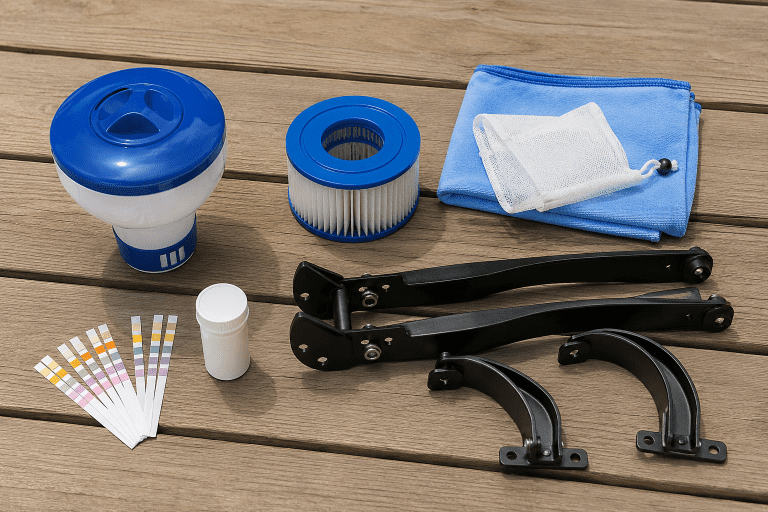
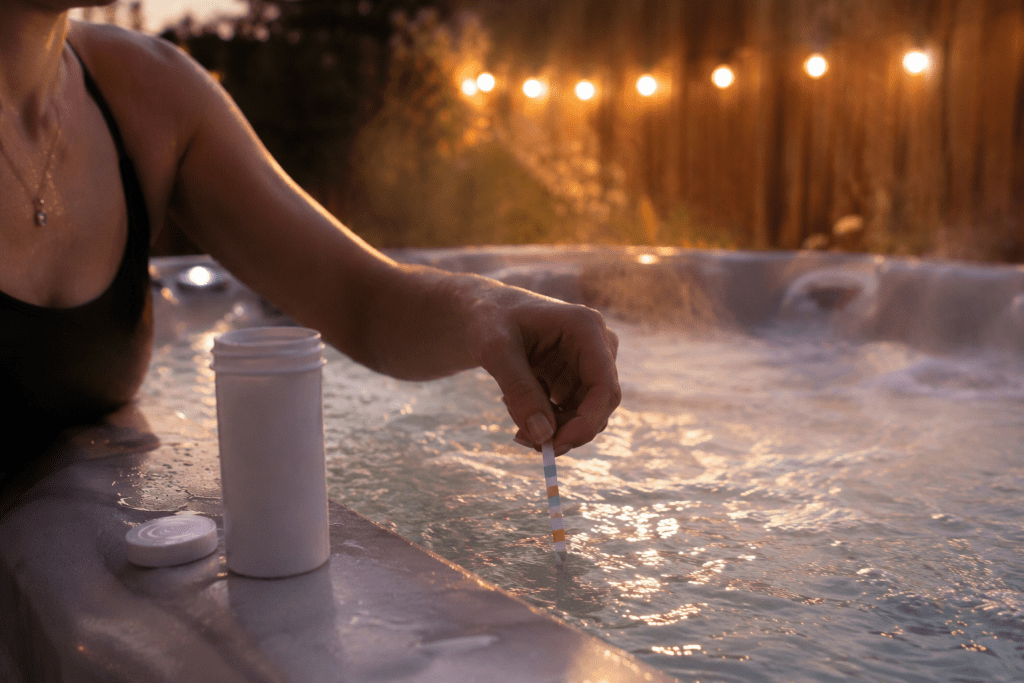
Test strips are the most common starting point. You dip the strip in the water for a couple of seconds, pull it out, wait about 15 seconds, and compare the colour pads to a chart on the bottle. Quick, cheap, and widely available. The limitation is that they require subjective colour matching — and colour matching is more difficult than it sounds, especially indoors.
Liquid drop test kits use reagent chemicals you add to a small water sample. The water changes colour and you compare it to a reference card. More steps, a couple of minutes per test, but more precise readings with less room for interpretation error.
Digital testers remove the colour-matching problem entirely. You dip a probe, get a number, done. The trade-off is cost — a decent digital tester starts around $30–$50 compared to a few dollars for a pack of strips — and you typically still need strips or a separate kit for alkalinity and calcium hardness, since most digital testers only read pH and chlorine/bromine directly.
What Does a Hot Tub Water Testing Kit Cost?
The price range for a hot tub water testing kit is wide, which is one of the things that makes first-time buying confusing.
Basic test strips — the kind you’ll find in most pool and spa sections — cost $8–$15 for a tub of 50–100 strips. That covers several months of regular testing if you’re testing two or three times a week. Liquid drop kits sit in the $15–$30 range for a full kit covering pH, chlorine or bromine, and alkalinity. Digital testers start around $30–$50 for entry-level models and can run $100+ for professional-grade readers.
The strip option is the most economical starting point and works fine for most home owners. The key is not skimping on frequency — a cheaper kit used consistently beats an expensive one used occasionally.
How Often Do You Actually Need to Test?
Most hot tub manufacturers recommend testing two to three times per week under normal use. That’s a reasonable baseline. In practice, there are several situations that call for testing more often.
After heavy use — a party, a longer family session, guests who aren’t regulars — test the same day. Heat and bather load burn through sanitiser faster than most people expect. The same applies after heavy rain if your tub is outdoors and uncovered, since rainwater affects pH and dilutes your chemistry.
If you’ve just added chemicals, test again about four hours later rather than assuming the dose was right. A hot tub water testing kit gives you the feedback loop that makes chemical dosing accurate rather than guesswork.
How often should I test my hot tub water? Two to three times per week is the standard recommendation. Test immediately after heavy use, after significant rain, or any time the water looks different — even slightly off. Don’t wait for visible cloudiness before testing.
The Honest Limitations Nobody Mentions
The thing that most articles on water testing skip is how much the result from a test strip depends on conditions that have nothing to do with your water chemistry.
Test strips are sensitive to moisture, heat, and light degradation. A tub of strips left in a warm cabinet near the tub can give inaccurate readings before the expiry date. But the one that catches people regularly is indoor lighting. The colour pads on a test strip read differently under LED lighting than in natural daylight. Under the warm tone of most indoor lights, the chlorine pad can look a shade lighter than it actually is — which leads you to believe your chlorine is low when it isn’t. If you’ve ever added a chemical dose and then tested again to find the level hasn’t moved much, that’s a likely explanation.
The fix is simple: take your reading outside, or use a consistent light source and stick with it. A digital tester removes this problem entirely, which is one genuine argument for the higher upfront cost.
Liquid drop kits also have a shelf life issue — the reagent bottles degrade once opened. A kit you’ve had for a year may give you unreliable readings in the last few months. Most kits don’t tell you this clearly on the packaging.
Pros and Cons
Pros
Test strips are fast, cheap, and require no chemistry knowledge to use. A basic hot tub water testing kit gives you a clear action signal — add this, don’t add that — without needing to understand the full chemistry behind it. Digital testers eliminate colour-matching subjectivity. Liquid drop kits offer greater precision when you want to dial in your chemistry exactly.
Regular use of a hot tub water testing kit means you catch small imbalances before they become visible problems. Cloudy water, skin irritation, and scaling on your shell are almost always the result of chemistry that drifted for too long without correction.
Cons
The main limitation the industry consistently undersells is that test strips don’t tell you why something is out of range. You can see that your pH is low, but a strip won’t tell you whether that’s because your total alkalinity is also low (which means fixing alkalinity first will stabilise your pH), or because you’ve been adding pH-down without testing alkalinity at the same time. Acting on a strip result without understanding the relationship between parameters leads to chemical chasing — adding something, testing again, adding the opposite, testing again — which is how people waste money and end up with worse water.
This isn’t a reason to avoid test strips. It’s a reason to understand what you’re looking at when you use one.
How Do the Three Types Compare?
Each format of hot tub water testing kit has a clear use case, and most experienced owners end up using more than one.
Test strips make sense for routine checks — quick confirmation that your levels are in range before a session. Liquid drop kits give you a sharper read on chlorine and pH than strips, removing some of the colour-matching guesswork for your two most important numbers — though strips remain the practical option for alkalinity and calcium hardness. A digital tester is a genuine upgrade if you’re testing daily or if you find colour comparison unreliable.
Hot Tub Installation Tips post from Hot Tub Installations cluster— getting your initial water chemistry right from day one is actually covered in detail there, which pairs well with understanding ongoing testing once the tub is running.
The format decision usually comes down to how invested you are in understanding your water rather than just reacting to it. If you want to understand why your water is behaving a certain way, liquid drop kits combined with basic chemistry knowledge is the most educational route.
Comparison Table
| Feature | Test Strips | Liquid Drop Kit | Digital Tester |
|---|---|---|---|
| Speed | ~15 seconds | 2–5 minutes | ~10 seconds |
| Accuracy | Good | Very good | Very good (pH/sanitiser) |
| Cost | $8–$15 | $15–$30 | $30–$100+ |
| Parameters covered | 4-7 | 3–4 | Typically 2 |
| Colour-matching required | Yes | Yes | No |
| Reading reliability under indoor light | Variable | Consistent | Consistent |
| Learning curve | Minimal | Low | Minimal |
Helpful Gear
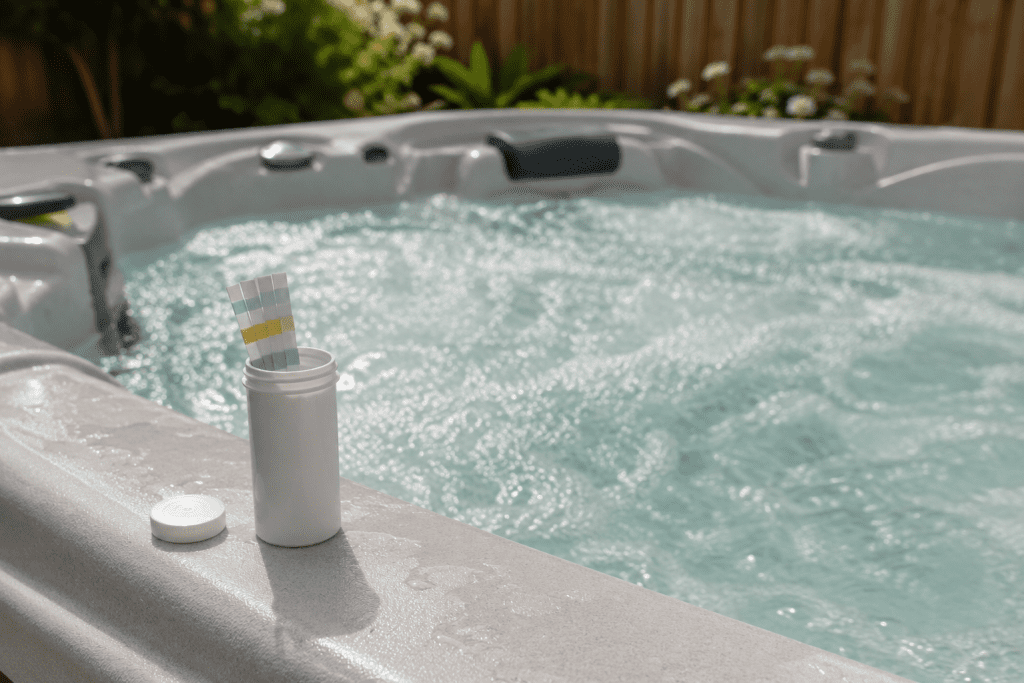
Hot tub test strips (7-1) A basic but essential tool. The 7-1 formats cover the parameters most home owners need in one dip. Look for packs of 100+ for regular use — individual strips at higher prices per unit don’t make sense for routine testing.
Liquid drop spa test kit – Liquid drop kits give you a sharper read on chlorine and pH than strips, removing some of the colour-matching guesswork for your two most important numbers — though strips remain the practical option for alkalinity and calcium hardness.
Digital pH and chlorine tester Search Amazon: “digital hot tub water tester” Removes the colour-matching variable entirely. Useful for anyone who tests frequently or finds strip readings inconsistent. Doesn’t replace strips for alkalinity and hardness, but handles the two most-checked parameters with precision.
FAQ
Is a hot tub water testing kit actually worth it if I only use the tub twice a week? Yes — and arguably more important for infrequent users. Water chemistry doesn’t pause between sessions. A tub used twice a week can drift significantly in the days between use, and you won’t know until you get in. Two minutes of testing before a session takes far less time than dealing with cloudy water or a skin reaction.
Why does my water look clear but my test shows the chemistry is off? Clear water is not safe water — this is one of the most common misunderstandings in hot tub ownership. Bacteria can be present at dangerous levels in water that looks completely normal. A hot tub water testing kit is the only reliable way to confirm the water is actually safe, not just visually acceptable.
Can I use pool test strips in my hot tub? Some overlap exists, but pool strips are calibrated for larger volumes and different chemical ranges. Hot tub water operates at higher temperatures with smaller volume and different bather load dynamics — hot tub specific strips are formulated for those conditions. Using pool strips occasionally won’t cause harm, but the readings may be less accurate at the ranges relevant to hot tub chemistry.
The Simple Rule
Test before you use it. Two minutes with a hot tub water testing kit before every session is the habit that keeps everything else working.
Summary Snapshot
A hot tub water testing kit is a non-optional part of ownership — not an accessory, a baseline. Test strips are the practical starting point at $8–$15 for a full tub. Liquid drop kits offer more precision for weekly full checks. Digital testers remove the colour-matching problem for daily users. Test two to three times per week minimum, and always after heavy use. Read strips in natural daylight — indoor LED lighting changes the colour reading more than most guides acknowledge. Clean water that’s chemically balanced is what makes a hot tub feel the way it’s supposed to.
Final Verdict
A hot tub water testing kit doesn’t need to be expensive or complicated to work. Test strips handle the day-to-day. A liquid drop kit or digital tester adds precision when you need it. The most important variable isn’t which format you choose — it’s whether you actually test consistently. The owners who have the best experience with their hot tubs are the ones who check the chemistry before it becomes a problem, not after.
If you’ve covered the core accessories and want to make sure your water maintenance routine is complete, checking the broader Best Hot Tub Accessories guides covers everything from covers and chemicals to the gear that makes regular use genuinely enjoyable. For anyone still in the setup phase, the Hot Tub Installation Tips posts cover getting your water balanced correctly from day one — which makes ongoing testing much more straightforward.