Best Hot Tub Energy Saving Accessories: What Actually Cuts Your Bill
If you’re tired of watching your electric bill creep up every winter, best hot tub energy saving accessories are one of the simplest fixes that doesn’t involve touching your hot tub’s wiring or calling an electrician.
Quick note before we get into it: this post contains affiliate links, and I may earn a small commission if you buy through them at no extra cost to you. I’ll also be upfront — this one’s built from digging through owner reviews and real-world feedback rather than my own months of testing, because energy accessories aren’t something I’ve run side-by-side comparisons on myself.
Quick Snapshot
- A quality thermal cover can reduce heat loss by a noticeable margin, with owners commonly reporting energy bill drops in the $20–$40/month range during winter
- Most energy-saving accessories cost between $15 and $150, with covers at the higher end
- Installation for all of these is genuinely DIY — no tools, no professional needed

Table of Contents
- What Actually Saves Energy (and What Doesn’t)
- The Real Cost Breakdown
- Installation: What’s Actually Involved
- Keeping These Accessories Working Over Time
- Pros and Cons Nobody Mentions
- Comparison: Which Accessory Earns Its Price
- Helpful Gear
- FAQs
- Final Verdict
What Actually Saves Energy (and What Doesn’t)
The category of best hot tub energy saving accessories breaks down into a few genuinely different approaches, and they’re not all equal. Floating thermal covers, insulated hard covers, cover locks that maintain a tight seal, and programmable timers all claim to reduce running costs — but the impact varies a lot.
A floating thermal blanket — essentially a layer of insulating material that sits directly on the water’s surface, under the hard cover — consistently comes up in reviews as the highest-impact, lowest-cost option. It reduces evaporation, which matters because evaporation is one of the biggest sources of heat loss in any spa.
What’s the single biggest energy loss point in a hot tub? According to owner feedback and basic thermodynamics, it’s evaporation through an ill-fitting or aging cover. A tight-fitting best hot tub energy saving accessories setup — particularly cover plus floating thermal layer — addresses this directly.
Cover locks and clips are the unglamorous part of this category. They don’t reduce heat loss on their own, but they keep the main cover sealed tightly against the tub’s edge, which is where a surprising amount of warm, humid air escapes if the cover has started to sag or warp.
Programmable timers for the heater and pump are the most debated accessory here. Some reviewers report meaningful savings by running the pump on a reduced schedule during off-peak hours; others note their hot tub’s existing smart controls already do this, making a separate timer redundant.
The Real Cost Breakdown
Among best hot tub energy saving accessories, floating thermal covers typically run $15–$35, making them the cheapest entry point in this entire category. Insulated hard cover replacements are the biggest investment, often $200–$400, but they’re a multi-year purchase rather than a recurring one.
Cover locks and clip sets are inexpensive, usually $10–$25 for a multi-pack, and reviewers frequently mention they’re an afterthought purchase that ends up mattering more than expected once installed.
The energy savings themselves are where things get interesting — and where I want to be careful not to overstate things. Owner reports commonly cite $20–$40/month reductions during colder months after adding a floating thermal cover to an existing setup, though this depends heavily on your local climate, your tub’s existing insulation quality, and your electricity rate.
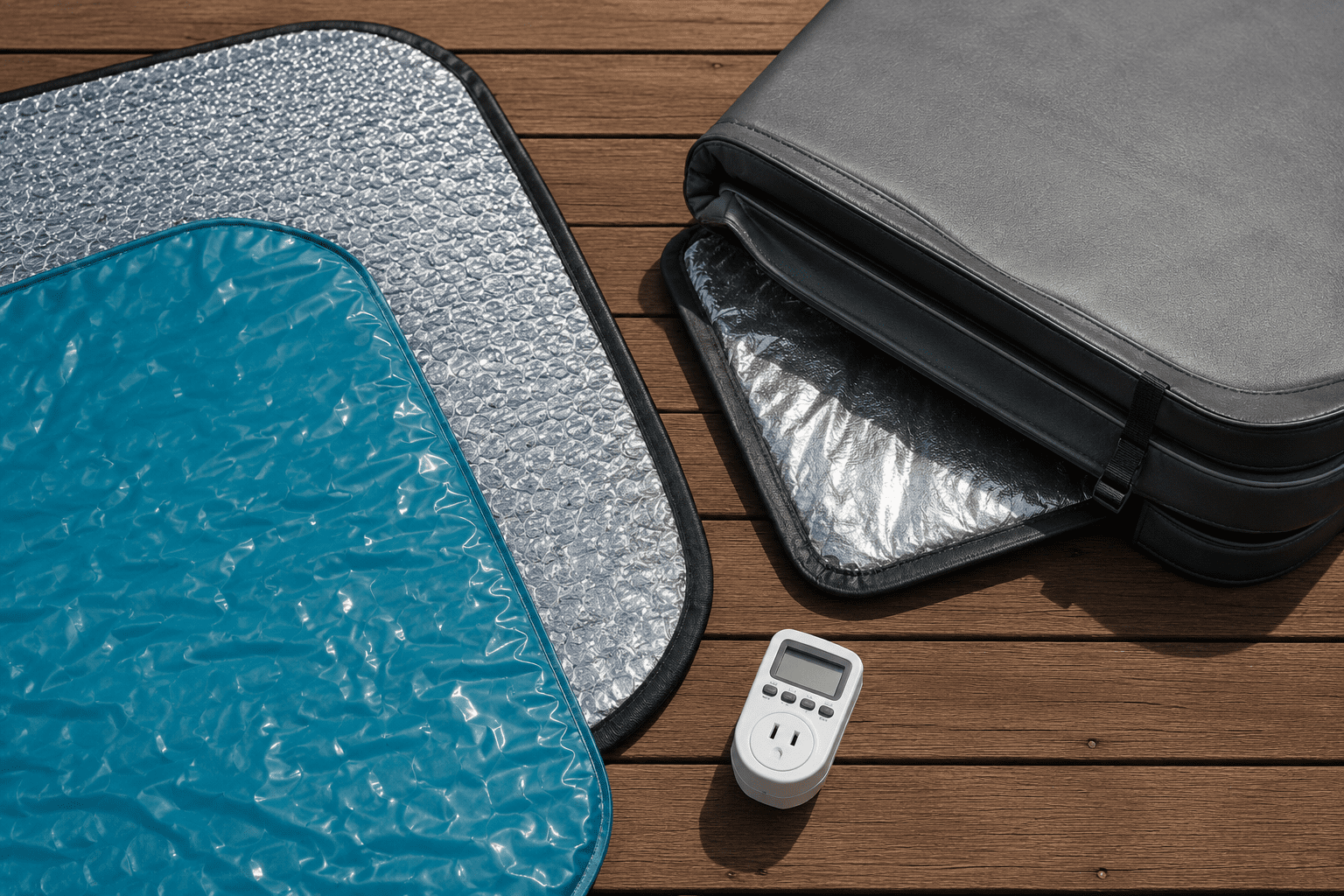
It’s also worth distinguishing between vinyl thermal covers and solar/bubble-style covers, since reviews treat these quite differently. Solar covers (the bubble-wrap style) are cheapest at $15-25 but degrade fastest, while vinyl thermal blankets cost slightly more at $25-35 but tend to hold up better against chemical exposure. Either way, best hot tub energy saving accessories at this price point remain the best value-per-dollar upgrade available for most owners.
The Department of Energy’s guidance on electric resistance heating reinforces why this matters — electric heating elements are notoriously inefficient at maintaining temperature against constant heat loss, so reducing that loss has an outsized effect on running costs.
Installation: What’s Actually Involved
This is genuinely the easiest category in hot tub accessories to install, and it’s part of why best hot tub energy saving accessories show up so often in budget-conscious owner discussions.
A floating thermal cover is just unrolled or placed onto the water’s surface — no fitting, no cutting, nothing to attach. It sits under your existing hard cover and that’s the entire installation process.
Cover locks typically clip onto the existing cover and tub frame, sometimes requiring a single screw or strap adjustment. Most reviews describe this as a 10-15 minute job with no tools beyond a screwdriver.
Where friction does show up — and this is something owner reviews flag consistently — is with replacement hard covers. Sizing has to be accurate, and a cover that’s even slightly off-spec won’t seal properly, which defeats much of the energy-saving purpose entirely.
If you use your spa through freezing weather, our Hot Tub Winter Cover guide explains what to check for fit, condition, and winter care.
Keeping These Accessories Working Over Time
Here’s something that comes up again and again in owner reviews but rarely makes it into marketing copy — floating thermal covers degrade faster than expected. Reviewers consistently describe the foam-like material becoming brittle, developing small holes, or starting to break apart into floating pieces after 6-12 months of regular use, especially in tubs run at higher temperatures.
This isn’t a defect so much as the nature of the material being constantly exposed to hot water and chemical sanitizers. The practical upshot from reviews: budget for replacing a floating thermal cover roughly once a year, and factor that into the actual cost-per-year of this best hot tub energy saving accessories strategy — it’s still cheap, but it’s not a one-time purchase the way the initial price tag suggests.
Hard cover maintenance is more familiar — vinyl conditioning every few months prevents cracking, and keeping the cover dry when not in use extends its life significantly. Cover locks need occasional tightening as straps stretch over time, but otherwise require almost no upkeep.
Honest Pros and Cons
Pros:
- Extremely low-cost entry point compared to almost any other hot tub upgrade category — among best hot tub energy saving accessories, this is hard to beat
- Zero professional installation required for any item in this category
- Floating thermal covers in particular show up repeatedly in reviews as genuinely effective, not just marketing fluff
Cons:
- The floating thermal cover’s relatively short lifespan (6-12 months) isn’t communicated clearly by most sellers, and buyers often discover this only after noticing degradation themselves — this is the kind of detail that gets buried because it makes an otherwise excellent, cheap product look less like a “buy once” solution
- Programmable timer benefits are genuinely inconsistent — some owners see real savings, others see none, depending heavily on their tub’s existing tech and their local utility’s rate structure
Comparison: Which Accessory Earns Its Price
| Floating Thermal Cover | Cover Locks | Insulated Hard Cover Replacement | |
|---|---|---|---|
| Cost | $15-35 | $10-25 | $200-400 |
| Lifespan | 6-12 months | 2-3+ years | 3-5+ years |
| Installation | Place on water surface | Clip/screw to frame | Requires accurate sizing |
| Reported monthly savings | $20-40 in cold months | Modest, mainly seal-related | Highest long-term, slower payback |
| Owner satisfaction theme | High initial enthusiasm, mild frustration at replacement frequency | “Wish I’d done this sooner” is a common phrase in reviews | Long-term investment mindset required |

Climate plays a bigger role than most buyers expect. Owners in colder states report the full $20-40/month range, while those in milder climates often see savings closer to $10-15/month — still worthwhile, but a useful expectation-setter before buying any best hot tub energy saving accessories based on the higher figure alone.
Helpful Gear
A floating solar/thermal hot tub cover is the standout recommendation here — cheap, easy, and the accessory most frequently credited with real energy savings in reviews.
A hot tub cover lock and strap kit is worth adding alongside any cover setup, since a loose or sagging cover undermines everything else in this category.
A digital pool and spa timer rounds out the category for anyone whose tub doesn’t already have smart scheduling — though reviewers are split on how much difference this makes versus a tub’s existing controls.
FAQs
Is it worth buying energy-saving accessories if I only use my hot tub occasionally? Yes, arguably more so. f your tub sits idle for days between uses, this kind of best hot tub energy saving accessories purchase — a floating thermal cover — reduces the heat loss during all that downtime, which is where the biggest cumulative savings tend to come from according to reviews.
Will a floating thermal cover actually make a noticeable difference, or is it placebo? Based on consistent owner feedback, it’s not placebo — the $20-40/month figure shows up repeatedly across independent reviews, particularly in colder climates. That said, results vary by tub size, insulation quality, and local electricity rates.
Does a programmable timer void my hot tub’s warranty? Generally no for external plug-in timers controlling the pump only, but reviewers strongly recommend checking your specific manufacturer’s warranty terms before connecting any third-party timer to the heating element directly.
Simple Rule
If you’re only going to buy one item from this entire category, make it a floating thermal cover — it’s the cheapest, easiest, and most consistently validated by best hot tub energy saving accessories owner reviews across the board.
Summary
Best hot tub energy saving accessories don’t require a big investment or any technical skill — the floating thermal cover alone, at $15-35, is one of the highest-value additions in the entire hot tub accessories space based on what owners consistently report. Just go in knowing it’s a recurring small cost, not a one-time fix.
Final Verdict
For anyone running a hot tub through colder months, a best hot tub energy saving accessories combo of floating thermal cover plus cover locks is close to a no-brainer — low cost, easy installation, and a real (if modest) dent in your electric bill.
For anyone still working out their water testing routine, hot tub water testing kits pairs naturally with this — keeping water balanced also helps protect cover materials from chemical degradation over time, and (hot tub maintenance basics) ties both topics together into a single seasonal routine.