
Hot Tub Electrical Requirements: What Every Homeowner Must Know Before They Buy
If you’re serious about adding a hot tub to your backyard, understanding the hot tub electrical requirements isn’t optional — it’s the first thing you need to figure out before you spend a single dollar on the tub itself.
Most people shop for jets, shell colors, and seat configurations. Then they get a quote from an electrician and feel their stomach drop. The electrical side of hot tub ownership is one of the most misunderstood parts of the whole process — and skipping it costs homeowners real money, real time, and sometimes real safety problems.
This isn’t a scare piece. It’s a clear-eyed look at what’s actually involved so you can go in informed.
Heads up: Some links in this post are affiliate links. If you buy something through them, we may earn a small commission at no extra cost to you. We only recommend products we’d actually use.
⚡ Quick Snapshot
- Most full-size hot tubs require a 240V / 50–60 amp dedicated circuit
- Plug-and-play (120V) models exist but come with serious limitations
- A licensed electrician is legally required in most U.S. states
- Electrical installation typically adds $1,000–$3,000+ to your total cost
- The NEC (National Electrical Code) Article 680 governs all hot tub wiring
- A GFCI breaker is non-negotiable — it’s a code requirement, not a suggestion
- Permits are required in most jurisdictions — skipping them can void your homeowner’s insurance

Table of Contents
- What Voltage Does a Hot Tub Actually Need?
- What Does Hot Tub Electrical Installation Actually Cost?
- The Installation Process — What’s Involved
- Ongoing Electrical Maintenance
- Pros and Cons of 240V vs 120V Hot Tubs
- How Different Hot Tub Types Compare
- Helpful Gear for Hot Tub Owners
- FAQ
- Final Verdict
What Voltage Does a Hot Tub Actually Need?
Here’s the straight answer most retailers gloss over: the vast majority of full-size hot tubs in the U.S. require a 240-volt, 50–60 amp dedicated circuit — the same type of circuit used for electric dryers and central AC units.Understanding hot tub electrical requirements starts with the 240V setup
This isn’t a preference. It’s a function of how much electricity the heaters and pumps draw. A typical hot tub pulls between 4,000 and 7,500 watts when the heater and jets are running simultaneously. Your standard household outlet delivers 120V at 15–20 amps. That’s nowhere near enough.
The 240V Setup — What’s Actually Required
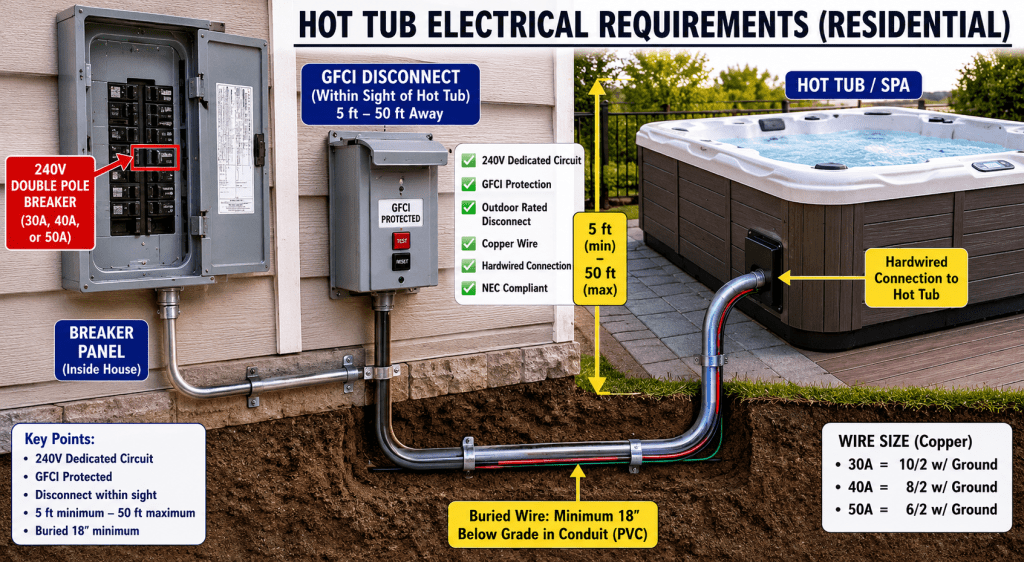
A properly wired hot tub installation under the National Electrical Code (NEC Article 680) requires:
- A dedicated 240V circuit — nothing else shares this breaker
- A 50-amp GFCI breaker at the main panel (60-amp for larger tubs)
- A disconnect box installed within sight of the tub but at least 5 feet away and no more than 50 feet from it
- GFCI protection at the disconnect — a ground fault circuit interrupter shuts power in milliseconds if current leaks toward water
- Proper wire gauge — typically 6-gauge copper wire for 50-amp circuits; heavier for 60-amp
The NEC requirements aren’t suggestions. They exist because water and electricity are a genuinely dangerous combination. According to the Electrical Safety Foundation International (ESFI), electrical incidents in and around pools and spas cause dozens of deaths and hundreds of injuries annually in the U.S.
What About Plug-and-Play (120V) Hot Tubs?
Plug-and-play hot tubs use a standard 120V, 15–20 amp outlet — no special wiring required. They’re real hot tubs, but with real trade-offs:
- Smaller shell capacity (usually 2–4 people max)
- Weaker jets — the heater and jets often can’t run simultaneously at full power
- Slower heat-up times (sometimes 12–24 hours to reach temperature)
- Less efficient at maintaining temperature in cold climates
If you live in a warmer state, have a small space, or are renting and can’t modify electrical, a 120V model is a legitimate option. For everyone else who wants the full hot tub experience, plan for 240V from the start.
What amperage does a hot tub require? Most full-size hot tubs require a 50-amp or 60-amp dedicated 240-volt circuit. The exact amperage depends on the tub’s total electrical load — check the manufacturer’s specification sheet for the “minimum circuit ampacity” (MCA) and “maximum overcurrent protection” (MOP) ratings before purchasing.
What Does Hot Tub Electrical Installation Actually Cost?
Let’s talk real numbers, because the range online is wildly unhelpful.
Typical hot tub electrical installation cost in the U.S.: $800 – $3,500
That’s a wide range. Here’s what drives it:
| Factor | Lower Cost | Higher Cost |
|---|---|---|
| Panel distance | Tub close to panel | Tub far from house/panel |
| Panel capacity | Panel has open slots | Panel is full, needs upgrade |
| Trench needed? | No trenching | Long trench through landscaping |
| Local permit fees | Low-fee jurisdiction | High-fee city/county |
| Electrician labor rate | Rural/lower COL area | Urban/high-demand market |
Panel upgrades are the big wildcard. If your home has an older 100-amp panel and you’re adding a 60-amp hot tub circuit on top of existing loads, you may need a panel upgrade to 200 amps — a job that runs $1,500–$4,000 on its own.Electrical work is only one part of the total project budget. Our Hot Tub Installation Cost in 2026 guide breaks down the additional costs for the foundation, delivery, permits, site preparation, and installation.
Get at least two licensed electrician quotes. Ask specifically: “Will my current panel support this circuit?” and “What permits will you pull?
These hot tub electrical requirements apply to every step of the installation process.
The Installation Process — What’s Involved
Understanding the sequence helps you manage timelines and avoid surprises.
Step 1: Site assessment An electrician evaluates your panel capacity, the planned tub location, and the best route for running wire. This is usually free or low-cost.
Step 2: Permits In most U.S. jurisdictions, a permit is required for any new 240V circuit installation. The electrician typically handles this. Skipping permits is a serious mistake — it can void your homeowner’s insurance and create problems when you sell your home.
Step 3: Wiring run Wire runs from the main panel to a dedicated disconnect box near (but not too near) the tub. Depending on distance, this may involve trenching conduit through a yard, running wire through walls, or both.
Step 4: GFCI disconnect installation The disconnect box is mounted according to NEC 680 specs — outdoor-rated, within sight of the tub.
Step 5: Connection and inspection The tub is connected to the disconnect. An electrical inspector signs off before you can legally use the tub. Most jurisdictions require this step.
How long does it take? Plan for 1–3 days of electrical work, plus 1–2 weeks of lead time for permits and scheduling. In busy seasons (spring and early summer), good electricians book out fast.
Does a hot tub require a permit? Yes, in almost every U.S. jurisdiction. A new 240V circuit requires an electrical permit, and in many municipalities a separate building or zoning permit for the tub itself. Skipping permits creates insurance, liability, and resale issues. Always pull the permits.
Ongoing Electrical Maintenance
Once your hot tub electrical requirements are met at installation.
- Test the GFCI monthly — press the test button on the breaker to confirm it trips and resets properly
- Inspect wiring connections annually — particularly the disconnect box connections, which can loosen from thermal cycling
- Check for tripped breakers after storms — power surges can trip GFCI breakers
- Don’t run extension cords near the tub — ever
- If the GFCI trips repeatedly without obvious cause — call an electrician. Don’t just reset and ignore it. Repeated GFCI trips signal a real electrical problem.
Hot tub covers help maintain water temperature, which reduces heater cycling and lowers your electrical bill — a surprisingly effective way to cut operating costs over time.
Pros and Cons of 240V vs 120V Hot Tubs
240V (Hard-Wired) Hot Tubs
Pros:
- Full jet power and heating capacity simultaneously
- Faster heat-up and better temperature maintenance
- Suitable for cold climates
- More size and feature options
- Better long-term investment
Cons:
- Requires professional electrical installation ($800–$3,500+)
- Not practical for renters or temporary setups
- Installation timeline adds days to weeks before use
120V (Plug-and-Play) Hot Tubs
Pros:
- No special wiring — plugs into a standard outdoor GFCI outlet
- Can be moved if needed
- Lower upfront total cost
- Faster to get up and running
Cons:
- Limited jet power — heater and jets often can’t run together
- Slower heat-up in cold weather
- Smaller capacity
- Not ideal for climates with freezing winters
How Different Hot Tub Types Compare
| Type | Voltage | Amperage | Install Required? | Avg Install Cost |
|---|---|---|---|---|
| Full-size in-ground spa | 240V | 50–60A | Yes | $2,000–$5,000+ |
| Full-size portable hot tub | 240V | 50–60A | Yes | $1,000–$3,000 |
| Mid-size portable hot tub | 240V | 40–50A | Yes | $800–$2,500 |
| Plug-and-play inflatable | 120V | 15–20A | No | $0 (use existing outlet) |
| Plug-and-play hard shell | 120V | 15–20A | No | $0–$200 (GFCI outlet) |
One thing worth noting: even plug-and-play models should be plugged into a dedicated outdoor GFCI outlet — not an extension cord, not a shared circuit, and not an indoor outlet run through a window. The National Electrical Code is clear on this.
For guidance on the broader NEC requirements that govern residential hot tub installations, Energy.gov’s home electrical safety resources provide useful context alongside your local jurisdiction’s specific rules.
Helpful Gear for Hot Tub Owners
A few items that make hot tub ownership easier — all chosen for their ratings and practicality:
1. GFCI Outlet Tester A simple, inexpensive tool to verify your GFCI outlets are working correctly. Worth having on hand for monthly checks.
2. Hot Tub Cover Lift A quality cover lift protects your cover from wear and makes entry/exit much easier. It also reduces the temptation to leave the cover off, which runs up your electric bill.
3. Waterproof Outdoor Extension Cord (NOT for the tub itself — for accessories For landscape lighting, music, or accessory power near the tub area — never run an extension to the tub itself. A heavy-gauge outdoor cord handles weather and load safely for everything else.
FAQ
Can I wire a hot tub myself? In most U.S. states, wiring a 240V hot tub circuit yourself is either illegal or requires pulling an owner-builder permit and passing inspection. Even where legally allowed, hot tub wiring involves GFCI disconnects, outdoor-rated conduit, and code-specific placement rules. Mistakes create electrocution risk. The cost of a licensed electrician is worth it — and required by most homeowner insurance policies.
How far does the disconnect box need to be from the hot tub? Per NEC Article 680, the disconnect must be at least 5 feet from the hot tub and no more than 50 feet away, with line-of-sight to the tub. It must be an outdoor-rated enclosure and include GFCI protection.
Will a hot tub raise my electric bill significantly? Yes, but how much depends on climate, tub size, insulation quality, and how often you use it. A well-insulated 240V hot tub in a moderate climate typically adds $30–$75/month to a utility bill. In colder regions with frequent use, costs can run $100–$150/month or more. A quality insulated cover makes a meaningful difference.
The simple rule: If it plugs into a wall, it’s a 120V plug-and-play. If it needs an electrician, it’s a 240V hard-wired tub — and that’s the kind that delivers the real hot tub experience.
Summary Snapshot
- Hot tub electrical requirements center on a 240V, 50–60 amp dedicated circuit for most full-size models
- NEC Article 680 governs all installation specs — this is federal code, not optional
- A GFCI breaker and outdoor disconnect box are non-negotiable
- Licensed electrician + permit = the only legal path in most U.S. states
- Budget $1,000–$3,000 for electrical installation on top of the tub price
- Plug-and-play 120V models skip the electrical work but trade off power and performance
- Monthly GFCI testing is your most important ongoing maintenance task

Final Verdict
The electrical requirements for hot tubs aren’t complicated once you understand the framework — but they do require real planning, real money, and a real licensed electrician. The NEC rules exist for good reason. Water and electricity demand respect..
If you’re buying a full-size hot tub, work backwards: find out what your panel can handle, get an electrician quote before you finalize the purchase, and make sure permits are built into the timeline. For buyers considering a 120V plug-and-play model, know the limitations upfront so you’re not disappointed by underwhelming jet pressure or slow heating.
Done right, the electrical side of a hot tub is a one-time project. After that, it’s just a monthly GFCI test and the occasional electrician check-in. The payoff — a properly wired, safe, powerful hot tub ready whenever you are — is absolutely worth it.
The permit side of this project deserves as much attention as the wiring itself — hot tub permit walks through exactly what triggers a permit requirement and what happens if you skip it. If you’re still weighing placement options, hot tub on a deck covers how deck installs affect the electrical run length and cost. If you’re also considering a sauna for your wellness setup, sauna heater 240V wiring covers a very similar electrical planning process worth reading alongside this one.