Do Sauna Heaters Require 240V Wiring?
Sauna heater 240V wiring is one of the first things you need to figure out before buying a single panel, heater, or bucket of water. And the answer? It depends — but mostly yes, for any traditional or full-size sauna you’re actually going to love.
Here’s the thing: the voltage question trips people up because it sounds like a simple yes or no, and the internet gives you a dozen different answers. Let’s cut through all of it.
Heads-up: Some links in this post are affiliate links. If you buy something through them, we may earn a small commission at no extra cost to you. We only recommend gear we’d actually use.
Quick Snapshot
- Most traditional electric sauna heaters require 240V dedicated wiring
- Small 1–2 person infrared saunas may run on standard 120V outlets
- 240V heaters need 30–60 amp breakers, depending on kilowatt rating
- All sauna heaters must be on a dedicated circuit — no sharing allowed
- 240V heaters are almost always hard-wired (no plug-in option)
- Professional electrician installation is required for 240V setups
- Expect to pay $300–$1,200+ for the electrical portion of your install
- Your panel may need an upgrade if it’s an older 100-amp service
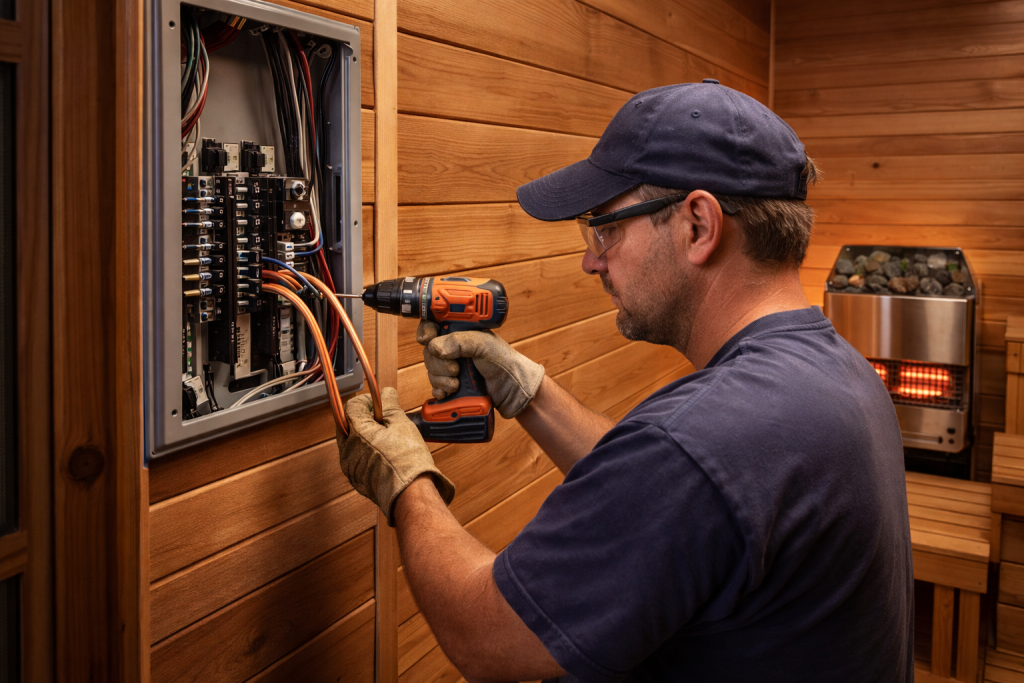
Table of Contents
- The Core Answer: Does Your Heater Need 240V?
- What Does 240V Wiring Actually Cost?
- Installation Friction: What Really Gets in the Way
- Maintenance: What to Actually Watch After Install
- Pros and Cons of 240V Sauna Heaters
- 240V vs 120V: Which Setup Is Right for You?
- 240V vs 120V Comparison Table
- Helpful Gear for Your Sauna Setup
- FAQ
- Final Verdict
- Browse Our Sauna Picks
The Core Answer: Does Your Sauna Heater 240V Wiring Actually Require It
The short answer is that almost every electric sauna heater worth buying — and virtually all traditional Finnish-style heaters — requires 240V dedicated service. This isn’t a preference or a convenience. It’s a function of how much power these heaters actually draw.
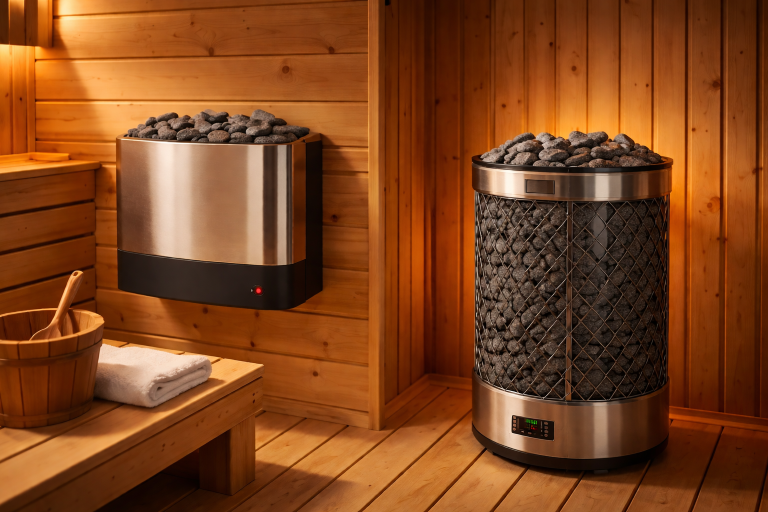
Traditional sauna heaters run anywhere from 4.5 kW to 9 kW or more. At 120V, you simply cannot deliver that kind of wattage without drawing insane amounts of current — current levels that would require wire gauges no residential circuit realistically supports. Doubling the voltage to 240V cuts the current draw in half for the same wattage, which is why every major heater brand — Harvia, HUUM, Finnleo, Tylo — ships their heaters designed for 240V operation.Every major brand designs their products around sauna heater 240V wiring as the default.
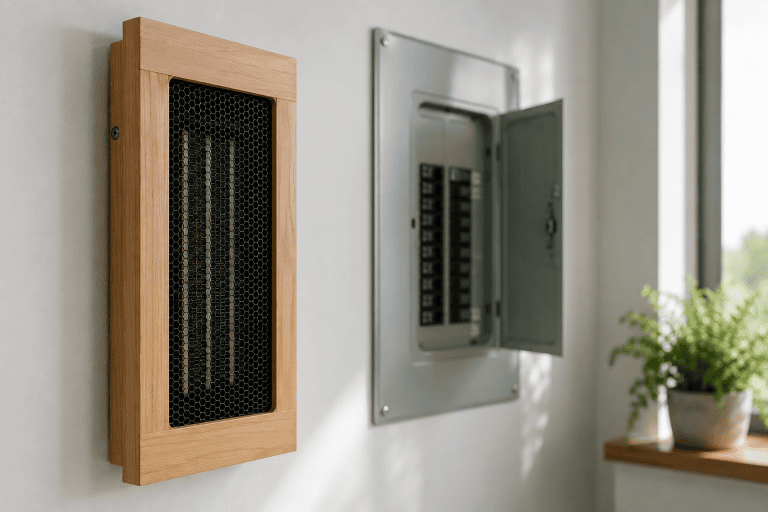
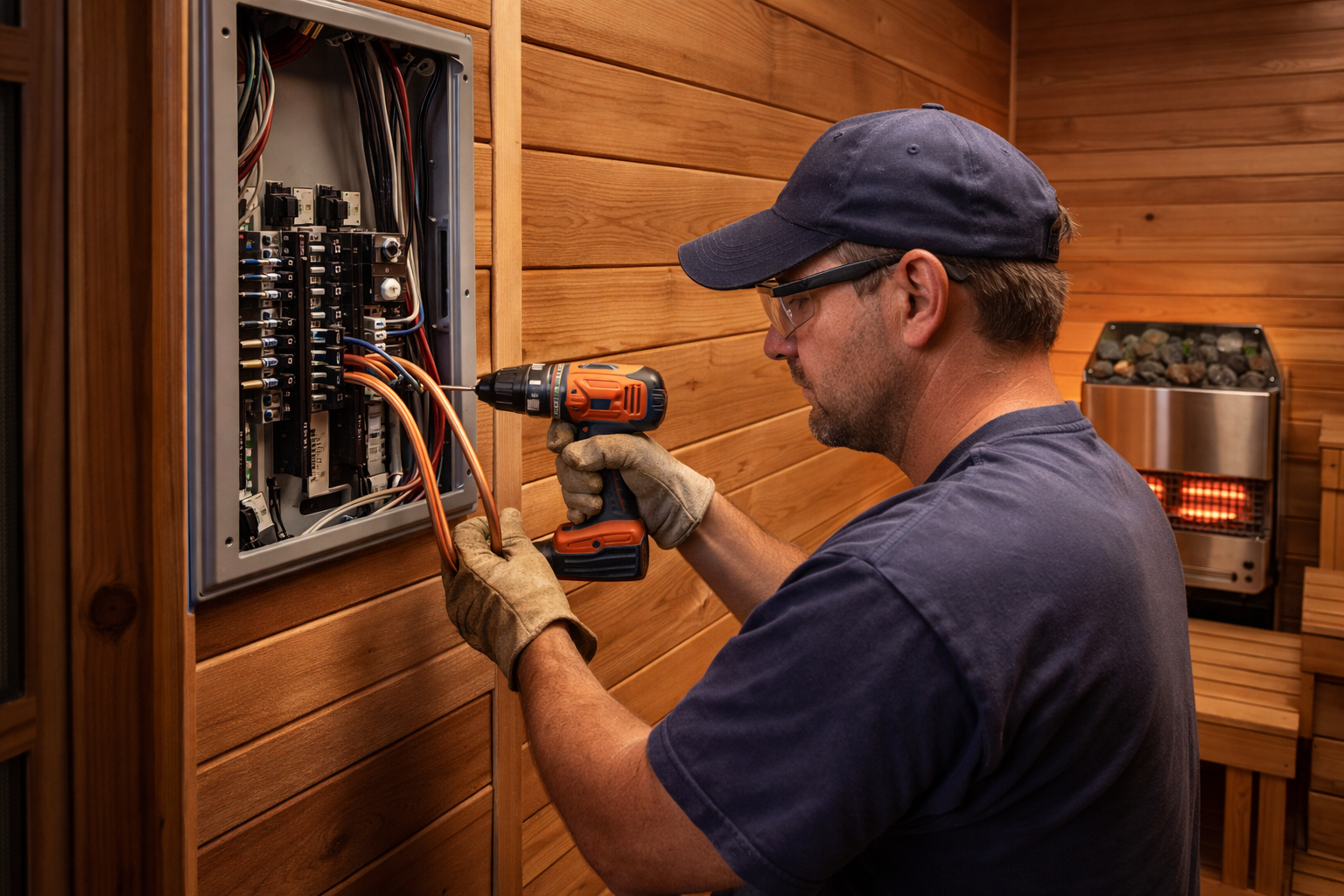
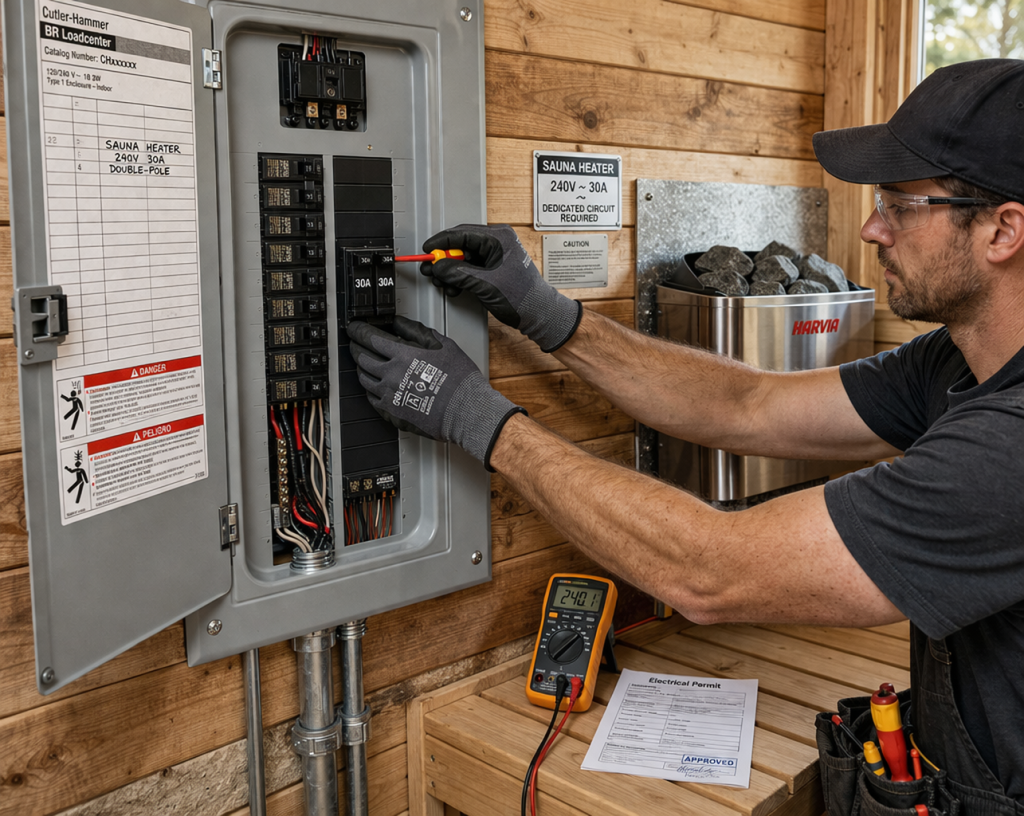
What this means in practice is that sauna heater 240V wiring commits you to a hardwired circuit, when you buy a traditional sauna heater, you’re committing to a hardwired 240V circuit. There’s no plug to pull. The heater goes directly to a dedicated double-pole breaker in your main panel (or a subpanel), and copper wire runs from that breaker straight to the heater location.
Does every sauna heater require 240V wiring?
No — but only the smallest models are the exception. Many 1–2 person infrared saunas are designed to operate on standard 120V, 15–20 amp circuits and simply plug into a dedicated outlet. The moment you move up to a larger infrared model (typically 3+ person) or any traditional electric sauna, 240V becomes the standard. If your sauna heater is 4 kW or higher, assume 240V is required until the manufacturer’s spec sheet tells you otherwise.
The NEC (National Electrical Code) governs sauna electrical installations under Article 422 for appliances, requiring any permanently connected appliance above 300 volt-amperes to have a properly sized branch-circuit breaker as the disconnecting means. That means sizing matters: a 4.5–6 kW heater typically calls for a 30-amp breaker and 10 AWG copper wire, while an 8 kW heater usually needs a 40-amp breaker with 8 AWG wire. For heaters requiring 50+ amps, 6 AWG wire enters the picture. These aren’t suggestions — under-wire a 240V sauna circuit and you’re looking at overheating insulation, tripped breakers, voided warranties, and in worst-case scenarios, a fire.
One detail that surprises many homeowners: the NEC’s continuous-load rule requires the circuit to be sized at 125% of the heater’s rated current draw, since saunas run continuously during a session. That means a heater drawing 25 amps needs a circuit rated for at least 31.25 amps — which rounds up to a 40-amp breaker, not a 30-amp one. Your electrician should know this, but if they don’t bring it up, you should.
What Does 240V Wiring Actually Cost?
The total budget for sauna heater 240V wiring in a straightforward install runs $300–$600. This is where the sticker shock comes in for a lot of people. The heater itself has a price tag; the electrical work is a second purchase that many buyers don’t fully budget for upfront.
For a straightforward basement or garage sauna installation where the breaker panel is nearby, a licensed electrician typically charges $300–$600 to run a new dedicated 240V circuit, install a double-pole breaker, pull wire, and make final connections. That’s the best-case scenario.
Things that drive the cost up fast: long runs from the panel, running wire through finished walls or ceilings, older homes with 100-amp service panels that can’t handle the load, and outdoor sauna installs that require direct-burial-rated conduit. A 100-amp panel upgrade alone can run $1,500–$3,000 before you’ve done a single inch of sauna wiring.
For outdoor sauna builds, budget more. Underground runs have to be buried at minimum 18–24 inches deep depending on conduit type and local jurisdiction, and require wire rated for those conditions — typically THHN/THWN conductors in Schedule 40 PVC conduit or UF-B direct-burial cable. These requirements add real cost but aren’t negotiable.Outdoor sauna heater 240V wiring adds burial depth and conduit requirements that push costs higher.
The honest number for a full-size traditional sauna electrical installation — heater circuit, dedicated breaker, all code-compliant wire and conduit, plus permit and inspection fees — lands somewhere between $500 and $1,500 in most areas. Budget toward the higher end if you’re in a metro area, if your panel is far from the sauna location, or if your home’s service needs upgrading.
Installation Friction: What Really Gets in the Way
Knowing you need 240V wiring and actually getting it installed smoothly are two very different things. Here’s what creates friction in real installations.
Panel capacity is the first obstacle with sauna heater 240V wiring – older 100-amp panels often can’t support it.. Many homes built before the 1990s have 100-amp service panels. A single large sauna heater can pull 30–50 amps. Add that to your HVAC, electric dryer, electric range, water heater, and EV charger, and you may simply not have headroom. Your electrician will run a load calculation before anything else. If the numbers don’t work, a panel upgrade is required — and that adds timeline, permits, and significant cost.
Before arranging the circuit, read Can My Electrical Panel Handle a Sauna Heater? for the checks that distinguish available breaker space from spare electrical capacity.
Permit and inspection requirements are another friction point that catches DIYers off guard. Most jurisdictions require a permit for new 240V circuit work, followed by a rough-in inspection before drywall and a final inspection after completion. Skipping this process doesn’t just risk a code violation — it can void your homeowner’s insurance and create problems when you sell the house. Budget 2–4 weeks for permit approval in busy building departments.Permit requirements for sauna heater 240V wiring vary by jurisdiction.
GFCI is one of the most genuinely confusing parts of sauna electrical work. Many traditional sauna heater manufacturers explicitly state “Do not use GFCI” in their installation manuals because the heat and humidity environment causes nuisance tripping. Yet some local inspectors want GFCI on any circuit operating near water. NEC Article 680.44 generally does not require GFCI for 240V circuits operating above 150 volts to ground — but local AHJs (Authorities Having Jurisdiction) can add their own requirements. Have this conversation with your electrician and your local inspector before the rough-in, not after.
Finally: the physical run of the wire. The longer the distance from your panel to the sauna location, the larger the wire gauge you need to prevent voltage drop below the acceptable 3% threshold. A heater receiving less voltage than rated will underperform and may damage its own components over time. For runs over 75–100 feet, consult your electrician about voltage-drop calculations before sizing your wire.
Maintenance: What to Actually Watch After Install
Once your sauna heater 240V wiring circuit is properly installed and inspected, ongoing electrical maintenance is minimal — but not zero.
Test your GFCI or disconnect switch periodically if your setup includes one. Tripping during a sauna session is annoying; a disconnect switch that doesn’t respond in an actual emergency is dangerous. A monthly test takes about 30 seconds.
Inspect visible wiring, conduit, and the junction box connection points once a year. In outdoor sauna setups particularly, moisture intrusion, pest damage, or UV degradation of conduit seals are real concerns. Catching a compromised seal before water reaches conductors is always better than finding it via a tripped breaker mid-winter.
Check heater terminal connections every 2–3 years if you’re comfortable doing so with the circuit de-energized at the breaker. Sauna environments cycle between extreme heat and ambient temperature constantly, which can cause thermal expansion and contraction that loosens terminals over time. Loose connections create resistance; resistance creates heat; heat creates problems.
If you ever notice burning smells, flickering sauna controls, or your breaker tripping repeatedly during normal sessions — stop using the sauna and have a licensed electrician inspect the circuit before using it again.
Pros and Cons of 240V Sauna Heaters
The main advantages of sauna heater 240V wiring come down to performance — heat, speed, and options that 120V simply can’t match.”
Pros:
- Dramatically faster preheat times — a 240V 6 kW heater typically reaches 180–190°F in 20–30 minutes, versus 45–60 minutes for underpowered 120V units
- Supports higher temperatures and better steam generation with authentic Finnish-style high heat
- Required for any sauna over roughly 150–200 square feet of interior space
- More heater options available — the premium brands all build for 240V
- Better energy efficiency relative to output: higher voltage means lower current for the same wattage, which reduces resistive losses in wiring
Cons:
- Requires professional installation — not a weekend DIY project
- Higher upfront cost for the electrical work
- Panel upgrade may be required in older homes
- Permit and inspection process adds time to your project
- Some jurisdictions add GFCI requirements that conflict with manufacturer recommendations, requiring extra coordination
240V vs 120V: Which Setup Is Right for You?
The decision between 240V and 120V for your sauna heater 240V wiring isn’t really a preference choice — it’s mostly dictated by the sauna you’re building and how serious you are about the heat.
120V infrared saunas are appealing because of their simplicity. A 1–2 person unit that plugs into a standard 15–20 amp dedicated outlet requires no electrical work beyond having a licensed electrician verify the circuit is dedicated and properly rated. Installation cost is essentially zero if the circuit already exists. These units work well for people who want the relaxation and light heat of an infrared session without the full sauna build.
The tradeoff: 120V units top out at lower temperatures, take longer to heat up, and can’t produce the kind of bone-deep Finnish sauna heat that traditional sauna enthusiasts are after. They’re also limited in size — once you need more than a 2-person sauna, 120V rarely has enough juice.
240V traditional heaters deliver the real thing. High heat, fast preheat, authentic steam when you ladle water onto the rocks, and the sustained temperature that makes a long sauna session possible. The commitment is higher — cost, installation complexity, permits — but for anyone building a dedicated home sauna, this is the setup that will actually satisfy.
Link to sauna heater sizing guide
240V vs 120V Comparison Table
| Feature | 240V Traditional Heater | 120V Infrared (Small) |
|---|---|---|
| Typical sauna size | 150–600+ sq ft | Up to ~100 sq ft |
| Preheat time | 20–30 minutes | 45–60+ minutes |
| Max temperature | 170–200°F | 120–150°F |
| Steam capability | Yes (pour water on rocks) | No |
| Installation type | Hard-wired, dedicated circuit | Plug-in, dedicated outlet |
| Electrician required? | Yes | Recommended |
| Permit required? | Usually yes | Sometimes |
| Cost to install circuit | $300–$1,500+ | $0–$200 |
| Best for | Authentic sauna experience | Simple, low-commitment heat therapy |
Helpful Gear for Your Sauna Setup
Once the wiring is handled, a few pieces of gear make your sauna life noticeably better.
Non-Contact Voltage Tester — Before any work happens near your panel, having a quality non-contact voltage tester lets you verify circuits are de-energized without guessing.
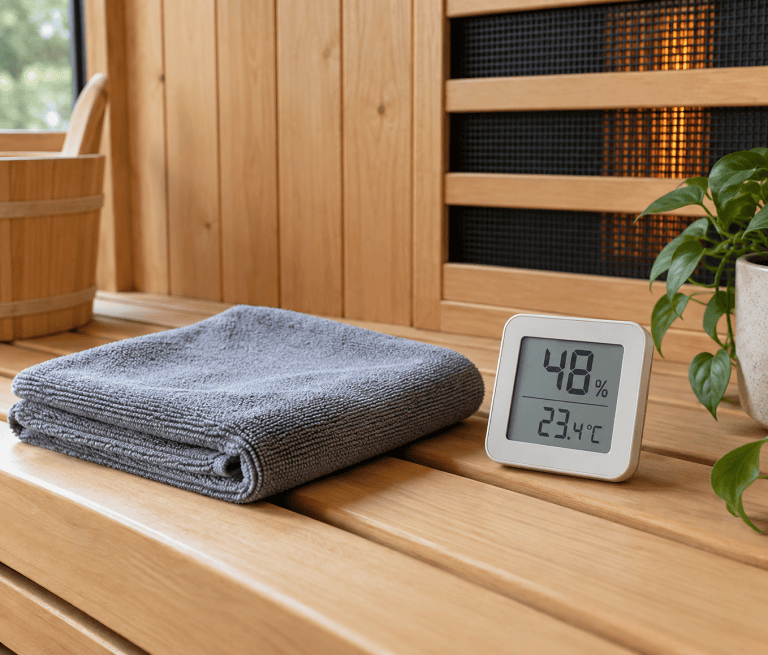
Sauna Thermometer and Hygrometer Combo — After your heater is running, you want to actually know what’s happening inside. A sauna-rated wooden thermometer/hygrometer combo lets you monitor temperature and humidity so you can dial in your experience.
Heat-Rated Wire Connectors (Wago or Ideal) — If your electrician needs to make any low-voltage connections for controls or lighting inside the sauna, standard wire nuts can degrade in the heat. Heat-rated lever connectors are worth having on-site.
FAQ
What wire gauge do I need for a 240V sauna heater?
Wire gauge depends on your heater’s amperage draw and the length of the circuit run. For heaters up to 30 amps, 10 AWG copper wire is standard for shorter runs. For 40–50 amp heaters, 8 AWG copper is typically required. Runs exceeding 75–100 feet may require the next gauge up to prevent voltage drop beyond the acceptable 3% threshold. Always use copper — many sauna heater manufacturers explicitly prohibit aluminum wiring connections. Have your electrician confirm the correct gauge based on your specific heater specs and actual circuit length.
Can I install a 240V sauna heater myself?
Technically, homeowners in some jurisdictions are permitted to do their own electrical work with proper permits and inspections. Practically speaking, sauna heater 240V wiring is not a beginner DIY project. You’re dealing with continuous-load calculations, breaker sizing, proper wire gauge selection, heat-rated materials, disconnect requirements, and a permit and inspection process. Mistakes create fire hazards, void warranties, and fail inspections. The professional installation cost is almost always worth it.
Does a sauna heater need a dedicated circuit?
Yes, without exception. Every sauna heater — whether 120V or 240V — must be on a dedicated circuit with no other loads sharing the breaker. This means no outlets, lighting, or other appliances on the same circuit. Sharing a circuit with other loads risks overloading the wiring, tripping the breaker mid-session, and creating genuine fire hazards. The only items permitted on the same circuit are the sauna’s own low-voltage lighting and control system, and even those are often better kept on a separate circuit entirely.
The Simple Rule
If your sauna heater is 4 kW or larger, plan for 240V hard-wired installation — and call a licensed electrician before you buy the heater, not after.
Summary Snapshot
- Traditional sauna heaters (4 kW+) require 240V dedicated wiring in almost all cases
- Small 1–2 person infrared saunas may run on 120V plug-in circuits
- Breaker sizing follows NEC continuous-load rules: circuit must be sized at 125% of rated current
- Wire gauge: 10 AWG for 30A, 8 AWG for 40–50A — copper only
- Expect $300–$1,500+ for professional electrical installation
- Permit and inspection required in most jurisdictions
- Check your panel capacity before purchasing your heater
- Discuss GFCI requirements with your electrician and local inspector
Final Verdict
The question “do sauna heaters require 240V wiring?” has a nuanced but ultimately clear answer: if you’re building a real sauna — traditional, large infrared, or anything designed to hit 170°F+ and sustain it — yes, you need 240V. The physics of the power requirements make 120V inadequate for anything beyond the smallest plug-in infrared units.
The good news is that sauna heater 240V wiring circuits, when properly installed by a licensed electrician with the right permits and inspections, are extremely reliable. These aren’t fragile systems. A properly wired sauna heater circuit can run for 15–20 years with minimal attention. The upfront work and cost are the hurdles — but they’re one-time hurdles that pay off in thousands of sauna sessions.
Don’t try to shortcut the electrical work. Get the dedicated circuit, size it correctly for 125% continuous load, use copper wire in the right gauge for your run length, pull the permit, and have it inspected. That’s the entire checklist for an electrical setup that will never give you trouble.
For the outbound reference on NEC electrical requirements, the authoritative source on dedicated circuit requirements and appliance disconnecting means is the National Fire Protection Association’s NFPA 70 (NEC) documentation is worth bookmarking if you’re working with a permit office or want to reference NEC Article 422 directly.