Infrared vs Traditional Sauna Running Costs: Which Is Actually Cheaper Long Term?
Infrared vs traditional sauna running costs is the question most people think they’ve already answered before they’ve actually done the math. The assumption tends to go one of two ways: infrared is modern so it must be more efficient, or traditional is simpler so it must be cheaper. Both assumptions are partly right and mostly incomplete. The real picture depends on how you heat, how long you run it, how often you use it, and what you’re actually comparing.
After years of using both, the cost difference surprised me — not because one was dramatically cheaper, but because the variables that actually move the number aren’t the ones most buying guides lead with.
Heads up: this post contains affiliate links. If you buy through them, I earn a small commission at no cost to you. I only link to product types I’d actually recommend.
Quick Snapshot
- Infrared saunas typically draw 1.5–3.5 kW per session vs 6–9 kW for traditional
- Average infrared running cost: roughly $3–$6 per month at typical US usage
- Average traditional running cost: roughly $10–$25 per month depending on size and frequency
- Warm-up time gap (10–15 min infrared vs 30–45 min traditional) changes real-world usage patterns
- Long-term cost gap narrows significantly if you factor in usage behaviour, not just wattage
- Installation cost difference: $500–$2,000+ in electrical work for traditional units in most homes

Table of Contents
- What Actually Determines Running Cost
- The Real Numbers: Infrared vs Traditional Side by Side
- Installation Costs That Change the Long-Term Equation
- Maintenance Costs Most Comparisons Skip
- Pros and Cons
- Which Wins on Long-Term Cost?
- Comparison Table
- Helpful Gear
- FAQs
- Final Verdict
What Actually Determines Running Cost
When people ask about infrared vs traditional sauna running costs, they usually want a simple answer: which one costs less to run per session? That’s a reasonable starting point but it misses three factors that matter more over time.
First: wattage draw. Infrared units typically pull 1.5–3.5 kW. Traditional electric sauna heaters typically pull 6–9 kW, sometimes more for larger rooms. At the US average electricity rate of around $0.16–$0.18 per kWh, that gap is meaningful in a single session and significant across a year.
Second: warm-up time. A traditional sauna needs 30–45 minutes to reach operating temperature before you step in. An infrared unit is typically ready in 10–15 minutes. That pre-heat energy is real consumption — it’s not part of your session, it’s overhead. Every session has it.
Third: usage frequency. This is the one almost every buying guide skips entirely. If you own a traditional sauna and you use it three times a week instead of five because the 40-minute pre-heat feels like too much on a busy evening — your real-world cost drops. But so does your value. Infrared’s shorter warm-up genuinely changes usage behaviour, which changes the cost calculation in a way raw kWh figures don’t capture.
The Real Numbers: Infrared vs Traditional Sauna Running Costs
Let’s run actual figures on infrared vs traditional sauna running costs using realistic assumptions: three sessions per week, 30-minute sessions, US average electricity rate of $0.17 per kWh.
Infrared:
A 2-person infrared unit at 2 kW draw, 10-minute warm-up + 30-minute session = roughly 40 minutes total per session.
Energy per session: ~1.3 kWh
Cost per session: ~$0.22
Monthly cost (12 sessions): ~$2.65
Annual cost: ~$32
Traditional (mid-size, 6 kW heater):
40-minute warm-up + 30-minute session = roughly 70 minutes total at full draw.
Energy per session: (accounting for thermostat cycling — call it 6–7 kWh realistically)
Cost per session: ~$1.00–$1.20
Monthly cost (12 sessions): ~$12–$14
Annual cost: ~$145–$170
Over five years, that’s a difference of roughly $565–$690 in electricity alone — before you factor in any installation or maintenance difference.(3 sessions per week)
.Infrared vs traditional sauna running costs is the question most people think they’ve already answered before they’ve actually done the math. The assumption tends to go one of two ways: infrared is modern so it must be more efficient, or traditional is simpler so it must be cheaper. Both assumptions are partly right and mostly incomplete. The real picture depends on how you heat, how long you run it, how often you use it, and what you’re actually comparing.
After years of using both, the cost difference surprised me — not because one was dramatically cheaper, but because the variables that actually move the number aren’t the ones most buying guides lead with.
Heads up: this post contains affiliate links. If you buy through them, I earn a small commission at no cost to you. I only link to product types I’d actually recommend.
Quick Snapshot
- Infrared saunas typically draw 1.5–3.5 kW per session vs 6–9 kW for traditional
- Average infrared running cost: roughly $3–$6 per month at typical US usage
- Average traditional running cost: roughly $10–$25 per month depending on size and frequency
- Warm-up time gap (10–15 min infrared vs 30–45 min traditional) changes real-world usage patterns
- Long-term cost gap narrows significantly if you factor in usage behaviour, not just wattage
- Installation cost difference: $500–$2,000+ in electrical work for traditional units in most homes

Table of Contents
- What Actually Determines Running Cost
- The Real Numbers: Infrared vs Traditional Side by Side
- Installation Costs That Change the Long-Term Equation
- Maintenance Costs Most Comparisons Skip
- Pros and Cons
- Which Wins on Long-Term Cost?
- Comparison Table
- Helpful Gear
- FAQs
- Final Verdict
What Actually Determines Running Cost
When people ask about infrared vs traditional sauna running costs, they usually want a simple answer: which one costs less to run per session? That’s a reasonable starting point but it misses three factors that matter more over time.
First: wattage draw. Infrared units typically pull 1.5–3.5 kW. Traditional electric sauna heaters typically pull 6–9 kW, sometimes more for larger rooms. At the US average electricity rate of around $0.16–$0.18 per kWh, that gap is meaningful in a single session and significant across a year.
Second: warm-up time. A traditional sauna needs 30–45 minutes to reach operating temperature before you step in. An infrared unit is typically ready in 10–15 minutes. That pre-heat energy is real consumption — it’s not part of your session, it’s overhead. Every session has it.
Third: usage frequency. This is the one almost every buying guide skips entirely. If you own a traditional sauna and you use it three times a week instead of five because the 40-minute pre-heat feels like too much on a busy evening — your real-world cost drops. But so does your value. Infrared’s shorter warm-up genuinely changes usage behaviour, which changes the cost calculation in a way raw kWh figures don’t capture.
The Real Numbers: Infrared vs Traditional Sauna Running Costs
Let’s run actual figures on infrared vs traditional sauna running costs using realistic assumptions: three sessions per week, 30-minute sessions, US average electricity rate of $0.17 per kWh.
Infrared:
A 2-person infrared unit at 2 kW draw, 10-minute warm-up + 30-minute session = roughly 40 minutes total per session.
Energy per session: ~1.3 kWh
Cost per session: ~$0.22
Monthly cost (12 sessions): ~$2.65
Annual cost: ~$32
Traditional (mid-size, 6 kW heater):
40-minute warm-up + 30-minute session = roughly 70 minutes total at full draw.
Energy per session: -6-7 KWh (accounting for thermostat cycling)
Cost per session: ~$1.00–$1.20
Monthly cost (12 sessions): ~$12–$14
Annual cost: ~$145–$170
Over five years, that’s a difference of roughly $565–$690 in electricity alone — before you factor in any installation or maintenance differences.
The gap widens with larger traditional units. A 9 kW heater in a 4-person sauna changes those numbers considerably. It narrows slightly if your utility rate is below the national average or if you use a time-of-use tariff to run sessions during off-peak hours.
According to the U.S. Department of Energy, electric resistance heating converts nearly all electrical energy directly to heat — meaning both sauna types run close to 100% efficiency at the point of use. The difference is purely in how much energy each type needs to create the environment, not in how efficiently it converts power to heat.
Installation Costs That Change the Long-Term Equation
Running cost isn’t the only number that matters when you’re comparing infrared vs traditional sauna running costs across years of ownership. Installation cost is a one-time spend that affects your total cost of ownership just as much as monthly electricity.
Most infrared saunas are plug-and-play on a standard 120V or 240V outlet, depending on size. A single-person unit often runs on a standard 15A household circuit with no additional electrical work required. Larger 2–4 person units typically need a dedicated 240V, 20–30A circuit, but that’s usually a straightforward job — $150–$400 in most markets.
Traditional electric sauna heaters typically require a dedicated 240V circuit with a higher amperage draw — 40A or 60A for larger units. If your panel doesn’t have capacity, you’re looking at a panel upgrade. That can run $800–$2,500 depending on your panel’s age and your local electrician’s rates. For many homeowners, that’s the single largest hidden cost in the traditional sauna purchase.
Add it to the five-year running cost difference above and the gap between the two types becomes harder to close purely on running cost grounds — even if you prefer the traditional experience.
Maintenance Costs Most Comparisons Skip
Maintenance is where infrared vs traditional sauna running costs comparisons almost always go quiet. Neither type is high maintenance, but the costs aren’t identical.
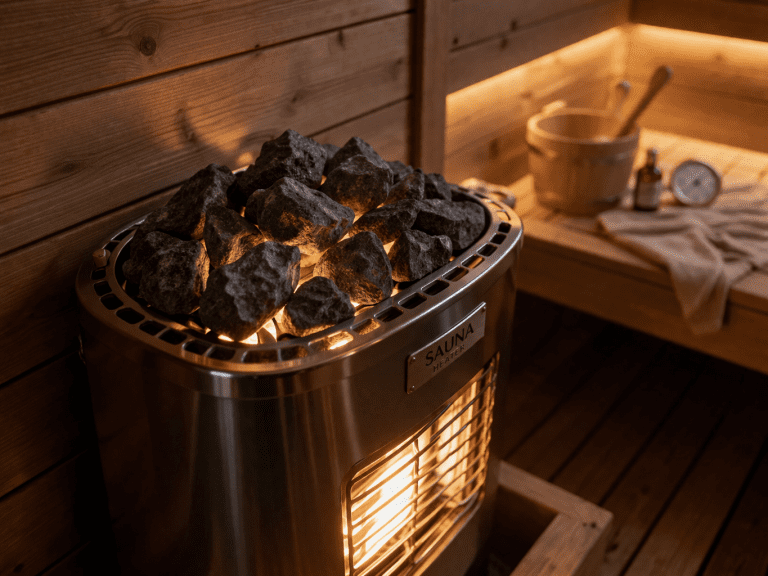
Traditional saunas require sauna rocks, which need replacing every 1–3 years depending on how frequently the unit is used and how often water is poured. A quality set of sauna rocks runs $30–$80. That’s not a huge expense, but it’s recurring and most buying guides don’t mention it.
Both types benefit from a quality sauna mat. The bench in a traditional sauna — and in many infrared units — gets hot enough to be genuinely uncomfortable on bare skin if you’re not paying attention, and sitting directly on the wood for extended sessions isn’t great for the bench finish either. A sauna mat isn’t an optional luxury — it’s the practical accessory that protects both you and the bench long-term.
Infrared heating elements — the carbon or ceramic panels that emit far-infrared heat — can degrade over time. Quality units carry 5–10 year warranties on panels. Cheaper units may need element replacement in years 3–5, which can cost $100–$300 depending on the unit.
Wood maintenance applies to both types: occasional light sanding and re-oiling of interior benches extends their life and keeps the sauna hygienic. Budget $20–$40 per year for basic upkeep materials.
Pros and Cons
Infrared — Pros
- Lower wattage draw means meaningfully lower monthly running costs in typical use
- Shorter warm-up time reduces per-session overhead energy consumption
- Lower installation cost in most homes — often no electrical upgrade required
- Infrared vs traditional sauna running costs consistently favour infrared in year-over-year comparisons
Infrared — Cons
- Lower operating temperature (120–150°F vs 160–195°F) means a genuinely different experience — not inferior, but different, and some people simply don’t adapt to it
- Heating element replacement is a real cost that doesn’t apply to traditional rock heaters in the same way
- The far-infrared experience divided opinion: some find it deeply effective, others find the lower temperature underwhelming compared to the intensity of a traditional Finnish session
Traditional — Pros
- Higher operating temperature produces the classic intense sauna experience many users specifically want
- Sauna rocks are inexpensive and simple to maintain — no electronic components to fail
- Longer lifespan on core components when properly maintained
Traditional — Cons
- Pre-heat time is a genuine behaviour tax. Most articles acknowledge it as an inconvenience. What they don’t say is that it quietly reduces how often people actually use the sauna — which means the real-world cost per session is higher than the per-kWh figure suggests, because you’re paying for a session you didn’t have
Which wins on infrared vs traditional sauna running costs?
The honest answer on infrared vs traditional sauna running costs is that infrared wins on electricity and installation in most home setups. Traditional wins if you factor in longevity of core components and the fact that rock heaters are extremely simple mechanical systems with low failure rates.
What rarely gets discussed is the usage behaviour effect. Infrared saunas get used more consistently in a home setting because the barrier to entry is lower. A 12-minute warm-up on a Tuesday evening when you’re tired is achievable. A 40-minute pre-heat often isn’t. That usage gap is the invisible variable in most cost comparisons — and it matters because a sauna that gets used five days a week at lower cost delivers far more value than one used twice a week at slightly lower per-session cost.
If pure operating economy is the priority, infrared is cheaper over a 3–5 year window in most homes. If the experience is the priority and running cost is secondary, traditional delivers something infrared doesn’t replicate — and that difference is worth money to many buyers.
As noted in our look at Do Infrared Saunas Get as Hot as Traditional Saunas , the temperature gap between the two types affects more than comfort — it shapes which health benefits each delivers and how long you can comfortably stay inside.
Comparison Table
| Factor | Infrared | Traditional |
|---|---|---|
| Average wattage draw | 1.5–3.5 kW | 6–9 kW |
| Warm-up time | 10–15 min | 30–45 min |
| Estimated monthly running cost | $3–$6 | $12–$25 |
| 5-year electricity cost (3×/week) | ~$160–$200 | ~$720–$1,500 |
| Typical installation electrical work | $0–$400 | $150–$2,500 |
| Core component lifespan | 5–10 years (elements) | 10–20 years (heater/rocks) |
| Post-session feeling | Gentle warmth, less draining | Intense, more physically demanding |
| Maintenance items | Sauna mat, light wood care | Rocks, sauna mat, light wood care |
Post-session feeling is the comparison point most tables skip. It’s not a soft metric — it directly affects whether you use the sauna before work, after a hard session, or only on rest days. That usage pattern determines your real annual cost more than wattage alone.

Helpful Gear
- Sauna mat — protects bench surfaces and prevents direct skin contact with hot wood during longer sessions; look for non-slip options with drainage
- Digital energy monitor — plugs between wall outlet and unit to track real-time kWh draw; useful for verifying actual running costs against manufacturer specs before committing to a schedule
- Sauna rocks replacement set — essential for traditional owners; quality igneous rock sets extend heater performance and maintain steam quality.
FAQs
Is an infrared sauna worth it if I only use it twice a week?
At twice a week, infrared running costs drop to roughly $15–$25 per year in electricity — essentially negligible. The real question is whether the experience itself justifies the purchase price. At low usage frequency, infrared’s lower warm-up barrier actually helps: a 12-minute pre-heat on a twice-weekly schedule is less of a friction point than a 40-minute one. If cost efficiency is the concern, twice weekly infrared is still meaningfully cheaper over three to five years than twice weekly traditional.
Do infrared saunas cost significantly less to run than traditional saunas?
In most home setups, yes — infrared vs traditional sauna running costs show infrared costing roughly 70–80% less in electricity per session. At typical US rates and three sessions per week, that’s a real difference of $100–$130 per year. Over five years, and accounting for a lower installation cost in many homes, the total ownership cost gap can reach $1,000–$2,500 depending on the traditional unit’s electrical requirements.
Will a traditional sauna’s higher electricity cost eventually pay off in resale value?
This is a buyer objection that doesn’t get a clean answer. A well-installed traditional sauna can add perceived value to a home, particularly in markets where wellness features are sought after. But resale value depends far more on installation quality, aesthetics, and local buyer preferences than on the type of heating element. Running cost is rarely a factor in resale — the upfront installation and finish quality are what buyers respond to.
Simple rule: If long-term running cost is your primary concern, infrared wins on every line of the electricity comparison. If the experience is your primary concern, choose on those grounds and treat the higher running cost as the price of the session quality you actually want.
Summary Snapshot
- Infrared saunas cost roughly $3–$6/month to run at typical home usage; traditional runs $12–$25/month
- The warm-up energy overhead on traditional units is real consumption — not part of your session
- Five-year electricity cost difference is typically $500–$1,000+ depending on usage and heater size
- Installation costs frequently add $500–$2,000 to the traditional sauna’s total ownership cost
- Usage behaviour matters as much as wattage — infrared’s lower barrier leads to more consistent use
- Infrared vs traditional sauna running costs favour infrared in economy; traditional wins on experience intensity
[IMAGE 3] — alt text: person relaxing in a warm home sauna in the evening

Final Verdict
After years of using both, the running cost comparison between infrared and traditional isn’t as dramatic as the wattage figures suggest — but it’s real and it compounds. Infrared vs traditional sauna running costs show infrared coming out meaningfully cheaper in electricity over a 3–5 year window, often significantly cheaper once installation is factored in.
The more honest version of this comparison is this: infrared is cheaper to run and easier to start using consistently. Traditional delivers an experience infrared doesn’t replicate at that temperature and steam intensity. If budget is the deciding factor, infrared is the rational choice. If the experience is the deciding factor, the extra running cost is worth treating as a premium for the session you actually want — and it’s unlikely to break anyone’s budget at $10–$15 per month.
If you’re on the fence about which heating method fits your usage pattern, it’s worth reading through our Energy-Saving Accessories post in the hot tub section — the principles around reducing standby energy draw and smart scheduling apply equally to sauna ownership.
What matters most is that you use it regularly. A cheaper sauna that gets used five times a week will always outperform an expensive one that gets used twice.
Cluster Block
If you’re working through the infrared vs traditional comparison, two other posts in this cluster cover the key ground alongside this one. Our piece on Do Infrared Saunas Get as Hot as Traditional Saunas? explains the temperature gap and what it means for your session experience — worth reading before deciding whether the cost saving is worth the heat reduction. For context on the heaters themselves and what drives the wattage figures above, What Size Sauna Heater Do I Need for a 2 Person Sauna? breaks down the sizing logic behind why traditional units pull so much more power.
The gap widens with larger traditional units. A 9 kW heater in a 4-person sauna changes those numbers considerably. It narrows slightly if your utility rate is below the national average or if you use a time-of-use tariff to run sessions during off-peak hours.
According to the U.S. Department of Energy, electric resistance heating converts nearly all electrical energy directly to heat — meaning both sauna types run close to 100% efficiency at the point of use. The difference is purely in how much energy each type needs to create the environment, not in how efficiently it converts power to heat.
Installation Costs That Change the Long-Term Equation
Running cost isn’t the only number that matters when you’re comparing infrared vs traditional sauna running costs across years of ownership. Installation cost is a one-time spend that affects your total cost of ownership just as much as monthly electricity.
Most infrared saunas are plug-and-play on a standard 120V or 240V outlet, depending on size. A single-person unit often runs on a standard 15A household circuit with no additional electrical work required. Larger 2–4 person units typically need a dedicated 240V, 20–30A circuit, but that’s usually a straightforward job — $150–$400 in most markets.
Traditional electric sauna heaters almost always require a dedicated 240V circuit with a higher amperage draw — 40A or 60A for larger units. If your panel doesn’t have capacity, you’re looking at a panel upgrade. That can run $800–$2,500 depending on your panel’s age and your local electrician’s rates. For many homeowners, that’s the single largest hidden cost in the traditional sauna purchase.
Add it to the five-year running cost difference above and the gap between the two types becomes harder to close purely on running cost grounds — even if you prefer the traditional experience.
Maintenance Costs Most Comparisons Skip
Maintenance is where infrared vs traditional sauna running costs comparisons almost always go quiet. Neither type is high maintenance, but the costs aren’t identical.
Traditional saunas require sauna rocks, which need replacing every 1–3 years depending on how frequently the unit is used and how often water is poured. A quality set of sauna rocks runs $30–$80. That’s not a huge expense, but it’s recurring and most buying guides don’t mention it.
Both types benefit from a quality sauna mat. The bench in a traditional sauna — and in many infrared units — gets hot enough to be genuinely uncomfortable on bare skin if you’re not paying attention, and sitting directly on the wood for extended sessions isn’t great for the bench finish either. A sauna mat isn’t an optional luxury — it’s the practical accessory that protects both you and the bench long-term.
Infrared heating elements — the carbon or ceramic panels that emit far-infrared heat — can degrade over time. Quality units carry 5–10 year warranties on panels. Cheaper units may need element replacement in years 3–5, which can cost $100–$300 depending on the unit.
Wood maintenance applies to both types: occasional light sanding and re-oiling of interior benches extends their life and keeps the sauna hygienic. Budget $20–$40 per year for basic upkeep materials.
Pros and Cons
Infrared — Pros
- Lower wattage draw means meaningfully lower monthly running costs in typical use
- Shorter warm-up time reduces per-session overhead energy consumption
- Lower installation cost in most homes — often no electrical upgrade required
- Infrared vs traditional sauna running costs consistently favour infrared in year-over-year comparisons
Infrared — Cons
- Lower operating temperature (120–150°F vs 160–195°F) means a genuinely different experience — not inferior, but different, and some people simply don’t adapt to it
- Heating element replacement is a real cost that doesn’t apply to traditional rock heaters in the same way
- The far-infrared experience divided opinion: some find it deeply effective, others find the lower temperature underwhelming compared to the intensity of a traditional Finnish session
Traditional — Pros
- Higher operating temperature produces the classic intense sauna experience many users specifically want
- Sauna rocks are inexpensive and simple to maintain — no electronic components to fail
- Longer lifespan on core components when properly maintained
Traditional — Cons
- Pre-heat time is a genuine behaviour tax. Most articles acknowledge it as an inconvenience. What they don’t say is that it quietly reduces how often people actually use the sauna — which means the real-world cost per session is higher than the per-kWh figure suggests, because you’re paying for a session you didn’t have
Which wins on infrared vs traditional sauna running costs?
The honest answer on infrared vs traditional sauna running costs is that infrared wins on electricity and installation in most home setups. Traditional wins if you factor in longevity of core components and the fact that rock heaters are extremely simple mechanical systems with low failure rates.
What rarely gets discussed is the usage behaviour effect. Infrared saunas get used more consistently in a home setting because the barrier to entry is lower. A 12-minute warm-up on a Tuesday evening when you’re tired is achievable. A 40-minute pre-heat often isn’t. That usage gap is the invisible variable in most cost comparisons — and it matters because a sauna that gets used five days a week at lower cost delivers far more value than one used twice a week at slightly lower per-session cost.
If pure operating economy is the priority, infrared is cheaper over a 3–5 year window in most homes. If the experience is the priority and running cost is secondary, traditional delivers something infrared doesn’t replicate — and that difference is worth money to many buyers.
As noted in our look at Do Infrared Saunas Get as Hot as Traditional Saunas , the temperature gap between the two types affects more than comfort — it shapes which health benefits each delivers and how long you can comfortably stay inside.
Comparison Table
| Factor | Infrared | Traditional |
|---|---|---|
| Average wattage draw | 1.5–3.5 kW | 6–9 kW |
| Warm-up time | 10–15 min | 30–45 min |
| Estimated monthly running cost | $3–$6 | $12–$25 |
| 5-year electricity cost (3×/week) | ~$160–$200 | ~$720–$1,500 |
| Typical installation electrical work | $0–$400 | $150–$2,500 |
| Core component lifespan | 5–10 years (elements) | 10–20 years (heater/rocks) |
| Post-session feeling | Gentle warmth, less draining | Intense, more physically demanding |
| Maintenance items | Sauna mat, light wood care | Rocks, sauna mat, light wood care |
Post-session feeling is the comparison point most tables skip. It’s not a soft metric — it directly affects whether you use the sauna before work, after a hard session, or only on rest days. That usage pattern determines your real annual cost more than wattage alone.

Helpful Gear
- Sauna mat — protects bench surfaces and prevents direct skin contact with hot wood during longer sessions; look for non-slip options with drainage
- Digital energy monitor — plugs between wall outlet and unit to track real-time kWh draw; useful for verifying actual running costs against manufacturer specs before committing to a schedule
- Sauna rocks replacement set — essential for traditional owners; quality igneous rock sets extend heater performance and maintain steam quality
FAQs
Is an infrared sauna worth it if I only use it twice a week?
At twice a week, infrared running costs drop to roughly $15–$25 per year in electricity — essentially negligible. The real question is whether the experience itself justifies the purchase price. At low usage frequency, infrared’s lower warm-up barrier actually helps: a 12-minute pre-heat on a twice-weekly schedule is less of a friction point than a 40-minute one. If cost efficiency is the concern, twice weekly infrared is still meaningfully cheaper over three to five years than twice weekly traditional.
Do infrared saunas cost significantly less to run than traditional saunas?
In most home setups, yes — infrared vs traditional sauna running costs show infrared costing roughly 70–80% less in electricity per session. At typical US rates and three sessions per week, that’s a real difference of $100–$130 per year. Over five years, and accounting for a lower installation cost in many homes, the total ownership cost gap can reach $1,000–$2,500 depending on the traditional unit’s electrical requirements.
Will a traditional sauna’s higher electricity cost eventually pay off in resale value?
This is a buyer objection that doesn’t get a clean answer. A well-installed traditional sauna can add perceived value to a home, particularly in markets where wellness features are sought after. But resale value depends far more on installation quality, aesthetics, and local buyer preferences than on the type of heating element. Running cost is rarely a factor in resale — the upfront installation and finish quality are what buyers respond to.
Simple rule: If long-term running cost is your primary concern, infrared wins on every line of the electricity comparison. If the experience is your primary concern, choose on those grounds and treat the higher running cost as the price of the session quality you actually want.
Summary Snapshot
- Infrared saunas cost roughly $3–$6/month to run at typical home usage; traditional runs $12–$25/month
- The warm-up energy overhead on traditional units is real consumption — not part of your session
- Five-year electricity cost difference is typically $500–$1,000+ depending on usage and heater size
- Installation costs frequently add $500–$2,000 to the traditional sauna’s total ownership cost
- Usage behaviour matters as much as wattage — infrared’s lower barrier leads to more consistent use
- Infrared vs traditional sauna running costs favour infrared in economy; traditional wins on experience intensity

Final Verdict
After years of using both, the running cost comparison between infrared and traditional isn’t as dramatic as the wattage figures suggest — but it’s real and it compounds. Infrared vs traditional sauna running costs show infrared coming out meaningfully cheaper in electricity over a 3–5 year window, often significantly cheaper once installation is factored in.
The more honest version of this comparison is this: infrared is cheaper to run and easier to start using consistently. Traditional delivers an experience infrared doesn’t replicate at that temperature and steam intensity. If budget is the deciding factor, infrared is the rational choice. If the experience is the deciding factor, the extra running cost is worth treating as a premium for the session you actually want — and it’s unlikely to break anyone’s budget at $10–$15 per month.
If you’re on the fence about which heating method fits your usage pattern, it’s worth reading through our Energy-Saving Accessories post in the hot tub section — the principles around reducing standby energy draw and smart scheduling apply equally to sauna ownership.
What matters most is that you use it regularly. A cheaper sauna that gets used five times a week will always outperform an expensive one that gets used twice.
Cluster Block
If you’re working through the infrared vs traditional comparison, two other posts in this cluster cover the key ground alongside this one. Our piece on Do Infrared Saunas Get as Hot as Traditional Saunas? explains the temperature gap and what it means for your session experience — worth reading before deciding whether the cost saving is worth the heat reduction. For context on the heaters themselves and what drives the wattage figures above, What Size Sauna Heater Do I Need for a 2 Person Sauna? breaks down the sizing logic behind why traditional units pull so much more power.