Infrared Sauna Electricity Usage: The Real Numbers Before You Buy
Infrared sauna electricity usage depends on the cabin’s power rating, total heating time and how its controls operate. To estimate consumption, multiply power in kilowatts by operating time in hours, including preheating.
For example, a 1,600-watt cabin running at full rated power for 45 minutes uses 1.2 kWh. At an illustrative electricity rate of $0.20/kWh, that costs $0.24. Actual consumption can differ if heater output changes during use.
The detail that is easy to miss is the warm-up. A 30-minute soak is not necessarily 30 minutes of electricity use. Count the time from switching the cabin on until heating finishes.
This guide focuses on electricity calculations and measurement. Installation requirements depend on the exact model; a familiar-looking plug does not establish that the existing circuit is suitable.
As an Amazon Associate, Sunrise & Vitalize earns from qualifying purchases. If you buy through an affiliate link, we may earn a small commission at no extra cost to you.
Quick Snapshot
- Calculation: rated watts ÷ 1,000 × total operating hours = a full-power energy estimate in kWh.
- Illustrative session: 1,600W × 45 minutes = 1.2 kWh, costing $0.24 at $0.20/kWh.
- Illustrative month: 20 of those sessions cost $4.80 at the same rate.
- Include preheating: add warm-up time to occupied session time.
- Check the manual: voltage, circuit requirements and permitted controls vary by model.
Table of Contents
- What the Wattage Number Actually Means
- The Real Cost Per Session
- Circuit and Installation Requirements
- Keeping Electricity Usage Under Control
- Pros and Cons of Using Rated Power to Budget
- Infrared vs Traditional: Compare Complete Sessions
- Measuring Actual Consumption
- FAQ
- Final Verdict
What the Wattage Number Actually Means
Watts describe electrical power at a particular moment. Kilowatt-hours describe energy used over time. A 1,600W rating is 1.6 kW; running at that power for one hour uses 1.6 kWh.
Use the manufacturer’s total input rating rather than adding up only the heating panels if the cabin specification already includes controls, lighting and other equipment. Check whether optional accessories add to that load.
There is no reliable wattage range that covers every one-person, two-person or larger infrared sauna. Product design and accessories matter as well as seating capacity. Get the specification for the exact model and US version you intend to buy.
Does a sauna always draw its rated power?
No, but you should not assume it always draws less either. Heater output may change with the temperature setting, program and control design. Some operating instructions call for heaters to remain on during the session.
For example, Clearlight’s operating FAQ describes a setting intended to keep its heaters running continuously. That is why a blanket assumption such as “all infrared cabins average 60–80% of rated wattage” is not a dependable budgeting method.
Treat the rated-power calculation as a reference estimate. Measured consumption for your complete routine is more useful when suitable monitoring is available.
The Real Cost Per Session
Energy estimate = rated power in kW × total operating time in hours.
Electricity cost = energy used in kWh × your applicable electricity rate.
These examples all assume 45 minutes of operation at full rated power and an illustrative rate of $0.20/kWh. They are calculation examples, not measured performance or claims about typical cabin sizes.
| Assumed rated power | Energy over 45 minutes | Cost at $0.20/kWh | 20 identical sessions |
|---|---|---|---|
| 1.6 kW | 1.2 kWh | $0.24 | $4.80 |
| 2.4 kW | 1.8 kWh | $0.36 | $7.20 |
| 3.6 kW | 2.7 kWh | $0.54 | $10.80 |
If your 1.6 kW cabin preheats for 15 minutes and then runs for a 30-minute session, the total is 45 minutes. Counting only the occupied half-hour would omit 0.4 kWh, or $0.08 at the example rate, if it operated at full power throughout.
Use the rate on your own bill, including applicable usage-based delivery charges where these are listed separately. The U.S. Energy Information Administration explains why electricity prices vary by location and season; it is a source for electricity pricing, not sauna specifications.
At $0.30/kWh, the same 1.2 kWh example costs $0.36 per session and $7.20 for 20 sessions. More sessions, longer heating periods or additional accessories change the total.
Circuit and Installation Requirements
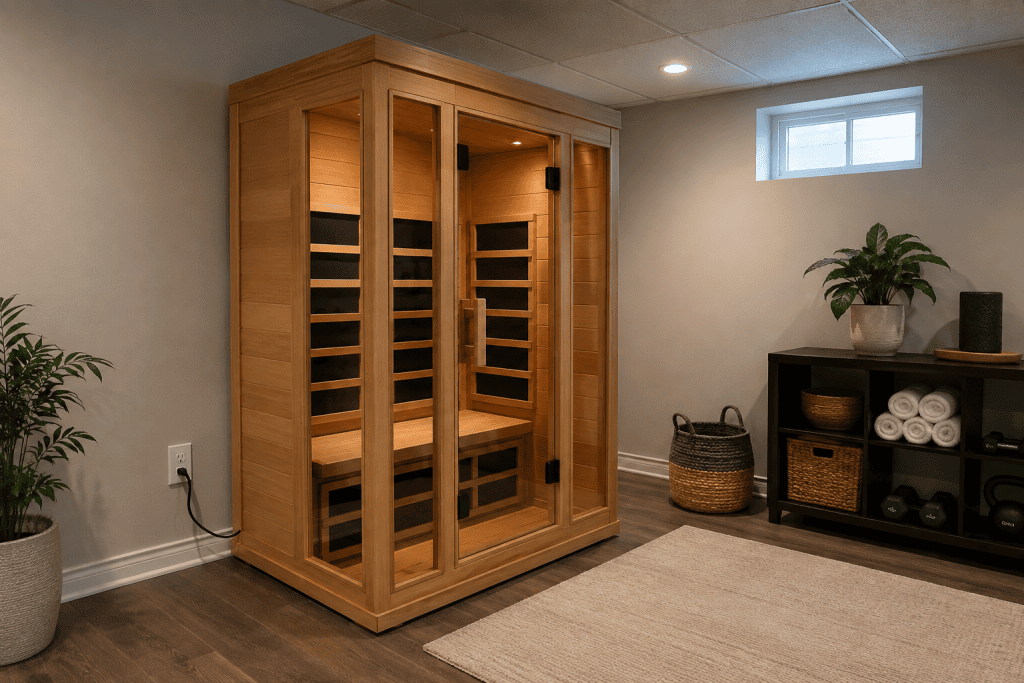
Follow the sauna manufacturer’s specified voltage, amperage, receptacle and circuit requirements. Some 120V cabins require a dedicated circuit even though the plug resembles those used by ordinary household appliances.
A dedicated circuit requirement is not limited to large cabins or 240V models. Ask a qualified electrician to confirm that the proposed supply meets the instructions and applicable local requirements before installation.
Do not treat a surge-protector power strip, extension cord, adapter or generic timer outlet as a substitute for the specified electrical connection. Clearlight’s Sanctuary owner’s manual, for example, directs owners to plug the sauna directly into the wall receptacle and advises against extension cords.
Use the cabin’s built-in timer or a control explicitly approved for that model. Any additional monitoring or switching equipment must also be suitable for the installation and permitted by the manufacturer.
A 240V label alone does not mean higher or lower running costs. Energy depends on power and operating time; voltage is part of selecting the correct electrical supply.
Keeping Electricity Usage Under Control
Start with the routine you actually intend to follow. Record preheat time, session time, temperature settings and how often the cabin is used. Those details make comparisons more useful than wattage alone.
- Follow the model’s warm-up guidance. Do not leave the cabin heating for longer than needed.
- Keep the door closed during heating. Avoid unnecessary heat loss while maintaining the ventilation the manufacturer requires.
- Check the permitted installation environment. A cold garage is not equivalent to a heated indoor room, and not every cabin is suitable for both.
- Use approved controls. Do not add an external timer simply to automate preheating.
- Maintain the cabin as instructed. Do not block vents or modify insulation to chase savings.
Warm-up time varies with the model, starting temperature and intended operating conditions. A manufacturer’s suggested time to begin using the cabin is not necessarily the time needed to reach the highest displayed air temperature.
For the separate question of waiting time, see our infrared vs traditional sauna heat-up comparison. Include the actual warm-up you use in your electricity calculation.
Pros and Cons of Using Rated Power to Budget
Pros:
- It gives you a simple calculation before buying.
- You can use your own electricity rate rather than a national average.
- It makes the effect of longer preheating or more frequent sessions clear.
Limitations:
- It does not measure the heater’s actual behavior during your session.
- It can miss accessory loads if you use an incomplete specification.
- It says nothing by itself about whether your existing outlet and circuit are suitable.
Infrared vs Traditional: Compare Complete Sessions
A lower power rating can reduce energy use, but total operating time matters too. Compare the full warm-up and occupied session for each setup. Neither infrared nor traditional electric heaters should automatically be assumed to run continuously or to follow a fixed cycling percentage.
| What to compare | Infrared cabin | Traditional electric sauna |
|---|---|---|
| Power | Exact cabin input specification | Exact heater and accessory specifications |
| Total time | Preheat plus occupied session | Preheat plus occupied session |
| Controls | Model-specific output and programs | Model-specific thermostat and controls |
| Electrical supply | Follow its installation manual | Follow its installation manual |
| Useful cost measure | kWh for a complete visit | kWh for a complete visit |
For the broader ownership comparison, see infrared vs traditional sauna running costs. This article focuses on calculating and checking the infrared cabin’s electricity use.
Measuring Actual Consumption
A suitable energy meter records kWh over the complete heating period. An instantaneous watt reading only shows what the equipment is drawing at that moment.
Do not assume a generic plug-in monitor is suitable for a sauna. Its voltage, current rating, plug arrangement and operating conditions must match the equipment, and the sauna manufacturer must permit its use. If the manual requires a direct wall connection, do not insert a monitor without manufacturer approval.
For a hardwired cabin or any installation where plug-in measurement is unsuitable, ask a qualified electrician about appropriate circuit-level energy monitoring. Do not open an electrical panel or expose live wiring to take readings yourself.
If monitoring is available, record several complete visits rather than one moment during warm-up. Note the room conditions, settings and duration, then calculate the cost using the measured kWh and your tariff.
FAQ
How much electricity does a 1,600W infrared sauna use?
At full rated power, it uses 1.6 kWh per hour. A total heating period of 45 minutes uses 1.2 kWh, costing $0.24 at an illustrative rate of $0.20/kWh. Actual consumption depends on how the model operates.
Does preheating count toward the electricity bill?
Yes. Count the full period when the sauna is consuming electricity, including warm-up. Do not calculate costs from the time spent sitting inside alone.
Will a few sessions a week add much to my bill?
Calculate it from the complete visit rather than assuming a monthly average. In the 1.6 kW, 45-minute example above, 20 sessions cost $4.80 at $0.20/kWh. That is an example for the stated assumptions, not a promise for every cabin.
Do infrared saunas need a dedicated circuit?
Some do, including some 120V models. Check the exact installation manual before buying. A standard-looking outlet does not establish that the circuit meets the sauna’s requirements.
Can I use a power strip or smart timer?
Use the connection and controls specified by the manufacturer. Do not add a power strip, generic smart plug or timer unless the manufacturer explicitly approves that arrangement and the device is correctly rated. The built-in timer is the starting point for controlling a session.
Summary Snapshot
- Use kWh: kilowatts multiplied by operating hours.
- Count preheating: a 30-minute soak may involve a longer heating period.
- Use your tariff: $0.20/kWh is an example rate throughout this guide.
- Avoid fixed cycling assumptions: output depends on the model and settings.
- Follow the manual: circuit requirements and accessory permissions are model-specific.
Final Verdict
Infrared sauna electricity usage is straightforward to estimate once you have the exact input rating, total heating time and electricity rate. The useful number is the energy used for a complete visit, not just the wattage printed in an advertisement.
Use the calculation to compare options before buying, then use suitable measured data if it becomes available. Confirm the electrical supply separately so a modest running-cost estimate is not mistaken for proof that any household outlet will do.