
Can My Electrical Panel Handle a Sauna Heater?
Your electrical panel sauna heater assessment needs to establish the home’s calculated electrical load, the panel’s condition and configuration, and the exact heater’s installation requirements. A 200-amp service or an empty breaker position alone doesn’t establish spare capacity.
Before buying, give a licensed electrician the heater’s US installation manual and your proposed sauna location. Ask them to assess the existing supply and quote any circuit, panel or service work needed.
This guide focuses on whether your existing electrical system can support the addition. Heater sizing and the sauna’s required voltage are separate decisions that feed into that assessment.
As an Amazon Associate, Sunrise & Vitalize earns from qualifying purchases. If you buy through an affiliate link, we may earn a small commission at no extra cost to you.
Quick Snapshot
- Many traditional electric sauna heaters require a dedicated 240V circuit.
- Some sauna models use 120V; check the exact US installation manual.
- Breaker and wiring requirements depend on the model and applicable code.
- Both 100-amp and 200-amp services need a load assessment.
- Spare breaker positions and spare electrical capacity are separate checks.
- A subpanel adds circuit space but doesn’t increase the home’s service capacity.
- Get a local installation quote and confirm permit requirements.

Table of Contents
- How Much Power Does a Sauna Heater Need?
- What Your Panel Needs to Support It
- Cost Reality
- Installation Requirements
- Maintenance
- Pros and Cons
- Comparing Panel Scenarios
- Comparison Table
- Choosing Equipment
- FAQ
- Simple Rule
- Summary Snapshot
- Final Verdict
How Much Power Does a Sauna Heater Need?
Start with the exact heater’s specified voltage, rated current, required circuit protection and approved room-volume range. Seating capacity alone doesn’t establish the correct heater or electrical circuit.
For a compact cabin, What Size Sauna Heater Do I Need for a 2 Person Sauna? covers the room-sizing decision. If you’re comparing outputs, see 6kW vs 8kW Sauna Heater.
Breaker size must match the equipment instructions, wiring and applicable code. Don’t increase a breaker from 30 amps to 40 amps simply to provide “headroom.” Have the electrician determine the complete circuit requirements.
A dedicated heater circuit serves the equipment specified by its installation instructions. Don’t share it with unrelated household appliances.
What Your Panel Needs to Support It
Service capacity: Have an electrician assess the home’s existing loads and the proposed sauna load. Neither a 100-amp nor a 200-amp service gives an automatic yes or no. Existing heating, cooking, vehicle charging and other equipment affect the assessment.
Panel space and compatibility: The panel must accommodate the correct listed breaker arrangement. A subpanel or an approved breaker configuration may address a shortage of circuit positions, but neither creates additional service capacity.
Wiring and cable route: Conductor sizing depends on the equipment instructions, circuit protection, conductor and terminal ratings, installation conditions and run length. Don’t select wire from a generic breaker-to-gauge shortcut.
Ask the installer to explain which issue applies: insufficient service capacity, insufficient circuit space, unsuitable existing equipment, or a combination. These can require different solutions.
Cost Reality
Electrical installation costs depend on the existing service, panel condition, cable route, access, required protection and permits.
Hooked Up Electric’s cost guide summarizes published estimates of $250–$800 for a 240V outlet requiring a new circuit. That is a general budgeting reference, not a sauna installation quote.
Panel or service upgrades, detached-building supplies, trenching and wall repairs can add substantially to the total. Ask for an itemized quote based on the actual heater manual.
Have the quote distinguish circuit installation from any panel or service work, permits and making good finished surfaces. This makes it easier to compare installers pricing the same job.
Installation Requirements
Choose a qualified installer. Ask about experience with sauna heaters or similar fixed electrical equipment. Supply the exact US installation manual before the quote.
Plan the route. A finished basement or detached sauna may require more work than a short accessible run. Have the installer assess the actual route before committing to the sauna location.
Confirm code requirements. Have the electrician confirm protective devices, disconnects, wiring methods and temperature ratings. GFCI requirements depend on the installation, adopted code and equipment instructions.
Confirm permits. Ask the electrician or local building department which permits and inspections apply and who will arrange them.
Use approved controls. Any proposed changes to the heater’s controls or electrical connection need manufacturer approval. A generic smart controller isn’t automatically suitable for a sauna heater.
Maintenance
Follow the manufacturer’s maintenance schedule. For the heater itself, our sauna heater maintenance guide covers stone care, cleaning and warning signs.
- Don’t open the electrical panel or inspect internal connections yourself.
- Inspect and rearrange stones as directed, replacing deteriorated stones.
- Have electrical faults investigated by a qualified electrician.
- Stop using the sauna if breakers trip repeatedly, connections discolor or you notice a burning smell.
- Don’t fit a larger breaker to solve repeated tripping.
Pros and Cons
Advantages of the specified dedicated supply:
- Provides the supply required by the heater.
- Allows suitable protection and wiring to be selected for the installation.
- Avoids sharing the heater circuit with unrelated appliances.
- Provides installation and inspection records where required.
Costs and practical constraints:
- New circuit installation adds to the sauna budget.
- Panel or service work can increase the total substantially.
- Finished walls and detached-building routes can make the work more involved.
- Permit and inspection scheduling can add time; confirm local lead times.
Comparing Panel Scenarios
200-amp panel with available positions: A load assessment must still confirm capacity. Open positions alone don’t establish that adding the heater is suitable.
Panel with no available positions: An electrician may identify an approved breaker arrangement or a suitable subpanel. These address circuit space, not insufficient service capacity.
Service with insufficient capacity: The electrician must identify an approved solution before adding the heater. Depending on the assessment, this may involve service upgrades or suitable load management.
Detached sauna building: Ask the electrician to design the supply route, wiring method, grounding and protection. Underground and overhead options depend on the site and applicable requirements.
Comparison Table
| Starting situation | What needs checking |
|---|---|
| 200A service, available positions | Calculated load, panel condition and breaker compatibility |
| Panel has no available positions | Approved circuit-space solution and service capacity |
| Insufficient service capacity | Approved upgrade or load-management solution |
| Detached sauna | Supply route, wiring, grounding, protection and permits |
Choosing Equipment
Choose the exact US heater model using its approved room-volume range and installation instructions. Compare the complete package, including required controls, sensors and stones, before arranging the electrical quote.
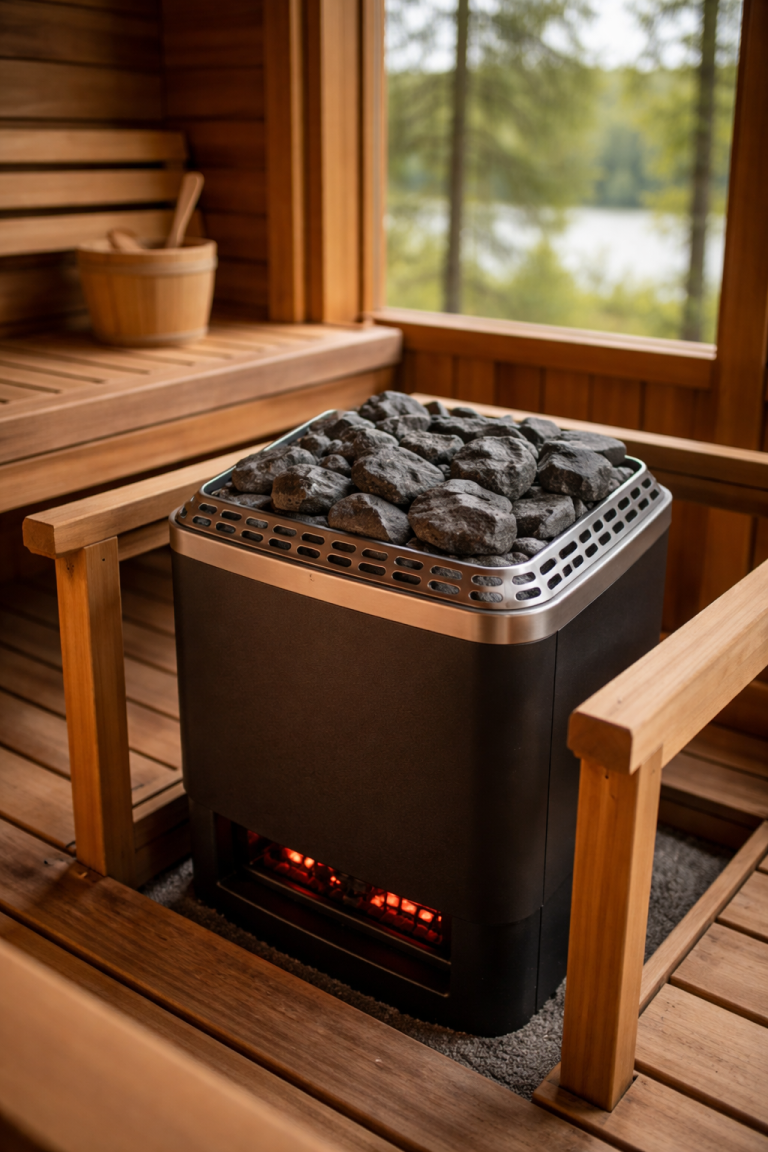
For example, the manufacturer’s Harvia KIP80B specification identifies an 8kW, 240V model with manual controls and no remote-use option. Don’t assume an aftermarket controller can safely add remote operation.
If you’re comparing infrared cabins, Infrared Sauna 240V explains why the exact model specification determines the supply. Cabin size alone doesn’t provide the answer.
FAQ
Can I use a 120V outlet for a small sauna? Some models use 120V, including certain infrared cabins. Follow the exact model’s voltage, amperage, receptacle and dedicated-circuit requirements. A standard-looking plug doesn’t prove that an existing outlet is suitable.
Do I need GFCI protection? Have your electrician confirm the requirements for the installation location, adopted electrical code and specific equipment. Don’t add or omit protection based on a general sauna rule.
Does a subpanel mean I can add a sauna? A subpanel can provide additional circuit positions, but it doesn’t increase the home’s service capacity. The installer must still assess the existing and proposed loads.
How long does installation take? Timing depends on panel work, cable routing, access and inspections. Ask the installer for a schedule after they assess the site and heater instructions.
Simple Rule
Confirm both calculated service capacity and a suitable breaker arrangement before adding the heater circuit.
Summary Snapshot
- Many traditional electric sauna heaters require a dedicated 240V circuit.
- Some sauna models use 120V; check the exact US installation manual.
- Breaker and wiring requirements depend on the model and applicable code.
- Both 100-amp and 200-amp services need a load assessment.
- Spare breaker positions and spare electrical capacity are separate checks.
- A subpanel adds circuit space but doesn’t increase the home’s service capacity.
- Get a local installation quote and confirm permit requirements.
Final Verdict
Your panel’s suitability needs an electrical assessment. Have a licensed electrician check the existing loads, panel configuration and heater instructions before ordering.
Get an itemized installation quote and confirm permits and inspections. That establishes what your particular home needs before the sauna arrives.