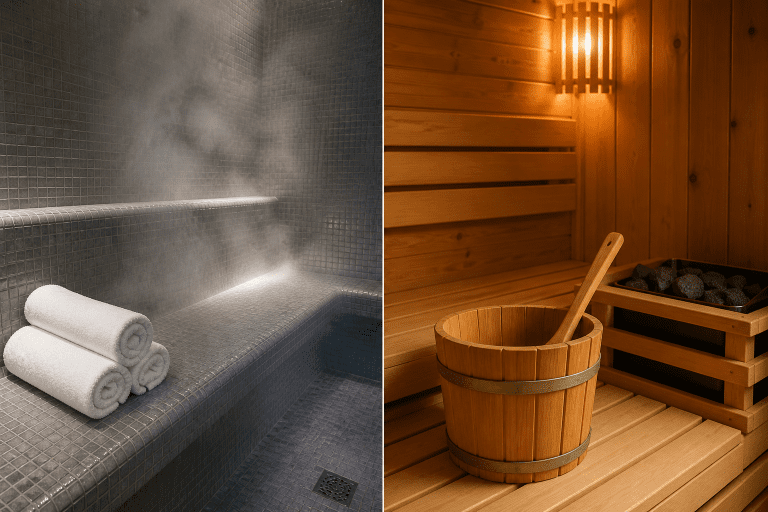

Steam Room vs Sauna Health Benefits: Which One Actually Does More for Your Body?
Steam room vs sauna health benefits is one of the most common questions I get from people setting up their first home wellness space. And honestly, it makes sense — both involve heat, both make you sweat, and both leave you feeling like a new person afterward.
But they work differently, feel different, and suit different people for different reasons.
Heads up: This post contains affiliate links. If you buy through them, I earn a small commission at no extra cost to you. I only recommend gear I’d genuinely use myself.
Quick Snapshot
- Steam rooms run at 100–115°F with 100% humidity; saunas run at 150–195°F with very low humidity
- Both support circulation, recovery, and relaxation — the mechanisms differ slightly
- Steam rooms edge ahead for respiratory and skin benefits
- Saunas have stronger cardiovascular research behind them
- Your choice often comes down to how you like to breathe during heat exposure
- Both require real installation, maintenance, and safety awareness

Table of Contents
- What Makes Steam Rooms and Saunas Different
- Steam Room vs Sauna Health Benefits Broken Down
- What It Costs to Own Either One
- Installation: What You’re Actually Getting Into
- Maintenance Realities for Both
- Pros and Cons
- How They Compare Side by Side
- Comparison Table
- Helpful Gear
- FAQ
- Final Verdict
What Makes Steam Rooms and Saunas Different
The biggest difference isn’t temperature — it’s moisture.
A sauna uses a heater (electric, wood-burning, or infrared) to heat the air around you. A steam room pumps in wet steam from a generator, wrapping you in close to 100% relative humidity.
That humidity gap changes everything. In a sauna, sweat evaporates off your skin almost immediately. In a steam room, it can’t — the air is already saturated. That’s why steam feels heavier and can be harder to tolerate for some people, even at lower temperatures.
Both create a heat stress response in your body. But the way that stress lands, and what it primarily targets, varies enough that the choice between them is worth thinking through carefully.
Steam Room vs Sauna Health Benefits Broken Down
This is where things get interesting. Steam room vs sauna health benefits aren’t identical — they overlap in some areas and diverge in others.
Shared benefits:
- Improved circulation from heat-induced vasodilation
- Muscle relaxation and reduced post-exercise soreness
- Stress reduction and improved mood via endorphin release
- Calorie burn from elevated heart rate (modest, but real)
Where steam rooms pull ahead:
Steam is genuinely better for your airways. The warm, wet air loosens mucus, opens bronchial passages, and can ease symptoms of congestion, asthma, and chronic sinusitis. If you regularly deal with respiratory issues, a steam environment is noticeably more comfortable than dry heat.
Skin benefits also lean toward steam. The moisture opens pores, softens skin, and supports better absorption of products applied afterward. According to Healthline’s medically reviewed guide to steam room benefits, steam exposure supports circulation in the skin and may help with overall skin tone when used consistently.
Where saunas pull ahead:
The cardiovascular research on traditional saunas is more robust. Finnish population studies show regular sauna use is associated with reduced risk of cardiovascular events, and the higher dry heat creates a stronger acute cardiovascular response than most steam environments.
Infrared saunas have their own research base around inflammation, joint pain, and deep tissue warmth — which steam doesn’t replicate in the same way.
What It Costs to Own Either One
Neither option is cheap once you account for the full picture.
Steam room costs:
A home steam generator runs $500–$2,500 depending on the size of the space. Add the enclosure build-out (waterproof tile, sealed door, drainage), and most homeowners spend $3,000–$8,000 for a basic install. Custom-tiled rooms with quality generators can reach $15,000+.
Running costs are moderate. Steam generators typically use 6–10kW per session, and most sessions run 15–20 minutes.
Sauna costs:
A prefab indoor barrel sauna starts around $2,000–$4,000. A custom-built sauna room with a quality heater can run $5,000–$12,000. Infrared units sit in the $1,500–$4,000 range for decent home models.
Running costs for an electric sauna heater are comparable to steam per session, though saunas typically heat up faster and sessions can run longer.
If you’re weighing a steam room vs sauna health benefits purchase purely on value-per-use, saunas often win on versatility and ease of use for daily routines.
Installation: What You’re Actually Getting Into
Steam rooms are harder to install than most people expect.
Every surface needs to be 100% waterproof — grout, walls, ceiling, and floor. The ceiling must slope so condensation drips to the side instead of landing on you. You’ll need a proper drain, a sealed door, and adequate ventilation outside the space. Electrical work for the generator typically requires a dedicated 240V circuit.
Saunas are more forgiving. Prefab kits can be assembled in a day. Even custom-built rooms work with standard wood panels, a dedicated heater, and basic electrical hookup. Most don’t need drainage at all.
Permits matter for both. Any structural modification or dedicated electrical circuit will likely require a permit — check your local building department before starting work.
Maintenance Realities for Both
Steam room maintenance:
The steam environment creates a breeding ground for mold and mildew if you don’t stay on top of it. After every session: wipe down all surfaces, leave the door cracked, and run the exhaust fan. Weekly: clean grout lines and check the generator’s mineral filter. Depending on your water hardness, you may need to descale the generator every few months.
Sauna maintenance:
Saunas are low-drama. Sweep out the floor, wipe down benches periodically, and inspect the heater annually. If you have a traditional heater with rocks, replace them every 2–3 years. No drainage, no mold risk if ventilated properly.
If you’re comparing steam room vs sauna health benefits alongside ownership practicality, saunas have a clear maintenance edge.
Pros and Cons
Steam Room
Pros:
- Superior for respiratory health and congestion
- Better for skin hydration and pore cleansing
- Lower air temperature is more accessible for heat-sensitive users
- Luxurious, spa-like experience
Cons:
- More complex and expensive to install correctly
- Mold risk requires diligent cleaning
- Humid air can feel suffocating for some people
- Less cardiovascular research than traditional saunas
Sauna
Pros:
- Stronger cardiovascular and deep heat research
- Easier to install, especially prefab options
- Low maintenance, no mold risk with proper ventilation
- Faster heat-up time, easier daily use
Cons:
- Dry air can irritate airways and sinuses
- Higher temperatures take adjustment for beginners
- Less effective for respiratory relief
- Custom builds still require significant investment
How They Compare Side by Side
When you break down steam room vs sauna health benefits category by category, neither wins outright.
For someone dealing with chronic respiratory issues, sinus congestion, or dry skin — a steam room is likely the better long-term choice. The moist heat does things dry air simply can’t.
For someone prioritizing cardiovascular conditioning, muscle recovery, or wanting a lower-maintenance daily ritual — a sauna fits better. The research is deeper, the habit is easier to sustain, and the install is simpler.
Some people solve this entirely by doing both. Many gym spa setups pair a steam room and sauna for a reason — they complement each other. If you’re interested in cold exposure as a third element, [CROSS-LINK: cold plunge benefits] stacks well with either heat option.
Comparison Table
| Feature | Steam Room | Sauna |
|---|---|---|
| Temperature | 100–115°F | 150–195°F |
| Humidity | ~100% | 5–30% |
| Respiratory benefit | Strong | Moderate |
| Cardiovascular research | Moderate | Strong |
| Skin hydration | Strong | Moderate |
| Muscle recovery | Good | Good |
| Installation complexity | High | Moderate |
| Maintenance burden | High | Low |
| Average install cost | $3,000–$15,000+ | $2,000–$12,000 |
| Best for | Respiratory, skin, spa feel | Cardio, recovery, daily habit |

Helpful Gear
Whether you go steam room or sauna, a few accessories make the experience noticeably better.
SMARTRO Professional Digital Hygrometer — Knowing your actual temperature and humidity takes the guesswork out. . “This is one of those small buys that makes your sessions feel a lot more intentional.”
Rainleaf Microfiber Towel — Works for both steam and sauna use. Good towels matter more than you’d think when you’re dripping that much.”
Steam room shower squeegee with handle — Makes post-session wipe-down genuinely painless. Non-negotiable if you want to keep mold from becoming a weekly battle.”
FAQ
What are the main steam room vs sauna health benefits differences? Steam rooms use 100% humidity at lower temperatures, making them better for respiratory health, skin hydration, and sinus relief. Saunas use dry heat at higher temperatures and have stronger cardiovascular research behind them. Both improve circulation and support muscle recovery, but they target slightly different systems.
Is a steam room or sauna better for muscle recovery? Both are effective for muscle recovery through heat-induced blood flow and reduced soreness. Saunas may have a slight edge due to the ability to tolerate longer sessions and the deeper tissue penetration of dry heat. For post-workout use, either works well — it often comes down to personal preference and what your body responds to best.
Can you use a steam room and sauna on the same day? Yes, many people do — typically sauna first, then a cool-down, then steam, or vice versa. Staying hydrated is critical if you’re combining both in one session. Keep each session moderate in length and listen to how your body responds.
The simple rule: If breathing and skin are your priority, lean steam. If heart health and daily recovery are your focus, lean sauna.
Summary Snapshot
- Steam room vs sauna health benefits overlap significantly — both deliver heat therapy value
- Steam wins on respiratory relief, skin hydration, and accessibility for heat-sensitive users
- Saunas win on cardiovascular research, ease of maintenance, and long-term daily use
- Installation complexity and cost are higher for steam rooms
- The best choice comes down to what your body needs most and how you want to maintain it

Final Verdict
Both options are genuinely worth it. The steam room vs sauna health benefits debate doesn’t have a universal winner — it has a personal one.
If you get frequent colds, deal with sinus issues, or simply love that spa-like misted warmth, a steam room will serve you better. If you want a straightforward, well-researched daily heat ritual with minimal maintenance headaches, a sauna is the smarter starting point.
The honest answer for most people? Start with whichever matches your primary wellness goal, and let the other be a future addition if budget and space allow. Pairing either with hot tub recovery sessions — especially if you use your hot tub post-workout — creates a complete heat therapy routine that covers multiple bases. hot tub installation tips
Either way, you’re making a long-term investment in how you feel day to day. That’s worth doing properly.
Explore More From Sunrise & Vitalize
- : Steam room health benefits — Go deeper on what consistent steam use does to your body over time.