Indoor vs Outdoor Hot Tub Installation: Which One Actually Works for Your Home?
Foundation requirements for outdoor saunas start with a stable, level base that supports the fully loaded sauna and keeps its wood clear of wet ground. Concrete, compacted gravel with suitable supports, pavers, and a properly designed deck can all work. The right choice depends on the exact sauna’s installation manual, your soil, drainage, climate, and local building requirements.
The sauna itself is only part of the project. The ground it sits on needs planning before you order materials or book delivery. This guide focuses on the base and site preparation; for the complete installation budget, see the cost to install an outdoor sauna.
As an Amazon Associate, Sunrise & Vitalize earns from qualifying purchases. If you buy through an affiliate link, we may earn a small commission at no extra cost to you.
Quick Snapshot
- Start with the exact model’s support layout, loaded weight, and foundation instructions.
- Keep the sauna’s support points level and direct surrounding runoff away.
- Concrete, gravel or pavers, and a load-rated deck each have a use case.
- A concrete slab is not automatically frost-proof; cold-climate foundation details depend on the site and local requirements.
- Check building, electrical, zoning, and any wood-stove requirements before starting work.
- Get an itemized site-specific quote rather than relying on a national foundation price range.
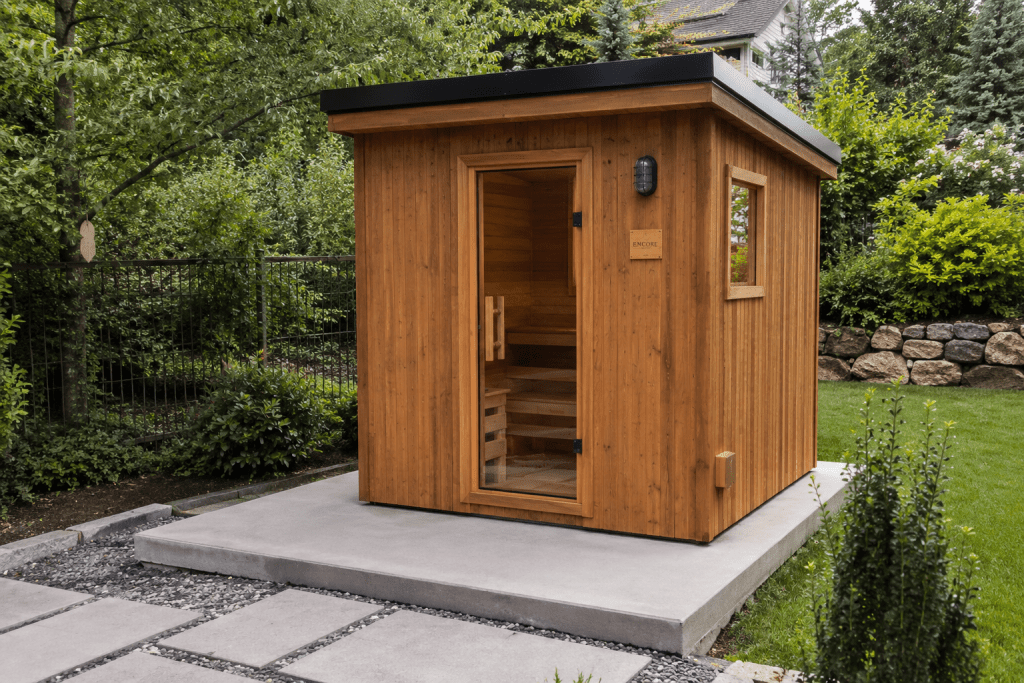
Table of Contents
- What Foundation Requirements for Outdoor Saunas Actually Cover
- The 3 Main Foundation Options and When Each Makes Sense
- What This Honestly Costs
- Installation Friction: What Slows People Down
- Maintenance Over Time
- Pros and Cons
- Comparing Foundation Types Head to Head
- Helpful Gear
- FAQ
- Summary Snapshot
- Final Verdict
What Foundation Requirements for Outdoor Saunas Actually Cover
Foundation requirements for outdoor saunas aren’t a single standard. They vary with the model, the structure’s support points, ground conditions, and local rules. A barrel on cradles and a cabin on continuous base rails may need very different support layouts.
At the core, the base needs to do three things: support the sauna without uneven settlement, maintain the required level, and manage moisture so the underside can dry. Include the cabin, heater, stones, accessories, and maximum intended occupants when checking the load. Dividing total weight by floor area alone does not establish whether a deck or individual support point is adequate.
Ask the supplier for the base dimensions, support locations, allowable level tolerance, anchoring instructions, and any required separation between wood and masonry. Do not assume a few blocks under the corners will support a cabin designed for continuous bearing.
Redwood Outdoors’ foundation guidance specifically calls for a strong, stable base and accounting for bathers’ weight. Its advice to have an existing deck assessed illustrates why an apparently solid deck is not proof of spare capacity.
The 3 Main Foundation Options and When Each Makes Sense
Gravel pad or pavers
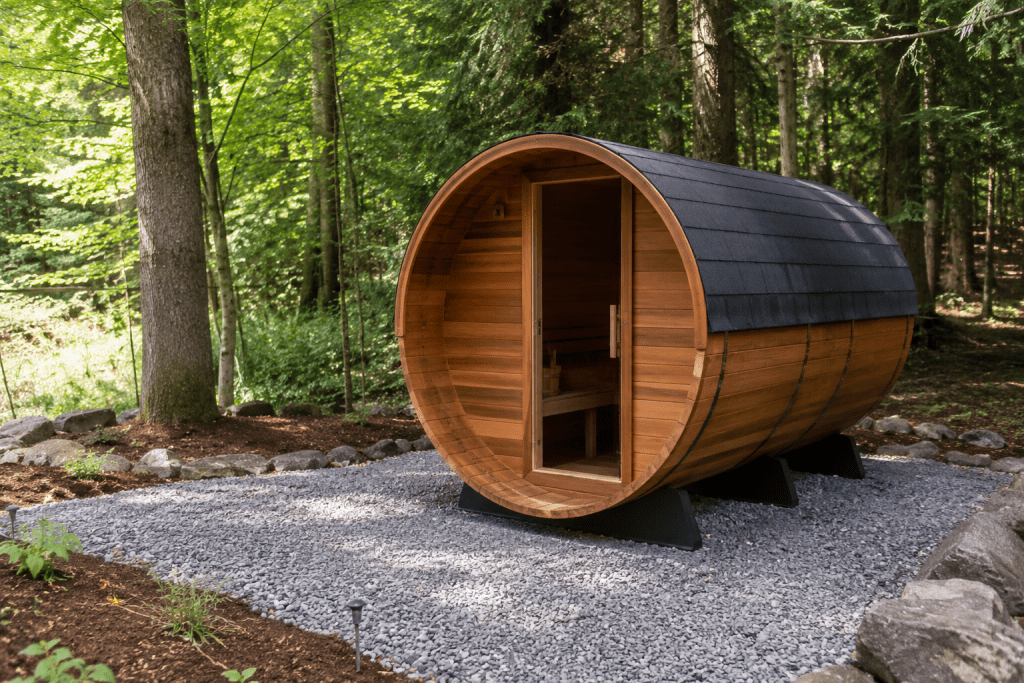
A compacted crushed-stone base can provide drainage and an adjustable support surface where the sauna manufacturer accepts it. Pavers or concrete blocks may be needed beneath cradles or base rails to spread the load and prevent sinking; follow the specified support layout.
Remove vegetation and unsuitable loose material, prepare the subgrade, and compact the aggregate in appropriate layers. A permeable separation geotextile may help keep soil and aggregate apart where the ground conditions call for it. It is not the same as impermeable plastic sheeting.
Do not treat one gravel depth as a universal construction specification. For example, Almost Heaven’s outdoor site-preparation guide describes compacted gravel among its accepted bases. Confirm the required depth, support details, and site suitability for your own model, particularly on soft soil or in freezing conditions.
Concrete slab
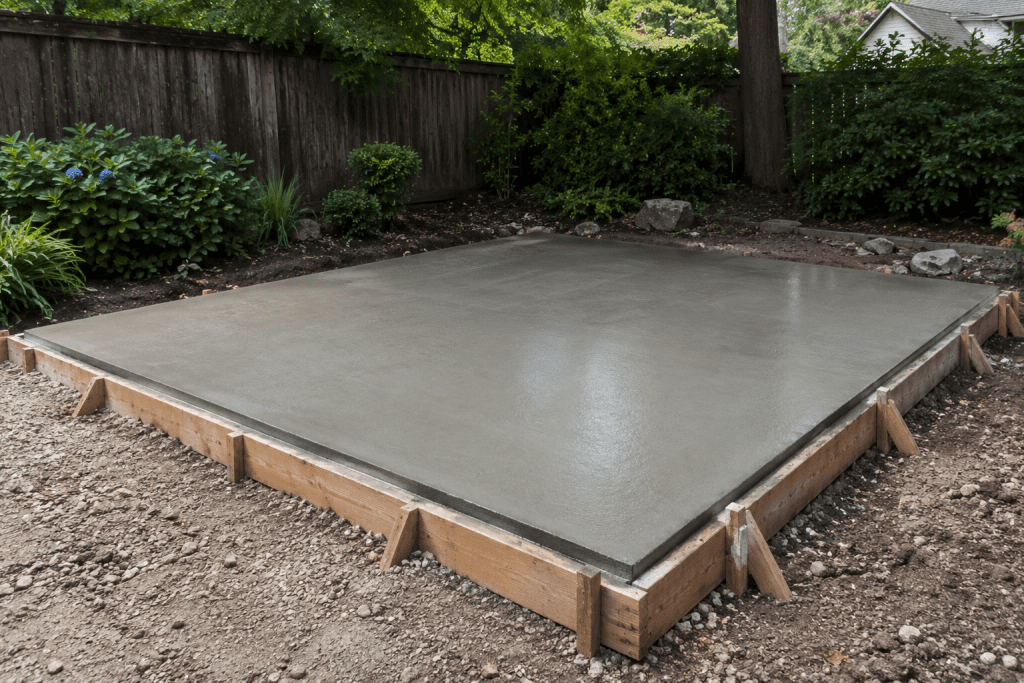
Concrete offers a firm support surface and can suit permanent installations, especially where the cabin manual calls for it. The slab thickness, reinforcement, sub-base, drainage, and any footings need to suit the load, soil, and local requirements. A generic 4-inch slab is not a complete design for every sauna.
Concrete does not eliminate frost heave. Where frost protection is required, the design may involve footings below the local frost depth or an approved alternative. Have the contractor establish the appropriate details before pouring. Keep the sauna’s bearing surface within the manufacturer’s level tolerance while directing surrounding water away.
Timber platform or existing deck
An elevated platform can improve airflow underneath and suit a sloping site, but its posts, footings, beams, joists, connections, and bracing must carry the loaded sauna. Have an existing deck assessed by a qualified structural professional before placing a sauna on it; reinforcement or new supports may be needed.
Use lumber and compatible fasteners specified for the actual exposure and structural application. There is no universal “UC4B minimum” for every component. The American Wood Protection Association’s use categories distinguish above-ground exposure from general and heavy-duty ground contact. The designer should choose the appropriate treatment and detailing. These external support materials are separate from the wood specified for the heated interior.
What This Honestly Costs
Site preparation is easy to underestimate because a foundation quote may cover only the finished pad. Excavation, spoil removal, drainage, access, engineering, inspection, and utility work can sit outside that price.
There is no verified nationwide price range here for a complete sauna foundation. A small DIY gravel pad, a professionally poured slab with a minimum delivery charge, and a deck requiring reinforcement are different jobs. Get local quotes against the same written scope.
- Gravel or pavers: include excavation, aggregate delivery, any separation fabric, edging, support blocks, compaction equipment, and disposal.
- Concrete: include ground preparation, base material, forms, reinforcement, any frost-protection details, concrete delivery or pumping, finishing, and curing arrangements.
- Timber or deck: include structural assessment, footings, framing, connections, treatment specification, access steps, and any reinforcement.
- All options: confirm taxes, permits, drainage work, utility coordination, and what happens if unsuitable soil is found.
For a material-quantity check, a hypothetical 8 × 8-foot pad with a 6-inch finished aggregate depth contains 32 cubic feet, or about 1.19 cubic yards, of compacted material. That calculation is not a recommended pad size or depth. Ask the supplier how much loose aggregate to order to achieve the specified compacted volume, plus any allowance for the actual site.
An existing deck may reduce new construction, but assessment and repairs are not automatically free. Sloped ground, poor access, standing water, and weak soil can change the budget more than the surface material itself.
Installation Friction: What Slows People Down
Foundation requirements for outdoor saunas introduce decisions that need to be settled before delivery: approval, ground conditions, utility routes, and when the base will be ready to load.
Permits and placement: Ask your local building department whether the sauna, base, deck alterations, electrical work, or wood-burning heater require approval. Size-based building-permit exemptions do not necessarily remove zoning, setback, electrical, or fire-safety requirements. A concrete slab alone does not establish the answer. Confirm the rules for your address and check any HOA restrictions before committing to a location.
Concrete strength: Do not schedule installation using a blanket 7-, 14-, or 28-day rule. The National Precast Concrete Association explains the 28-day strength-testing convention; it is not a universal date when concrete reaches all its strength. Ask your concrete contractor or designer when this slab can take the planned sauna and any delivery equipment, given the mix, curing, weather, and loading.
Utilities: An electric heater needs the specified electrical supply, so coordinate conduit routes and penetrations with a licensed electrician before the foundation is built. A wood-fired sauna may not need electricity for heating, although lighting or controls can have their own requirements. Wood-burning models also need the prescribed hearth, chimney, and clearances.
Excavation and access: Arrange utility locating before digging and identify private services that may need separate locating. Confirm a route for materials and equipment, delivery access, and space for assembly. Do not position the sauna so its door opens onto an unsafe drop or obstructed path.
Compaction: Poorly prepared aggregate can settle unevenly and affect the sauna’s alignment. Choose equipment and layer depths suitable for the specified material and site. A hand tamper is useful for small areas, but it is not an automatic substitute for mechanical compaction across a full pad.
Maintenance Over Time
A well-built foundation is generally low maintenance, but it still needs inspection. Check after heavy rain, after the first freeze-thaw season where relevant, and whenever the sauna’s door or support alignment changes.
On concrete, look for settlement, pooling water, and cracks that widen or create uneven support. On gravel or pavers, check for erosion, displaced edging, and sinking support points. Address the cause of movement rather than simply adding loose stone under a loaded sauna.
Inspect timber platforms at least annually for decay, loose connections, corroded hardware, and movement at posts or footings. Keep vegetation and debris from blocking airflow beneath the structure. Follow the supplier’s instructions if lifting or re-leveling is needed.
The foundation requirements for outdoor saunas do not disappear after installation. Keeping runoff away and the support points stable protects the floor and walls above. No base material guarantees a maintenance-free lifespan.
Pros and Cons
- Concrete slab: firm, durable support when correctly designed; higher construction commitment, curing requirements, and difficult removal. Cracking, drainage problems, and frost movement remain possible.
- Gravel or pavers: good drainage and easier adjustment when properly prepared; support details, compaction, and edge containment matter, and settlement may need attention.
- Timber platform or deck: useful for elevation and airflow; needs a load-appropriate structure, suitable footings and connections, and ongoing inspection. Relocating it is not always practical.
Even a well-built base cannot solve uncontrolled runoff from higher ground. If water pools at the proposed site after heavy rain, resolve the drainage before installation, without directing the problem toward neighboring property or the house.
Comparing Foundation Types Head to Head
| Factor | Concrete slab | Gravel / pavers | Timber / deck |
|---|---|---|---|
| Main advantage | Rigid support surface | Drainage and adjustability | Elevation and airflow |
| Key design check | Soil, slab and footing details | Compaction and bearing points | Footings, framing and connections |
| Cabin or barrel suitability | Follow model requirements | Follow model requirements | Follow model requirements |
| Cold-climate concern | Frost design still matters | Soil moisture and movement | Footing frost protection |
| Cost comparison | Get an itemized local quote | Get an itemized local quote | Include structural assessment |
| Maintenance | Check cracks, level and drainage | Check settlement and erosion | Inspect timber and connections |
Choose the base the sauna manufacturer accepts and the site can support. Concrete is not automatically best in every freezing climate, and a sauna’s shape alone does not determine whether gravel or a deck is suitable.
Helpful Gear
Separation fabric and moisture control: Buy the material the base design actually calls for. Permeable geotextile can separate soil from aggregate; a vapor barrier beneath a slab or a damp-proof layer beneath wood serves a different purpose. Do not place impermeable plastic beneath a draining gravel pad as a universal precaution. It can interfere with drainage. Follow the sauna supplier’s moisture-control instructions.
Compaction equipment: A rented plate compactor may suit a full aggregate pad. For small areas and edges, a BlumeTrec hand tamper is an example of a manual tool—not a plate-compactor rental kit. Confirm the required compaction method before buying equipment.
Construction level: A CHANNELLOCK 48-inch I-beam level can help check supports in both directions. Larger layouts may also need a suitable laser or builder’s level. Check level at the specified bearing points rather than assuming the surrounding ground should all be flat.
FAQ
Do outdoor saunas always need a concrete foundation?
No. Some models accept compacted gravel, pavers, or a properly designed platform. Others have more specific foundation requirements. Follow the exact manual and the site’s structural and frost-protection requirements rather than choosing from the sauna’s shape alone.
Do I need a permit to install an outdoor sauna foundation?
It depends on your location and the complete project. Ask the local building department about the sauna, its foundation, utility work, and any stove or chimney. Confirm setbacks and zoning even if a small structure is exempt from a building permit. Do not assume a gravel base avoids approval requirements.
How long does a sauna foundation take to install?
A straightforward gravel or paver base may be quick to build once the site is ready, but excavation, drainage, inspections, and contractor availability can extend the schedule. Concrete also needs curing and authorization for the intended load. Get a project schedule from the installer rather than assuming a fixed number of days.
Can I put an outdoor sauna directly on grass?
Do not set it directly on grass or loose soil as a shortcut. Vegetation and wet ground can retain moisture, while concentrated support loads can sink unevenly. Use the manufacturer’s accepted prepared base and support layout.
Summary Snapshot
- Match the base to the exact sauna manual and fully loaded weight.
- Keep bearing points level and manage water around and beneath the structure.
- Check soil and frost conditions; a plain slab does not solve every site problem.
- Have an existing deck assessed before adding the sauna.
- Confirm local approvals and utility routes before construction.
- Inspect the base over time and address movement or pooling early.
Final Verdict
Foundation requirements for outdoor saunas deserve the same planning attention as the sauna itself. The decision is not simply concrete versus gravel: it is whether the chosen base will support this model, on this ground, with adequate drainage and the required approvals.
Before ordering, obtain the installation manual, confirm the loaded weight and bearing layout, and have the proposed base assessed where the site or structure calls for it. Fixing soft ground or a drainage problem before assembly is much easier than correcting it beneath a finished sauna.
If you are still choosing the location, the indoor vs outdoor sauna comparison covers the broader setup decision. For related planning articles, browse the Indoor vs Outdoor Saunas guides.