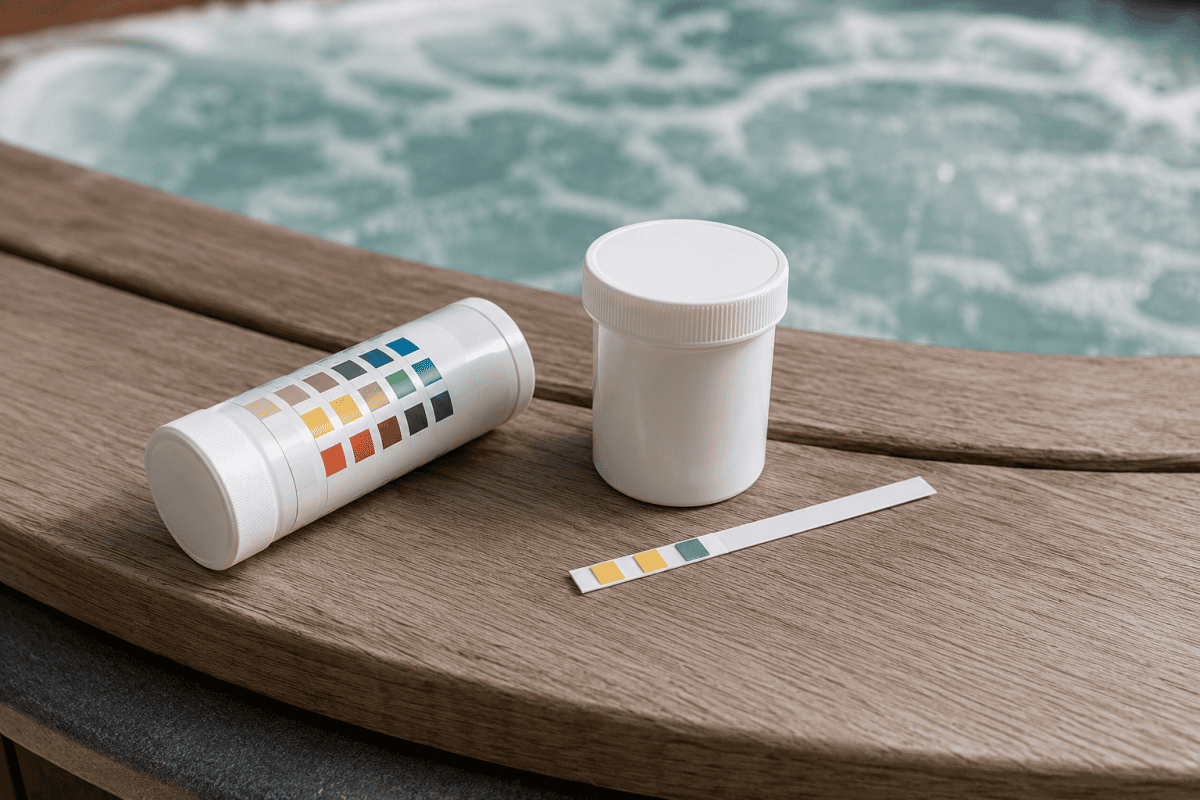
Hot Tub Water Chemistry Basics: A Real Owner’s Guide
Hot tub water chemistry basics come down to three numbers you actually need to track — sanitizer level, pH, and total alkalinity — and almost everything else owners worry about is downstream of those three. Get them wrong and the water looks fine right up until it doesn’t: cloudy, smelly, or irritating skin and eyes within a day or two.
I test my water two to three times a week, not because a manual told me to, but because skipping it always costs more time than the test itself takes. A five-minute check with strips beats an hour of shocking and re-balancing a tub that’s already gone sideways.
Quick heads up: this post contains affiliate links. If you buy through them, I may earn a small commission at no extra cost to you — it’s how this site stays free to use.
Quick Snapshot
- Core numbers to track: sanitizer (chlorine or bromine), pH (7.2–7.8), total alkalinity (80–120 ppm)
- Testing frequency: 2–3 times weekly for active tubs, daily during heavy use
- Typical monthly chemical cost: roughly $20–$40 for a standard 300–400 gallon tub
- Full water change interval: every 3–4 months for most households
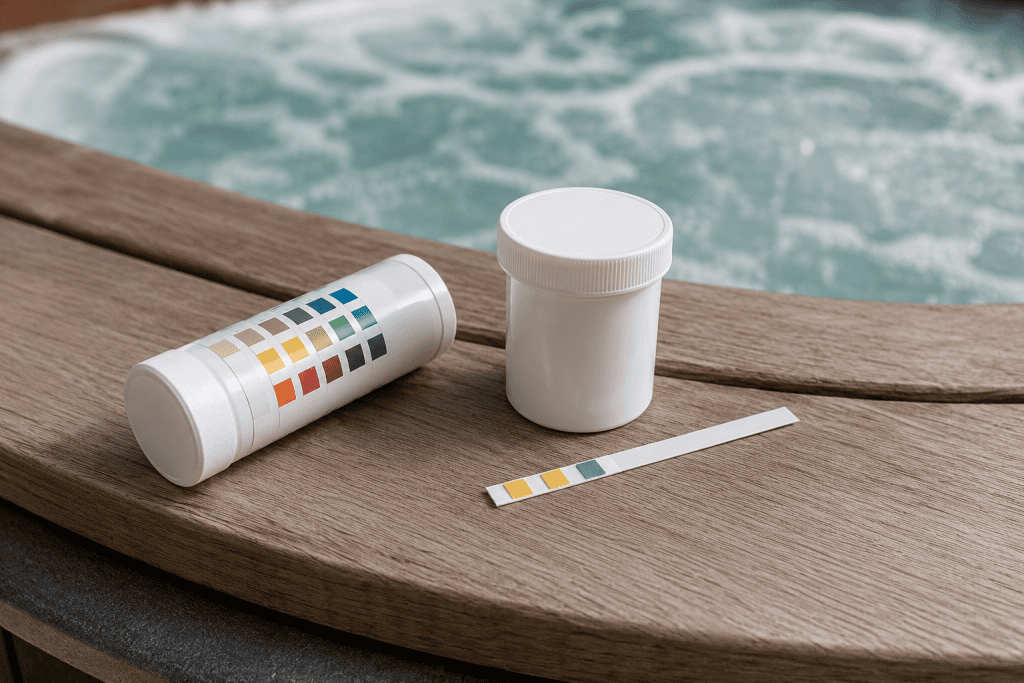
Table of Contents
- What Hot Tub Water Chemistry Basics Actually Mean
- The Real Cost of Staying Balanced: $20–$40 a Month
- Building a Testing Routine That Sticks
- Ongoing Maintenance Beyond Testing
- Pros and Cons of DIY Chemistry Management
- Chemistry Management: Strips vs Digital Testers vs Professional Test
- FAQ
Hot Tub Water Chemistry Basics: What the Numbers Actually Mean
Hot tub water chemistry basics start with sanitizer — chlorine or bromine — which kills bacteria and prevents the tub from becoming a health risk. Below the effective range, water looks clear but isn’t actually being disinfected. Above it, skin and eyes take the hit.
pH sits right behind sanitizer in importance. A range of 7.2 to 7.8 keeps sanitizer working efficiently and protects your skin, your eyes, and the tub’s equipment from corrosion or scale buildup. Total alkalinity, sitting between 80 and 120 ppm, acts as a buffer that stops pH from swinging wildly every time you add chemicals or fresh fill water changes the balance.
According to the CDC’s guidance on home pool and hot tub water treatment, hot tubs require more frequent monitoring than pools because higher water temperatures accelerate both bacterial growth and sanitizer breakdown, which is exactly why a once-a-week glance isn’t really enough for a tub that’s used regularly.
Hot tub water chemistry basics also cover something most owners learn the hard way: stinging eyes and a sharp chemical smell aren’t a sign of too much sanitizer. They’re almost always chloramines — sanitizer that’s already spent itself fighting sweat, lotion, and other contaminants and is no longer actively disinfecting. The fix is shocking the water to burn off the chloramines, not cutting back on chemicals, which is the opposite of what most people’s instinct tells them to do the first time it happens.
The Real Cost of Staying Balanced: $20–$40 a Month
Staying on top of hot tub water chemistry basics isn’t expensive, but it isn’t free either. A typical household running a 300–400 gallon tub spends somewhere around $20–$40 a month on sanitizer, pH adjusters, and shock treatment, with costs climbing a bit in warmer months when the tub gets used more often. Test strips run a few dollars for a bottle of 50, so testing itself is close to negligible.
Where the real cost shows up is neglect. Letting chemistry drift for a few weeks usually means a full drain, clean, and refill — plus a round of fresh chemicals to rebalance from scratch — which costs more in time and product than staying consistent ever would have.
For a wider budget covering electricity, filters, water changes and occasional repairs, see our hot tub maintenance cost breakdown.
Building a Testing Routine That Sticks
The honest answer is that hot tub water chemistry basics only work if testing becomes a habit rather than a chore you remember when the water already looks off. I test before I get in, not after, since that’s the moment I’m already standing next to the tub anyway.
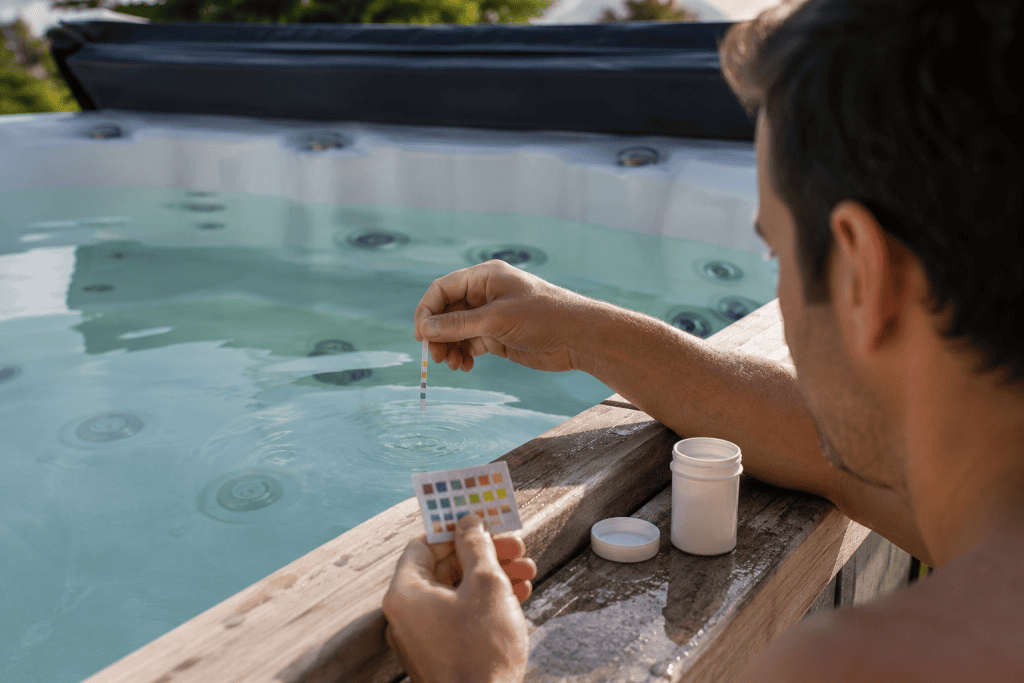
Strips are the simplest entry point — dip, wait the stated time, compare colors. Digital testers cost more upfront but remove the guesswork of reading strip colors under evening light, which is where a lot of people misjudge their readings on hot tub water chemistry basics and end up over-correcting.
Ongoing Maintenance Beyond Testing
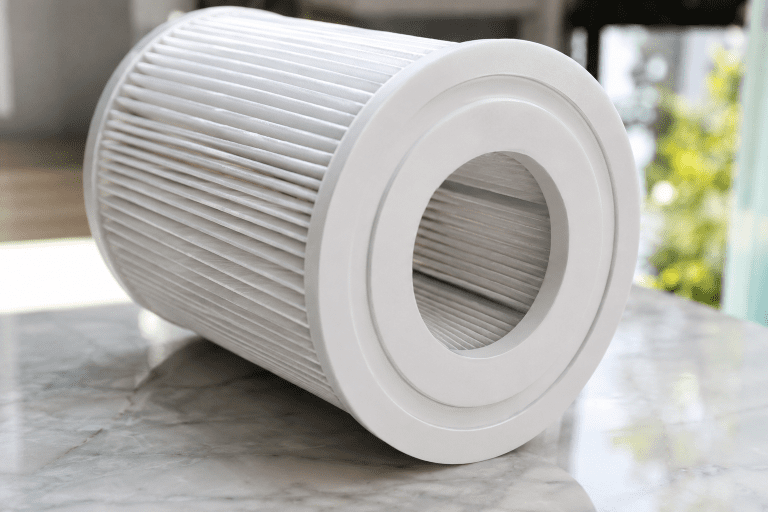
Testing tells you where the water stands, but hot tub water chemistry basics are only half the maintenance picture. Filters need rinsing every couple of weeks and a deeper clean monthly, since a dirty filter drags sanitizer efficiency down no matter how well you’re dosing chemicals. Covers deserve a wipe-down too — buildup on the underside drips back into the water every time it’s removed.
None of this replaces the core routine — filters and drains work alongside hot tub water chemistry basics, not instead of them. A full drain and refill every 3–4 months resets everything that gradual chemical dosing can’t fully clear — dissolved solids, built-up byproducts, and anything that’s accumulated in corners the filter doesn’t reach. Skipping this step is the single most common reason a well-tested tub still starts smelling off after a few months.
Pros and Cons of DIY Chemistry Management
Managing your own hot tub water chemistry basics keeps costs down and gives you direct control over water quality, which matters more once you’ve felt the difference between a properly balanced soak and one that leaves your skin tight and your eyes stinging afterward. It also takes a genuine time commitment, and the learning curve — reading strip colors accurately, understanding why pH swung after a rain top-up — trips up most new owners in the first month or two.
One thing worth being upfront about: even a perfectly tested tub can still cause mild skin dryness with very frequent use — a limitation chemistry alone doesn’t fully solve, easy to miss until it’s already happening.
Chemistry Management: Strips vs Digital Testers vs Professional Test
Getting hot tub water chemistry basics right long-term usually comes down to which testing tool you actually stick with, not which one is most accurate on paper — a $70 digital tester left in a drawer does nothing for you.
| Method | Cost | Accuracy | Best For |
|---|---|---|---|
| Test strips | $5–$10 per 50 | Good, color-judgment dependent | Quick daily/weekly checks |
| Digital tester | $30–$80 | High, removes color guesswork | Owners who test often or have trouble reading colors |
| Professional lab test | $10–$25 per test (pool store) | Highest, catches trace issues | Monthly deep-check or troubleshooting a persistent smell |
| Post-soak feel test | Free | Subjective but immediate | Catching chloramine buildup before the numbers even confirm it — stinging eyes or a sharp smell often shows up before a strip reading looks obviously wrong |
Helpful Gear
- Hot tub test strip kit — the fastest way to check sanitizer, pH, and alkalinity in one dip; look for a kit that covers all three readings, not just chlorine.
- pH increaser and decreaser combo — the two adjustments you’ll reach for most often once you know which direction your water tends to drift.
- Non-chlorine shock treatment — the fix for the chloramine problem covered above; worth keeping on hand rather than buying it only after eyes start stinging.
FAQ
Is it worth learning hot tub water chemistry basics if I only use my tub once or twice a week? Yes — hot tub water chemistry basics matter more with infrequent use, not less, since stagnant water between sessions gives bacteria and chemical breakdown more time to work unchecked. A twice-weekly tub still needs the same 2–3 tests a week that a daily one does.
How long does it take to notice if my water chemistry is off? Sanitizer and pH can shift within a day or two, especially after heavy use, rain, or a top-up with fresh water. Visible cloudiness or smell usually shows up faster than the numbers actually change, which is why testing before symptoms appear matters.
Can I mix different sanitizer types, like switching from chlorine to bromine mid-cycle? It’s possible but not ideal — mixing systems can throw off your baseline readings for a few days while the water re-stabilizes, so most owners are better off picking one system and sticking with it through a full drain cycle.
The simple rule for hot tub water chemistry basics: test before you soak, not after you notice a problem.
Summary Snapshot
- Track three numbers: sanitizer, pH (7.2–7.8), total alkalinity (80–120 ppm)
- Test 2–3 times weekly; more during heavy use
- Stinging eyes and chemical smell usually mean chloramines, not “too much” sanitizer
- Budget roughly $20–$40 monthly in chemicals for a standard tub
- Drain and refill every 3–4 months regardless of how well you’ve tested

Final Verdict
Hot tub water chemistry basics aren’t difficult once the routine is in place — it’s the first few weeks of learning what your specific tub, fill water, and usage pattern actually need that take the most effort. After that, it’s a five-minute habit that saves both money and the discomfort of soaking in water that isn’t properly balanced.
If you’re also working through the broader upkeep side, Saltwater vs Chlorine Hot Tub Maintenance: The Honest Comparison is worth reading alongside this one, since sanitizer choice changes how your chemistry routine actually plays out week to week. And if you’re weighing manual testing against a more automated water-safety setup, the way Cold Plunge Safety: Ice Bath vs Professional System — Which Actually Protects You Better? runs into a similar trade-off between hands-on control and convenience.
Browse Hot Tub Picks →
View Hot Tub Guides →
If you’re setting up a testing routine for the first time, it’s worth reading Saltwater vs Chlorine Hot Tub Maintenance: The Honest Comparison first, and pairing it with Must-Have Hot Tub Accessories: What Actually Makes a Difference for the testing and cleaning gear that makes the routine easier to stick with.