Which Is Cheaper to Install: Steam Room vs Sauna?
Is steam room or sauna cheaper to install? is the question I get asked more than almost anything else when people find out I use both regularly. And honestly, it’s the right question to ask — because the gap between what you expect to pay and what you actually pay can be significant either way.
I’m not going to give you a vague “it depends” answer and call it a day. Let me break down what I’ve learned from years of using both, including the costs most guides don’t mention until you’re already committed.
Quick note: Some links in this post are affiliate links. If you buy through them, I earn a small commission at no extra cost to you. I only link what I’d personally recommend.
Is Steam Room or Sauna Cheaper? Quick Snapshot
- Steam rooms typically cost $3,000–$6,500 installed for a prefab unit; custom builds run $8,000–$15,000+
- Traditional saunas range from $3,000–$8,000 installed; infrared saunas start lower at $1,500–$4,000
- Steam rooms carry higher long-term maintenance costs due to water chemistry and waterproofing demands
- Saunas are generally easier to install and cheaper to run month-to-month
- Both require a dedicated electrical circuit — typically 240V
- Space requirements differ: steam rooms need fully enclosed, waterproofed builds; saunas are more flexible
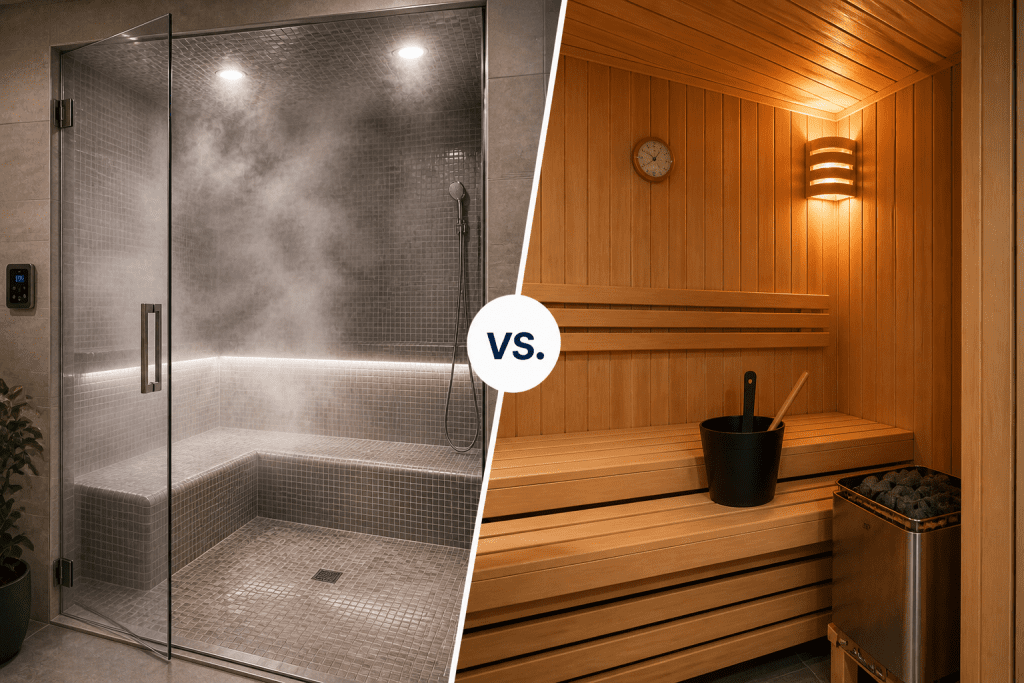
Table of Contents
- What You’re Actually Comparing
- The Real Cost of Installing a Steam Room
- The Real Cost of Installing a Sauna
- Installation Friction: Which Is Harder to Put In
- Maintenance: Where the Long-Term Costs Hide
- Pros and Cons
- Head-to-Head Comparison
- Comparison Table
- Helpful Gear
- FAQ
- Final Verdict
What You’re Actually Comparing
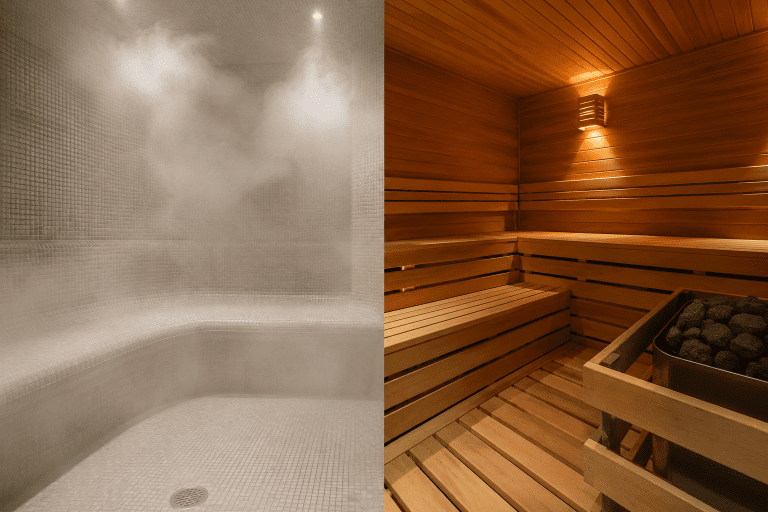
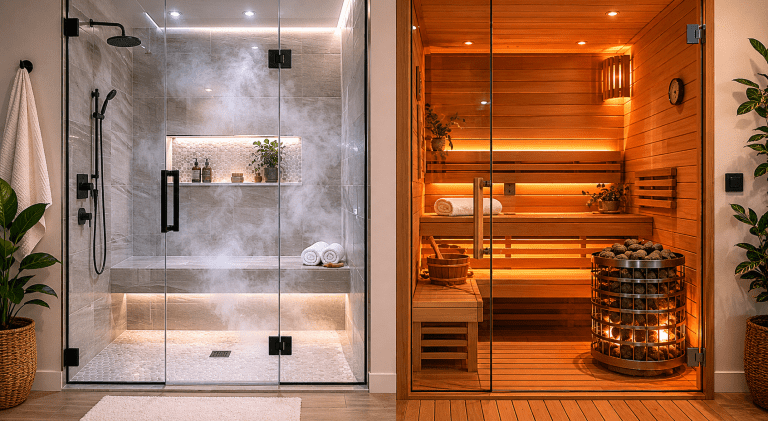
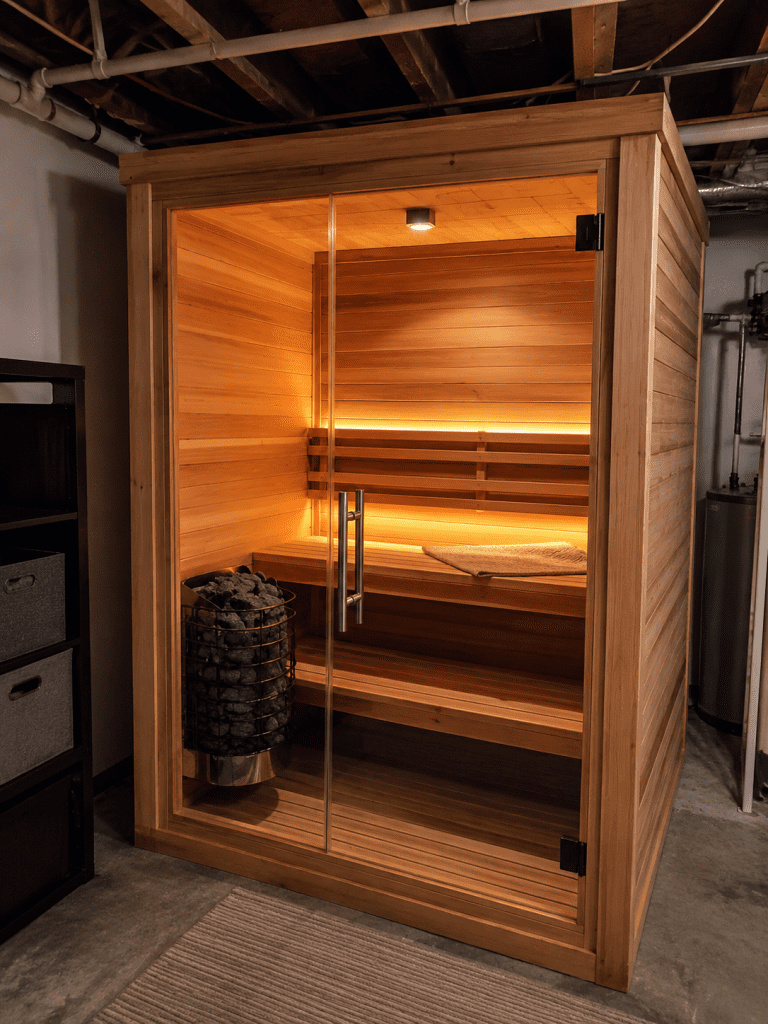
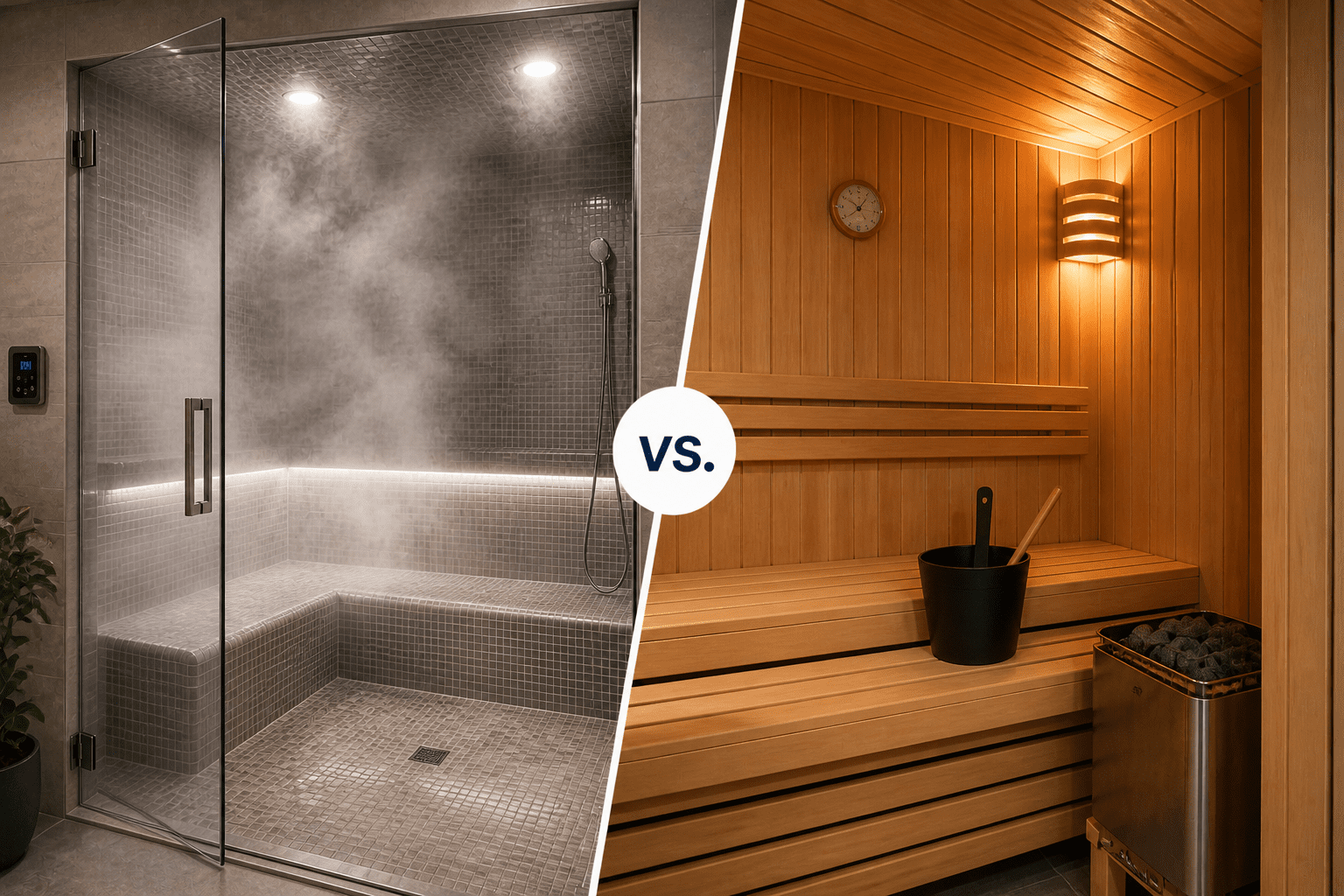
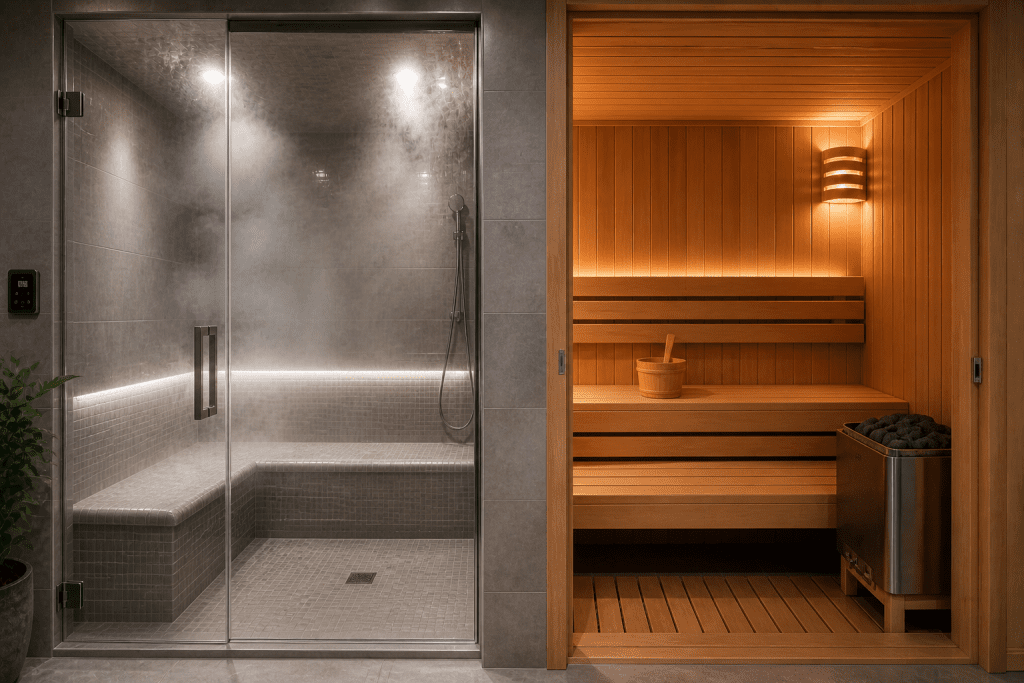
Before you can make sense of steam room vs sauna cost, you need to understand that these are fundamentally different builds — not just two versions of the same hot room. A steam room operates at lower temperatures (100–120°F) with near-100% humidity, generated by a steam generator pushing moisture through a completely sealed, waterproofed enclosure. A sauna runs hotter (150–195°F) with very low humidity, and relies on dry heat from either a traditional electric heater with rocks or an infrared panel system.
That difference in how each unit works is exactly what drives the cost difference at every stage. Steam rooms need waterproofed walls, floors, and ceilings that can handle constant moisture exposure. Saunas need wood that can tolerate dry, intense heat without warping or releasing harmful compounds. Neither is cheap to do properly — but the failure points, and therefore the costs, sit in completely different places.
When I started comparing steam room vs sauna cost in real terms, I realised most articles only cover the headline unit price. That’s the smallest part of the story.
The Real Cost of Installing a Steam Room
What does a home steam room cost to install? A prefab steam room kit — the enclosure plus generator — typically runs $3,000 to $6,500 for a unit sized for home use. Professional installation adds $1,500 to $3,500 depending on your existing bathroom setup and the complexity of the waterproofing required. Custom-tiled steam rooms built from scratch by a contractor can easily reach $10,000 to $15,000 or more. The generator itself is often $800 to $2,500 of that total, depending on output capacity.
The biggest hidden cost in steam room vs sauna cost comparisons is the waterproofing. Steam rooms require a fully waterproofed enclosure — membrane, tile adhesive rated for steam, grout sealed against moisture penetration, and a ceiling sloped to prevent condensation dripping. If any of that is done wrong, you’re looking at mould, tile failure, and structural moisture damage within a couple of years. Cutting costs here is how people end up with expensive remediation projects.
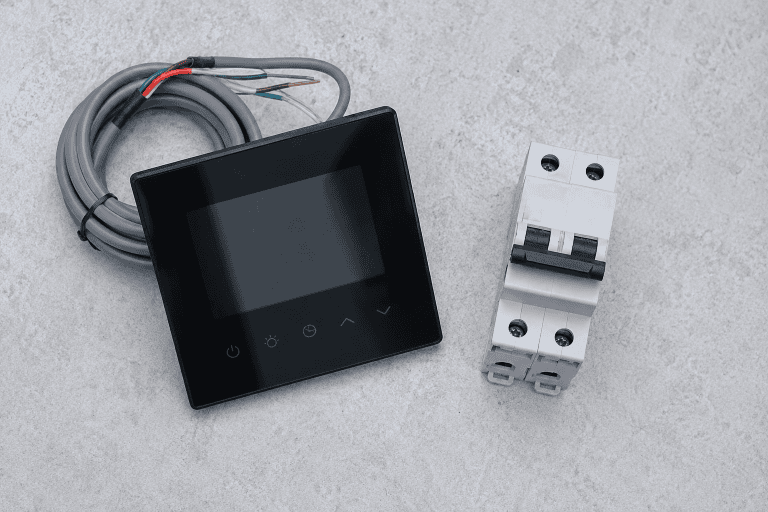
Electrically, a steam generator requires a dedicated 240V circuit. If your panel needs upgrading or the circuit run is long, that’s another $500 to $1,500 in electrical work before the unit even turns on. According to Healthline’s overview of steam room benefits, the cardiovascular and respiratory rewards of regular steam room use are well-documented — but none of that matters if the room itself fails structurally in year two.
The Real Cost of Installing a Sauna
Traditional electric saunas — the wood-lined room with a heater and rocks — typically run $3,000 to $8,000 installed for a prefab or kit-based home unit. Infrared saunas are often cheaper to purchase, starting around $1,500 to $2,500 for a quality two-person cabin unit, and they’re significantly easier to install because they plug into a standard 120V outlet in many cases. Custom-built traditional saunas with premium wood and a professional build start at $5,000 and can go well past $10,000.
When I compare steam room vs sauna cost at the install stage, saunas consistently come out ahead on simplicity. You’re not dealing with waterproofing membranes, moisture-rated tile systems, or sealed enclosures. You’re building a wood room with a heater. That doesn’t mean it’s trivial — but the list of things that can go wrong is shorter, and the failure modes are less catastrophic.
The wood choice matters more than most people realise. Cedar and hemlock are the go-to options — they handle the heat-dry-heat-dry cycle without warping or splitting. Cheaper wood selections create problems within a few years. A properly built sauna with quality wood will outperform a poorly specified one at twice the price.
Installation Friction: Which Is Harder to Put In
Is a steam room harder to install than a sauna? Yes — consistently. Steam room vs sauna cost doesn’t just show up in the purchase price. It shows up in the complexity of the install. A steam room demands a licensed contractor for the waterproofing work in most cases, a dedicated 240V electrical circuit, a proper drain, a sloped ceiling, and a ventilation plan that prevents moisture from migrating into adjacent walls. Miss any of those elements and you’ve got an expensive mould problem.
A sauna — particularly an infrared cabin unit — can often be assembled by a capable DIYer in a weekend. Prefab panels connect with a straightforward interlocking system, the heater drops into a fixed bracket, and the wiring is often as simple as a dedicated 240V plug. Traditional barrel or cabin saunas outdoors require ground preparation but not structural waterproofing.
Permit requirements add another layer to the steam room vs sauna cost calculation. Most jurisdictions require permits for electrical work involving new circuits, and some require permits for structural enclosures above a certain size. The Nolo guide on home improvement permits is worth checking before you start — getting caught without the right permits creates problems at resale. Factor in $100 to $600 for permits depending on your location and the scope of work.
Maintenance: Where the Long-Term Costs Hide
Which costs more to maintain — a steam room or a sauna? Steam rooms cost more to maintain, consistently. The steam generator needs descaling every three to six months depending on your water hardness. Hard water accelerates scale buildup inside the generator, reducing efficiency and eventually damaging the heating element. Descaling kits cost $15 to $40, but the process takes time and neglecting it shortens the generator’s lifespan. Generator replacement — when it eventually happens — runs $800 to $2,000.
The enclosure itself needs regular inspection for grout integrity, tile seal condition, and any signs of moisture penetration behind the tile. Regrouting or resealing every few years is normal maintenance. If moisture gets behind the tile, remediation costs can reach several thousand dollars.
Saunas are considerably lower maintenance in the steam room vs sauna cost picture over time. The wood needs occasional treatment — a sauna-specific oil or sealant — and the heater rocks should be inspected and rotated periodically. Rocks can crack after repeated heat cycling and need replacing every few years, which costs $30 to $80. The heating element itself is durable and often lasts 10 to 20 years with basic care. Monthly running costs for a sauna are also lower — dry heat is less energy-intensive than steam generation.
Pros and Cons
Steam Room
Pros
- Exceptional skin and respiratory benefits from consistent use
- Immersive heat experience at lower temperatures — more accessible for heat-sensitive users
- The genuine energised feeling after a session is something most people don’t expect — steam room vs sauna cost debates often ignore that the steam room delivers a different kind of recovery
Cons
- Higher installation cost, particularly for custom tile builds
- Waterproofing is unforgiving — mistakes are expensive
- Generator maintenance is ongoing and non-negotiable
- Running costs slightly higher due to steam generation
Sauna
Pros
- Simpler installation — especially infrared units
- Lower long-term maintenance burden
- Intense dry heat produces a deeper purging sensation — something I’d describe as more physically demanding but rewarding in a different way than steam
- Cheaper to run month-to-month
Cons
- Higher temperatures can be challenging for beginners
- Quality wood selection matters significantly — cheap builds show problems quickly
- Traditional saunas require 240V dedicated circuit regardless of format
Head-to-Head Comparison
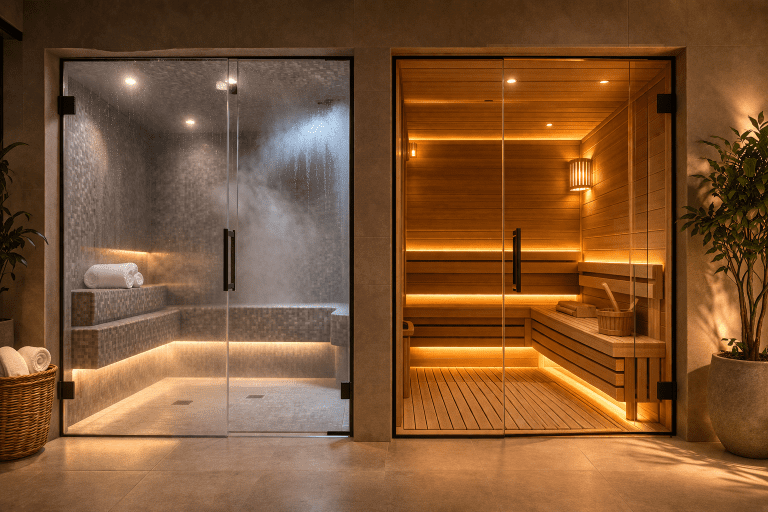
When I look at steam room vs sauna cost as a straight head-to-head, the sauna wins on installation simplicity and long-term running costs in most scenarios. An infrared sauna at the entry level can be installed and operational for under $3,000 all-in — something a steam room can rarely match once waterproofing and electrical work are included.
But steam room vs sauna cost isn’t the only variable worth weighing. If your priority is skin health, respiratory benefit, and that specific energised feeling after a session — which for me is genuinely one of the best parts of consistent steam room use — then the higher upfront cost can be a reasonable trade-off. The steam room is my personal favourite of the four categories I use regularly, and that preference has nothing to do with price.
If you’re considering adding a sauna to your setup, the range of options available at different price points is worth exploring — the Indoor vs Outdoor Saunas comparison covers the install angle from a different direction and is worth reading alongside this one. And if you’re thinking about contrast therapy to complement either option, Ice Plunge Safety is worth a read before you commit to a cold plunge setup alongside your heat source.
Comparison Table
| Factor | Steam Room | Sauna (Infrared) | Sauna (Traditional) |
|---|---|---|---|
| Entry-level unit cost | $3,000–$6,500 | $1,500–$2,500 | $3,000–$5,000 |
| Custom build cost | $10,000–$15,000+ | $3,000–$6,000 | $5,000–$10,000+ |
| Install complexity | High | Low–Medium | Medium |
| Electrical requirement | 240V dedicated | 120V or 240V | 240V dedicated |
| Waterproofing required | Yes — critical | No | No |
| Monthly running cost | Medium–High | Low | Low–Medium |
| Maintenance frequency | High | Low | Low–Medium |
| Permit likely required | Yes | Sometimes | Sometimes |
| Lifespan (well-maintained) | 10–15 years | 15–20 years | 20+ years |
Helpful Gear
If you’re installing either option, a few items make the process and ongoing maintenance considerably easier.
Digital Hygrometer and Thermometer Combo — useful for both steam rooms and saunas to verify that your unit is reaching target conditions.. A reliable reading tells you immediately if something’s off before it becomes a problem.
Steam Generator Descaling Solution — if you go the steam room route, descaling regularly is non-negotiable. Search . A quality product extends generator life significantly and keeps efficiency consistent.
Sauna Wood Treatment Oil — for traditional sauna owners, proper wood treatment every year or two prevents drying, cracking, and discolouration. Apply to benches and interior panels, not the area near the heater.
FAQ
Is a steam room or sauna cheaper to install overall? A sauna is almost always cheaper to install, especially at the entry level. An infrared sauna can be operational for $2,000 to $3,500 all-in including delivery and basic electrical work. A steam room rarely comes in under $4,000 once waterproofing, generator, and professional installation are included, and custom builds push significantly higher. If budget is the primary constraint, the sauna wins at every tier.
What are the hidden costs of a steam room vs sauna? For steam rooms, the hidden costs sit in waterproofing quality, generator maintenance, and descaling. A poorly waterproofed steam room will need remediation within a few years — that cost can exceed the original install price. For saunas, the hidden cost is usually wood quality and heater sizing. An undersized heater or low-grade wood will underperform and wear out faster than a properly specified build.
Do steam rooms and saunas both need a permit? Usually yes for the electrical work — any new 240V circuit typically requires a permit in most US jurisdictions. The enclosure itself may require a permit depending on size and whether it’s classified as a structural modification. Check your local building department before starting. Getting the permits right protects you at resale and ensures the work is done to code.
The simple rule: if you want lower upfront cost and simpler installation, start with a sauna — if you want the skin and respiratory benefits of steam and you’re prepared for a more involved build, the steam room investment pays off with consistency.
Summary Snapshot
- Steam rooms cost more to install and maintain than saunas in most scenarios
- Infrared saunas offer the lowest entry point — often under $3,000 all-in
- Custom steam room builds can reach $15,000+ when waterproofing and professional installation are included
- Both require dedicated electrical work — factor that into your total budget
- Maintenance costs favour saunas significantly over the long term
- The best choice depends on what you want from the experience — not just what costs less

Final Verdict
When it comes to steam room vs sauna cost, the honest answer is that saunas win on almost every financial metric — lower install cost, simpler build, cheaper to run, and less demanding to maintain year after year. If you’re working with a defined budget and want to get something excellent in place without a major contractor project, a quality infrared or traditional sauna will deliver.
But steam room vs sauna cost isn’t the whole conversation. The steam room experience is genuinely different — the humidity, the way it sits in your lungs, the skin effect that people comment on without you saying anything. That return on investment doesn’t show up in an installation quote. If you’re torn, think about what you actually want to feel when you step in — because the experience gap is real, and it matters more over time than the price difference at install.
If you’re weighing up your options, our guide to Steam Room Health Benefits covers what you actually gain from regular use. For a direct comparison, Steam vs Sauna breaks down the key differences beyond just cost.
If you’re considering adding a sauna to your setup, Indoor vs Outdoor Saunaslooks at the installation side from a practical angle. And if contrast therapy is part of your plan, Ice Plunge Safety is worth reading before committing to cold exposure alongside heat.