Steam Room vs Sauna Energy Costs: The Honest Numbers Before You Buy
Steam room vs sauna energy costs depend on the electricity each setup uses during warm-up and bathing, multiplied by your electricity rate. Neither system is automatically cheaper. At an illustrative $0.16 per kWh, a setup using 4 kWh per visit costs $0.64, or $19.20 for 30 visits.
I’ve used both regularly for years, and steam is my personal favorite. But enjoying the experience and knowing what a home installation would add to the electricity bill are different things. For that, you need to compare complete operating periods, including warm-up.
This guide compares home steam generators with traditional electric sauna heaters. Infrared cabins have different heating arrangements and should be assessed separately.
Affiliate disclosure: If you buy through an affiliate link on this site, Sunrise & Vitalize may earn a small commission at no extra cost to you. As an Amazon Associate, Sunrise & Vitalize earns from qualifying purchases.
Quick Snapshot
- Electricity cost = kWh consumed × your electricity rate.
- Include warm-up, bathing time and any powered drying cycle.
- A heater’s kW rating tells you its rated power, not exactly how much electricity a complete visit uses.
- At an illustrative $0.16/kWh, 4 kWh costs $0.64 and 6 kWh costs $0.96.
- At 30 visits per month, those examples cost $19.20 and $28.80.
- Neither steam nor sauna has a guaranteed running-cost advantage.
- Installation, water and maintenance costs are separate from these electricity figures.
How Steam Rooms and Saunas Use Electricity
A traditional electric sauna heater warms the stones, air, benches and surrounding surfaces. During warm-up, the heating elements may run continuously. Once the room approaches its set temperature, the controls regulate their operation to maintain the heat.
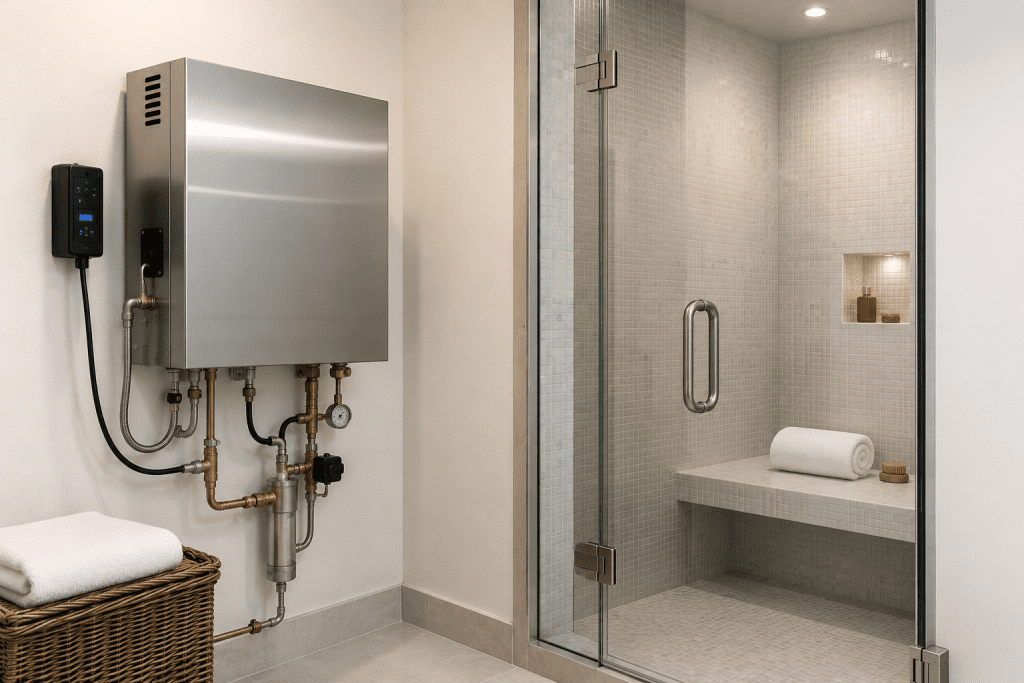
A steam generator heats water to produce steam. That steam transfers heat to the enclosure while maintaining high humidity. The generator’s output and electricity consumption depend on its controls, the selected temperature, room construction and operating time.
Both use electric resistance heating, but that does not make their running costs identical. You are heating different environments, with different surfaces, temperatures and heat losses.
Harvia’s energy-consumption guidance explains why multiplying a sauna heater’s rated power by the whole operating period can overestimate consumption: the elements cycle after warm-up.
The useful comparison is total kWh consumed for a complete visit.
How to Calculate Your Electricity Cost
Cost per visit = electricity consumed in kWh × electricity rate per kWh
Monthly electricity cost = cost per visit × visits per month
The examples here use $0.16/kWh as an illustrative rate, rather than the current US national average. Substitute the usage-based rate from your bill, including applicable delivery charges. Fixed charges you already pay generally do not increase because you add a sauna or steam session.
| Electricity per complete visit | Cost at $0.16/kWh | 20 visits | 30 visits |
|---|---|---|---|
| 3 kWh | $0.48 | $9.60 | $14.40 |
| 4 kWh | $0.64 | $12.80 | $19.20 |
| 4.5 kWh | $0.72 | $14.40 | $21.60 |
| 6 kWh | $0.96 | $19.20 | $28.80 |
These are calculations, not promises about what either system will consume. They exclude water, maintenance and installation. If your electricity costs $0.32/kWh, double the figures. If you have a time-of-use tariff, calculate each operating period using the applicable rate.
Worked Examples: Include Warm-Up
The easiest mistake is comparing an hour of sauna operation with 20 minutes inside a steam room. Those figures may describe different parts of the visit.
Traditional electric sauna example
Suppose a 6 kW heater draws its full 6 kW for 30 minutes of warm-up, then averages 3 kW over another 20 minutes while maintaining temperature.
- Warm-up: 6 kW × 30 ÷ 60 = 3 kWh
- Maintaining temperature: 3 kW × 20 ÷ 60 = 1 kWh
- Total: 4 kWh
- At $0.16/kWh: $0.64 per visit, or $19.20 for 30 visits
The average draw during bathing is an assumption for this example. Your heater’s controls and room conditions determine the actual figure. Any additional powered drying period must also be counted.
Steam room example
Suppose a 9 kW generator draws full rated power for a total of 40 minutes, including warm-up and bathing.
- Consumption: 9 kW × 40 ÷ 60 = 6 kWh
- At $0.16/kWh: $0.96 per visit
- For 30 visits: $28.80
If the generator cycles or reduces output during that period, consumption would be lower. If it runs longer, consumption increases. These examples explain the calculation; they do not establish that every sauna is cheaper than every steam room.
Five Factors That Change Your Running Costs
1. Your electricity tariff
The same 4 kWh visit costs $0.64 at $0.16/kWh and $1.28 at $0.32/kWh. Check your own bill before relying on a running-cost estimate. With a time-of-use tariff, the timing of warm-up matters as well as the timing of bathing.
2. Room construction and heat loss
Insulation, exposed surfaces, glass, door openings and ventilation affect how much heat the equipment must replace. Cold tile or stone can add to a steam room’s warm-up demand. A sauna with extensive glass or inadequate insulation can also require more energy than a smaller, well-insulated room.
Follow the manufacturer’s ventilation requirements. Restricting necessary airflow is not an appropriate energy-saving measure.
3. Starting temperature
A cold room needs energy to warm its surfaces before it becomes comfortable. Outdoor conditions, an unheated location and the time since the previous use can affect the starting temperature. Do not assume yesterday’s session leaves enough warmth to make today’s visit substantially cheaper.
4. Total equipment operating time
Warm-up consumes electricity before you enter. Leaving the equipment running afterward adds more. Count the complete powered period for your budget, while treating time spent bathing separately. A long warm-up is not a reason to extend heat exposure.
For readiness and warm-up differences, see Steam Room vs Sauna Heat Up Time.
5. Equipment sizing and controls
Choose equipment using the manufacturer’s sizing method, including adjustments for construction materials and glass. A higher kW rating does not automatically mean higher consumption per visit. A more powerful unit may warm the room faster, while an undersized unit may struggle to reach the selected temperature.
That does not mean bigger is always better. Correct sizing comes first. The guide to choosing a steam generator covers the relevant room and installation checks.
How Installation Affects Electricity Use
Installation influences running costs through insulation, exposed surfaces, ventilation and equipment sizing. A steam enclosure needs an appropriate waterproofing and vapor-control system. Tile and grout alone do not provide that protection. A traditional sauna also needs suitable construction and ventilation.
Electrical requirements depend on the selected equipment. Have a qualified electrician check the manufacturer’s requirements and the available supply.
For purchase prices and construction budgets, see the separate Steam Room vs Sauna Cost comparison. Keep those upfront costs separate from the electricity calculations here.
Maintenance and Running Costs
Maintenance belongs in your annual budget, but a fixed maintenance premium does not apply to every steam room. For a steam generator, follow the model’s instructions for water quality, draining, flushing and any descaling. Requirements vary with the equipment and local water conditions. Do not assume a generic descaler, water softener or distilled-water supply is appropriate.
Traditional sauna heaters need attention too. Stones can deteriorate and settle, affecting airflow through the heater. Harvia recommends maintaining sauna stones at least annually, with more frequent attention where needed. Follow your heater’s manual for inspecting, restacking and replacing deteriorated stones.
Record maintenance spending separately from electricity. That makes it easier to see whether a higher annual total comes from energy use, servicing or replacement parts.
Which Is Cheaper: Steam Room or Sauna?
There is no universal winner. A shorter warm-up can help reduce electricity consumption, but it does not settle the comparison. Generator or heater output, controls, room construction and total operating time can change the result.
There is also no universal 45-minute crossover at which sauna becomes cheaper than steam.
If one setup uses 4 kWh per complete visit and another uses 6 kWh, the difference at $0.16/kWh is $0.32 per visit. Across 30 visits, that is $9.60 per month. That is a useful calculation once you know consumption, rather than a general prediction for every steam room and sauna.

Comparison Table
| Factor | Steam room | Traditional electric sauna |
|---|---|---|
| Heating method | Generator heats water to produce steam | Heater warms stones, air and surfaces |
| What to compare | kWh for the complete powered period | kWh for the complete powered period |
| Warm-up demand | Depends on generator, enclosure and starting temperature | Depends on heater, room and starting temperature |
| Meaning of rated kW | Rated power, rather than measured consumption per visit | Rated power, rather than measured consumption per visit |
| Maintenance affecting performance | Model-specific water-quality and servicing requirements | Stone condition, arrangement and heater maintenance |
| Guaranteed cheaper option | None without comparable consumption figures | None without comparable consumption figures |
How to Measure Your Actual Consumption
For a hardwired sauna heater or steam generator, ask an electrician about a compatible circuit-level energy monitor. An ordinary plug-in electricity meter is not suitable for those hardwired circuits.
Measure several complete visits and record:
- Starting conditions
- Warm-up time
- Time spent bathing
- Any additional powered operating period
- Total kWh consumed
Add the recorded kWh and divide by the number of visits. Multiply that average by your electricity rate and expected monthly use. This gives you a more useful household estimate than assuming the equipment draws full rated power throughout every visit.
Frequently Asked Questions
Is a steam room or sauna cheaper to run?
Neither is always cheaper. Compare complete-visit electricity consumption, including warm-up, and multiply it by your tariff. Different room sizes and operating schedules can reverse the result.
How much would daily use add to my electricity bill?
At an illustrative $0.16/kWh, 4 kWh per visit costs $19.20 for 30 visits. At 6 kWh per visit, the equivalent cost is $28.80. Water, servicing and other costs are additional.
Does a 20-minute session mean paying for only 20 minutes of electricity?
No. Warm-up adds operating time before you enter, and any powered drying cycle adds more afterward. Equipment operating time and time spent bathing are different measurements.
Does a 9 kW generator always use 9 kWh per hour?
It would use 9 kWh if it drew 9 kW continuously for a full hour. Controls may cycle or stage the output, so measured consumption can be lower. Check the specific model rather than assuming continuous full-power operation.
Summary Snapshot
- Compare electricity consumption in kWh per complete visit.
- Include warm-up and any additional powered operating time.
- Use your own electricity tariff.
- Treat rated kW as a power rating, rather than a measured running cost.
- Neither system has a guaranteed cost advantage.
- Keep installation, water and maintenance separate from electricity.
Final Verdict
Steam room vs sauna energy costs depend on the equipment, enclosure and operating schedule. Before buying, compare correctly sized models and ask what any quoted consumption figure includes. After installation, measuring several complete visits gives you a practical average.
Multiply that average by your electricity rate and expected monthly visits. You then have a running-cost estimate that reflects your setup and habits.