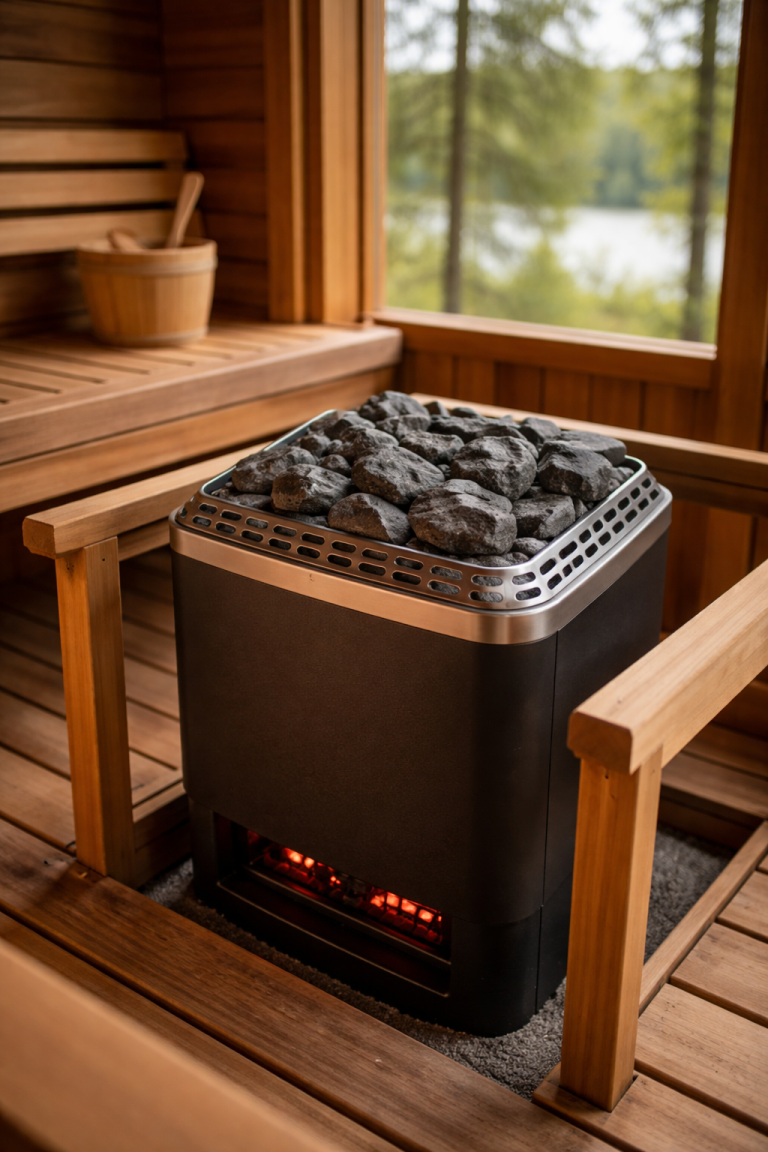

What Size Sauna Heater Do I Need for a 2 Person Sauna?
Choosing the right size sauna heater for a 2 person sauna starts with the room’s dimensions and construction—not its seating capacity. Measure the room, account for glass and other uninsulated surfaces, then choose a heater whose manufacturer-approved room-volume range covers your adjusted calculation.
An undersized heater may struggle to reach temperature. A heater rated for a larger room than yours can also be unsuitable, so check both the minimum and maximum room sizes before buying.
As an Amazon Associate, Sunrise & Vitalize earns from qualifying purchases. If you buy through an affiliate link, we may earn a small commission at no extra cost to you.
Quick Snapshot: Sauna Heater Size for a 2 Person Sauna
- Example room sizes: 4 × 4 ft to 4 × 6 ft with a 7 ft ceiling
- Volume of those examples: 112–168 cubic feet before adjustments
- Heater size: Match the adjusted room volume to the exact model’s approved range
- Key sizing factors: Glass, uninsulated surfaces, insulation and ceiling height
- Purchase budget: Check current US prices, including controls and stones where sold separately
- Installation budget: Get an electrician’s quote covering circuit work and any required permits
- Heat-up time: Depends on the heater, room construction, starting temperature and target temperature

Table of Contents
- How to Calculate the Right Heater Size
- Cost Reality: What You’ll Actually Pay
- Installation: What to Expect
- Maintenance and Long-Term Ownership
- Pros and Cons of Different Heater Types
- Comparison: 3 kW vs 4.5 kW vs 6 kW
- Comparison Table
- FAQs
- Simple Rule
- Summary Snapshot
- Final Verdict
How to Calculate the Right Heater Size
Measure the sauna’s interior length, width and height, then multiply them together. A room measuring 4 × 5 × 7 feet has a volume of 140 cubic feet.
Next, follow the heater manufacturer’s instructions for glass, masonry and other uninsulated surfaces. For example, Harvia adds 1.2 cubic meters of equivalent room volume for each square meter of glass, stone or similar uninsulated surface. That adjustment is specific to its sizing method; it is not a universal 25% increase.
Compare the adjusted volume with the exact heater model’s approved room-size range. Include ceiling height in your measurement, and check any separate minimum-height requirement. A glass door or outdoor location does not automatically mean you need a 6 kW heater.
Use the Harvia sauna calculator as a starting point when considering its heaters, then confirm the result against the selected model’s installation manual.
Traditional vs. Infrared: A Size Note
This calculation applies to traditional electric sauna heaters that heat rocks and produce steam. If you’re running an infrared sauna, the sizing logic is different — infrared heaters work by warming bodies directly rather than heating air volume, so the panel count and wattage guidance from the manufacturer matters more than cubic feet. Most 2-person infrared cabins come with pre-matched heaters and aren’t designed to be retrofitted.
If you’re also considering a steam shower, How to Choose a Steam Generator explains its separate sizing and installation requirements.
Cost Reality: What You’ll Actually Pay
People often get a pleasant surprise when they research heater costs — and then get an unpleasant one when they look at installation. Here’s how the numbers break down honestly.
Heater unit costs for a 2-person sauna:
Compare complete equipment packages rather than heater-only prices. Controls and stones may be included or sold separately. Check the exact model’s US voltage, approved room-size range, warranty and parts availability before comparing prices.
What drives the price up:
- Integrated digital controllers (vs. manual dials)
- Rock capacity — more rocks means longer, more stable heat
- Build material quality (stainless steel vs. aluminum body)
- Brand origin (European-made units carry a premium in the US market)
Electrical costs to operate:
Estimate electricity cost using heater power × equivalent full-power running time × your electricity rate. At an example rate of $0.16 per kWh, a 4 kW heater drawing full power for one hour costs $0.64; a 6 kW heater drawing full power for 90 minutes costs $1.44. Actual consumption varies because the thermostat cycles the elements. Include preheating time in your estimate.
For a fuller breakdown, see How Much Does It Cost to Run an Electric Sauna Heater?.
Installation costs:
Get a local electrician’s quote for the circuit, wiring, any panel upgrades and required permits. The cost depends on the selected heater, distance from the panel and work needed; a short circuit run and a major electrical upgrade are different projects.
Installation: What to Expect
Many traditional residential sauna heaters use a dedicated 240V circuit, but the exact electrical requirements depend on the model. Ask a licensed electrician to quote the circuit, wiring, panel work and permits needed for your installation. Distance from the panel and any required upgrades can substantially change the cost.
Mounting height and clearances are model-specific. Follow the installation manual’s distances from the floor, walls, benches and ceiling, including any required heater guard. Do not substitute a general clearance rule for the manufacturer’s diagram.
Have a licensed electrician confirm the required supply voltage, circuit, wiring and protective devices against the heater manual and applicable local requirements.
Before ordering, read Can My Electrical Panel Handle a Sauna Heater? for the panel-capacity questions to discuss with your electrician.
Install controls and temperature sensors only in the locations approved for that model. Some heaters have built-in controls; others require a separate controller. Sensor position is part of the safety system and should not be changed for convenience.
If you’re deciding between an indoor vs. outdoor sauna setup and how that affects your installation complexity, the Indoor vs. Outdoor Sauna Guide is a useful reference.
Maintenance and Long-Term Ownership
Sauna heaters are genuinely low-maintenance compared to most home appliances — but “low maintenance” doesn’t mean “zero maintenance.”
Inspect and rearrange the stones at least annually, or more often if the manual or frequency of use requires it. Replace cracked or crumbling stones and remove debris according to the manufacturer’s instructions. Use only approved sauna stones in the specified size and quantity.
Harvia recommends annual stone maintenance, with replacement depending on use and condition.
Keep the heating elements clear. Crumbled rocks, dust, and debris can accumulate around the heating elements over time. A quick inspection every few months and a light clean-out keeps the heater running efficiently and safely.
Leave electrical connections and internal electrical servicing to a qualified electrician. Stop using the heater if you notice damaged wiring, burning smells or repeated breaker trips.
Heater lifespan varies with use, installation, maintenance and replacement-parts availability. Check the warranty and availability of elements and controls rather than assuming a particular brand will last a fixed number of years.
Pros and Cons of Different Heater Types for a 2 Person Sauna
Electric Stone Heaters (Traditional)
Pros:
- Authentic sauna experience with löyly (steam from water on rocks)
- Wide range of sizes and wattages available
- Easily replaceable components
- Long lifespan when quality brands are used
Cons:
- Usually needs a dedicated 240V circuit
- Needs preheating before use; time varies by heater and room
- Ongoing rock replacement needed
- Higher installation cost if 240V line not already in place
Wood-Burning Heaters (Kiuas)
Pros:
- No electrical requirements — works off-grid
- Extremely authentic, traditional heat quality
- Long lifespan — mechanical simplicity means little to fail
Cons:
- Requires chimney/flue installation (major additional cost)
- Not practical for most indoor residential saunas
- Requires dry, seasoned firewood of the type the manufacturer specifies
- Slower, less controllable heat management
Infrared Panels
Pros:
- Lower upfront installation cost
- Works on standard 120V circuits in many cases
- Heats bodies directly — some users feel benefit at lower air temperatures
Cons:
- No traditional steam/löyly experience
- Different heat sensation — preferred by some, disliked by others
- Cabin-style units not easily retrofitted with different panel configurations
Comparison: 3 kW vs 4.5 kW vs 6 kW
3 kW: Consider this only when the exact model’s approved room-volume range covers your adjusted sauna volume.
4.5 kW: Compare suitable models against your measured room and construction. Seating capacity alone does not establish whether this wattage is right.
6 kW: Consider this when the adjusted volume requires it and the room also meets the model’s minimum-volume requirement. An extra occupant is not a reason by itself to increase heater power.

Comparison Table
| Heater Size | When to Consider It | Main Sizing Check | Before Buying |
|---|---|---|---|
| 3 kW | A small cabin within the model’s approved range | Account for glass and uninsulated surfaces before choosing | Confirm voltage, clearances and required controls |
| 4.5 kW | A cabin whose adjusted volume fits the model’s range | Two-person seating capacity alone does not establish suitability | Check whether controls and stones are included |
| 6 kW | A cabin whose adjusted volume calls for this output | Check both the minimum and maximum approved room volumes | Confirm electrical requirements and installation cost |
| What seating capacity misses | Two cabins seating two people can need different heaters | Dimensions, glass and construction determine the sizing | Use the exact model’s manual rather than a universal wattage rule |
Choose the heater model after completing the sizing calculation. Before buying, confirm its approved room-volume range, US electrical requirements, required controls, included stones, warranty and replacement-parts support.
Premium brands like Harvia and Finlandia are available through specialist sauna retailers .
Frequently Asked Questions
Can I use a 240V sauna heater on a 120V circuit?
No. Connect the heater only to the supply specified on its rating plate and installation manual. If your available supply does not match, ask a licensed electrician about the required work or choose a heater specifically designed for that supply.
What happens if I oversize the heater for my sauna?
Choose a heater whose approved room-volume range includes your adjusted sauna volume. A higher wattage is not automatically better, and a room below the model’s minimum size may be unsuitable. Confirm the sizing with the manufacturer before buying.
Do I need a permit to install a sauna heater?
Permit requirements depend on your local jurisdiction and the work involved. Ask your electrician and local building department what permits and inspections are required before installation.
The Simple Rule
Measure the room, apply the manufacturer’s construction adjustments, and choose a model approved for that adjusted volume. Do not size by seating capacity alone.
Summary Snapshot
- Room volume: Measure interior length × width × height.
- Sizing adjustments: Account for glass and uninsulated surfaces using the manufacturer’s method.
- Heater selection: Check the exact model’s minimum and maximum approved room volumes.
- Installation: Confirm electrical requirements, clearances, controls and stones.
- Budget: Check current equipment prices and obtain an electrician’s installation quote.
- Maintenance: Follow the manufacturer’s inspection, cleaning and stone-replacement guidance.
Final Verdict
The right heater for a two-person sauna is the one approved for its adjusted room volume and construction. Start with accurate measurements, account for heat-loss surfaces, and confirm the exact model’s installation requirements before buying.
Compare the complete purchase cost, warranty and parts support once you have identified suitable models. Neither a blanket 4.5 kW default nor an automatic upgrade to 6 kW replaces that check.
If you want to go deeper on sauna heater specs, controls, and brand comparisons before committing, the full guide is below