Sauna vs Steam Room Small Spaces: Which One Actually Fits?
If you’re working with a spare bathroom, a converted closet, or a corner of a basement, the sauna vs steam room small spaces question isn’t academic — it’s the deciding factor between a project that works and one that doesn’t.
Both can fit in tight quarters. Neither is automatically the better choice. The real answer depends on how your space is built, what your walls are made of, and what you actually want to feel when you come out the other side.
I’ve used both regularly for years and have a clear preference — but the honest answer is it’s not the same for everyone.
Disclosure: Sunrise & Vitalize uses affiliate links. If you buy through them, we may earn a small commission at no extra cost to you. We only recommend products we’d actually use.
Quick Snapshot
- A barrel sauna or prefab indoor sauna can fit in as little as a 4×4 ft footprint
- A steam generator for a small shower enclosure typically runs $500–$1,500 installed
- Steam rooms require fully waterproofed, sealed enclosures — a standard tiled shower does not qualify without modification
- Saunas need dry, ventilated space; steam rooms need wet-rated construction throughout
- Running costs differ: a sauna heater draws 3–8 kW per session; a steam generator typically 2–7.5 kW
- For truly tiny spaces (under 40 sq ft), a steam shower conversion is often more practical than a standalone sauna build
- Both options produce real, measurable wellness results — this decision is about logistics, not outcomes
![sauna vs steam room small spaces comparison in compact home installation]](https://sunriseandvitalize.com/wp-content/uploads/2026/05/Sauna-vs-Steam-Room-Small-Spaces-768x1024.png)
Table of Contents
- What Actually Fits in a Small Space?
- The Real Cost Difference for Compact Builds
- Installation Friction: 5 Things That Catch People Off Guard
- Maintenance in Tight Quarters
- Honest Pros and Cons for Each
- Head-to-Head Comparison
- Comparison Table
- Helpful Gear for Small Space Builds
- FAQs
- Final Verdict
Sauna vs Steam Room Small Spaces: What Actually Fits in a Small Space?
When people think about the sauna vs steam room small spaces debate, the assumption is usually that steam rooms win on footprint because they can be built into an existing shower. That’s partly true — but it misses some important caveats.
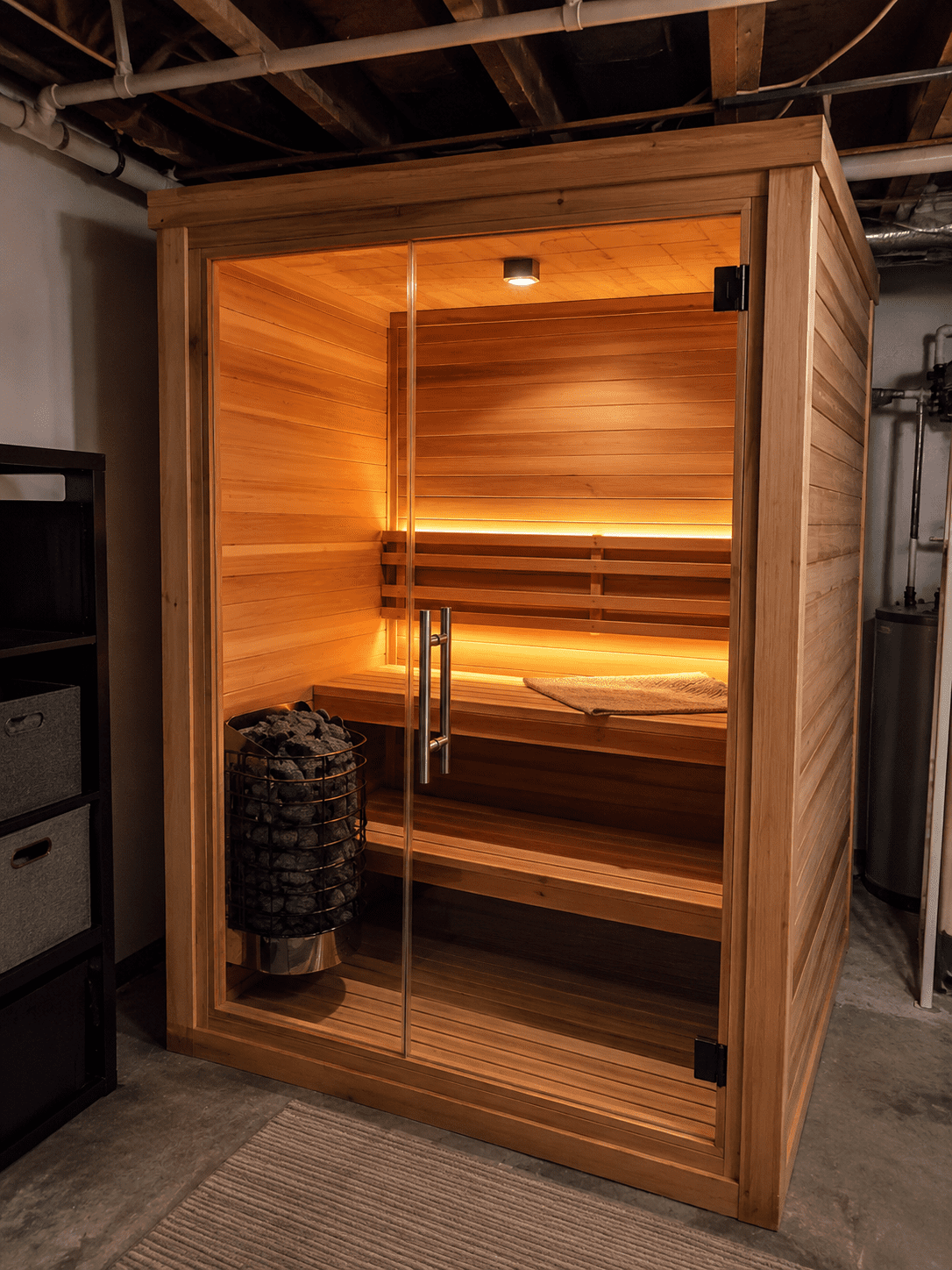
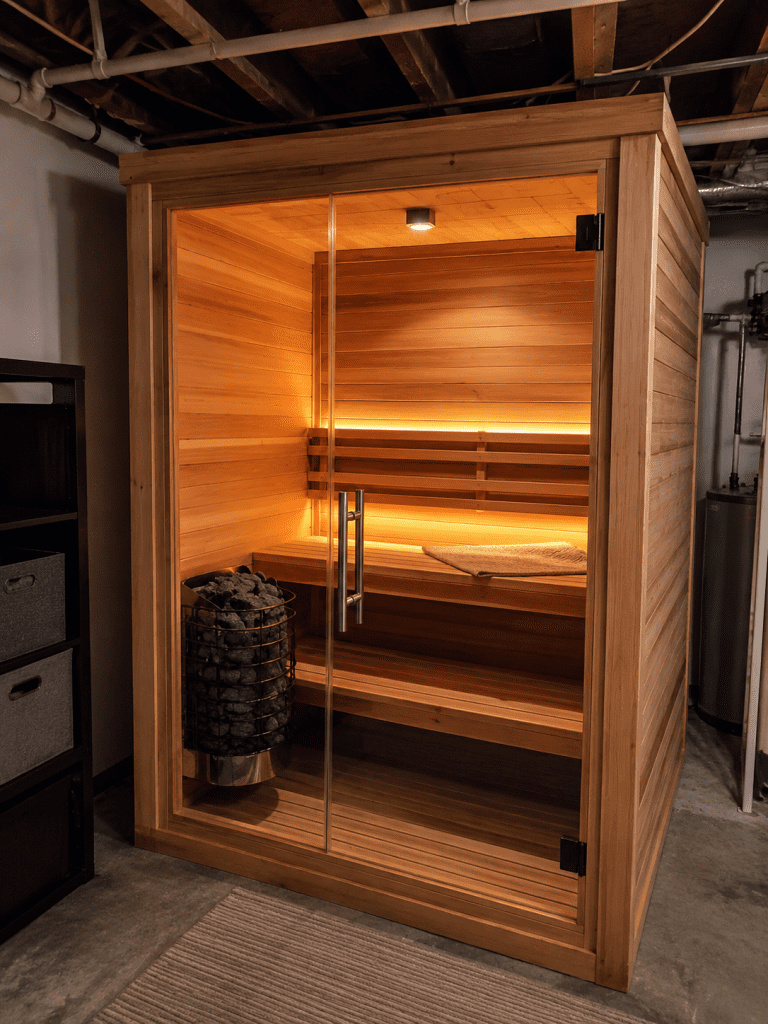
A traditional sauna needs a minimum of roughly 4×4 feet of interior floor space to be usable. That’s enough for one person sitting on a bench with adequate clearance from the heater. Prefab sauna kits are specifically built for these dimensions and are available in hemlock, cedar, and spruce — all in modular panels that can be assembled in a basement, garage corner, or spare room without major construction. The sauna vs steam room small spaces comparison starts here because many people don’t realise how compact a real sauna can actually be.
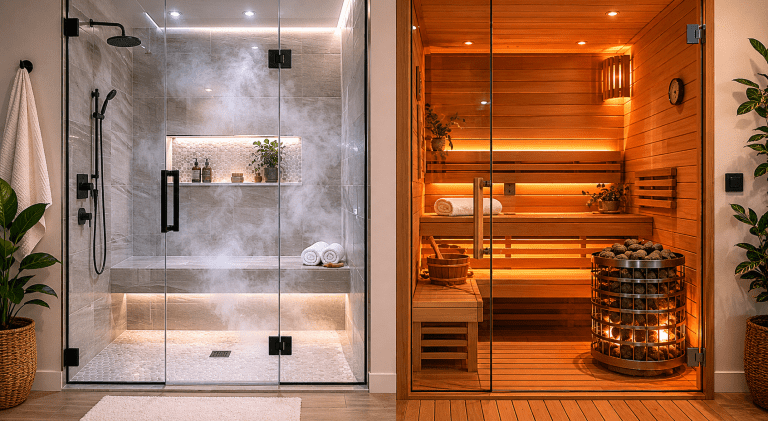
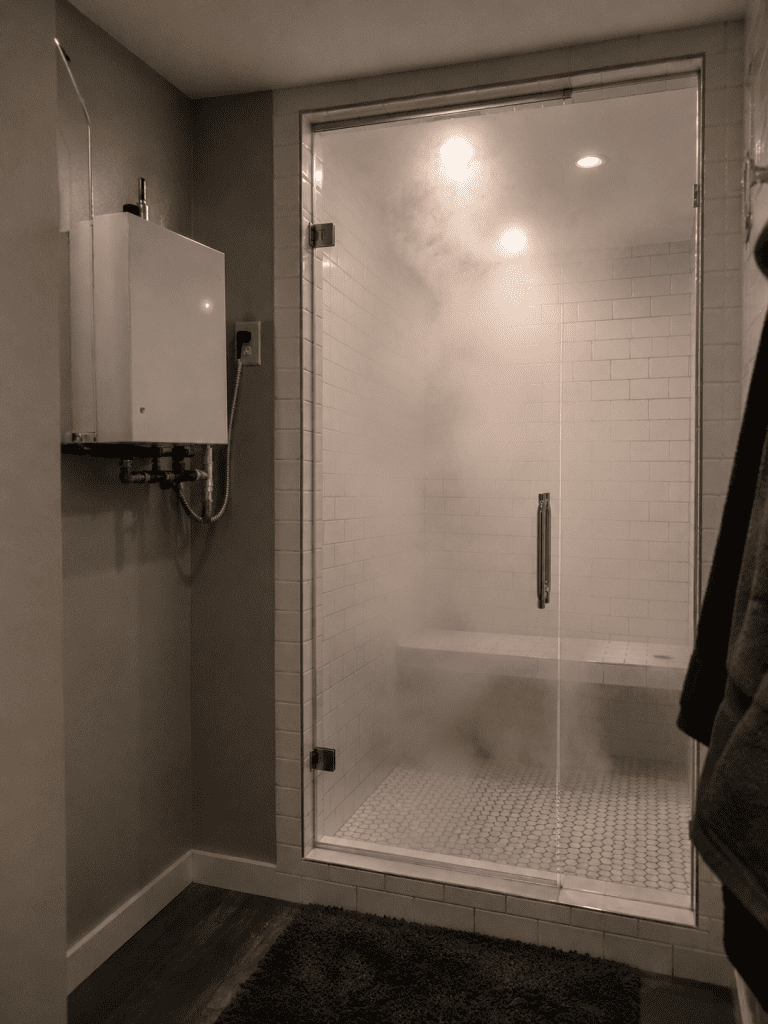
A steam room, by contrast, can technically fit into a shower enclosure as small as 3×3 feet. The steam generator itself is wall-mounted or installed remotely — in a nearby cabinet or under a vanity — so it doesn’t consume floor space inside the enclosure. What it does consume is your entire wall and ceiling construction. This is where the real space conversation shifts: it’s not about square footage, it’s about what your walls are made of.
What’s the minimum space needed for a home sauna? A one-person prefab sauna can work in as little as 4×4 feet of interior space, with ceiling height of at least 7 feet. Wall clearance from the heater is typically 6–12 inches depending on the unit. The overall room footprint including bench, heater, and movement space comes in at around 16–25 sq ft for a solo setup.
The Real Cost Difference for Compact Builds
For the sauna vs steam room small spaces decision, cost is not always what people expect. A prefab indoor sauna kit — a proper one, not a portable tent — starts around $1,200 to $2,500 for a one- or two-person unit. Add professional electrical installation for a 240V circuit and you’re looking at a total of $1,500 to $3,500 depending on your existing wiring.
A steam generator for a shower conversion starts lower — around $300 for entry-level residential units — but the real cost is the enclosure work. A standard tiled bathroom shower is not a steam room. The ceiling needs to be sloped (usually 2 inches per foot minimum) so condensation runs to the walls rather than dripping directly onto you. All surfaces need to be fully waterproofed with a steam-rated membrane behind the tile. The door needs a proper seal rated for steam. When you add up the generator, the waterproofing, the slope work, and a quality door, a properly built steam shower conversion typically runs $1,800 to $5,000+, depending on how much of the enclosure is already close to spec.
The cost comparison for the sauna vs steam room small spaces debate often surprises people. Saunas look expensive upfront, but their installation requirements are simpler — dry walls, a ventilated space, and an electrical circuit. Steam rooms look cheaper because people price only the generator, not the enclosure work behind it. For the full numbers side by side, see our Steam Room vs Sauna Cost breakdown.
Installation Friction: 5 Things That Catch People Off Guard
1. Sauna clearance requirements are non-negotiable In a sauna vs steam room small spaces context, the most common sauna installation mistake is underestimating heater clearance. Manufacturers specify minimum distances from the heater to any wood surface. Go under that, and you’re creating a fire risk, not a relaxation space. In a compact build, that 6–12 inch clearance from each wall genuinely limits how small you can go.
2. Steam room ceilings must slope This is the one almost no beginner guide covers in enough detail. In a compact steam shower, the ceiling has to slope toward the walls — not lie flat. A flat ceiling collects condensation and drips straight down. If you’ve ever sat in a poorly finished steam room, you’ll know exactly what this means: random cold drips landing on your shoulders mid-session. It kills the experience and it’s entirely preventable with the right ceiling pitch during construction.
3. Electrical requirements for saunas in tight spaces Most sauna heaters — even compact 3 kW units — require a dedicated 240V circuit. If your spare room, basement corner, or converted closet doesn’t have an electrical panel nearby, that adds to the job. Per Energy.gov guidance on electric resistance heating, correct circuit sizing matters for both efficiency and safety.
4. Steam room waterproofing goes all the way up The waterproof membrane doesn’t just go behind the tile at floor level. It goes behind every tiled surface — walls, ceiling, and the transition points where they meet. Missing any joint in a compact space leads to moisture penetration into the structure behind the tile. In a small space that’s used regularly, this causes damage faster than it would in a larger room simply because the steam is more concentrated.
5. Ventilation for saunas is often forgotten A sauna needs air exchange — a small vent near the floor for fresh air intake and an exit vent near the ceiling. In compact builds, people sometimes skip this entirely to save the construction step. The result is stale, oxygen-depleted air that makes sessions feel suffocating rather than restorative. It’s a small detail that has a significant effect on the experience.
Maintenance in Tight Quarters
For the sauna vs steam room small spaces comparison, maintenance is where the differences really add up over time.
A compact sauna is relatively low maintenance. The wood interior needs occasional cleaning — warm water, mild soap, no harsh chemicals. Sauna benches and backrests should be wiped down after sessions. In a tight space with regular use, the wood will develop a patina over time, and light sanding every year or two keeps it from discolouring. The heater itself — if electric — requires minimal attention beyond occasional stone replacement every few years. The sauna vs steam room small spaces maintenance gap favours saunas here.
A compact steam room requires consistent attention. The generator needs descaling on a schedule that depends on your local water hardness — in areas with hard water, every 3–4 months is realistic. The enclosure tile needs regular grout cleaning; steam and warmth accelerate mould growth in any joint that isn’t perfectly sealed. The door seal degrades faster in small, frequently used spaces and typically needs replacement every 2–3 years. None of this is unmanageable, but it is more ongoing work than a sauna demands.
The honest reality for the sauna vs steam room small spaces decision: if you’re building in a tight space and won’t be meticulous about monthly cleaning, a sauna ages better.
Honest Pros and Cons for Each
Sauna in a Small Space
Pros:
- Prefab kits are purpose-built for compact footprints
- Dry heat — no waterproofing requirements, simpler installation
- Lower ongoing maintenance
- The wood bench environment has a particular feel — grounded, warm, quiet — that’s genuinely hard to replicate
- No condensation issues if properly ventilated
Cons:
- Needs a dedicated 240V circuit regardless of size
- Heater clearance limits how small you can realistically go
- The bench gets hot enough to be uncomfortable without a mat — a sauna mat isn’t optional in a compact build where your knees and legs are closer to the heater than they would be in a commercial space
- Takes 15–30 minutes to reach temperature before a session
Steam Room in a Small Space
Pros:
- Can be retrofitted into an existing shower enclosure
- Generator is remote-mounted — no floor space used inside
- Reaches temperature in 5–10 minutes
- The skin effect is real — consistent use produces visible results that other people actually notice, not something wellness sites invented
Cons:
- Requires complete enclosure waterproofing — not a DIY shortcut situation
- Ceiling slope is non-negotiable; skipping it makes the space unpleasant to use
- Generator descaling and tile maintenance is ongoing
- The humidity means any organic material in or near the enclosure (wood trim, unsealed grout, standard drywall behind the membrane) degrades faster than in a dry sauna
Industry-undersold con: Steam room installation guides almost universally understate the enclosure work. Most people budget for the generator and the tile. They don’t budget for the waterproofing membrane, the slope ceiling construction, and the steam-rated door. By the time the full job is done in a small space, the “cheaper option” often isn’t.
Head-to-Head Comparison
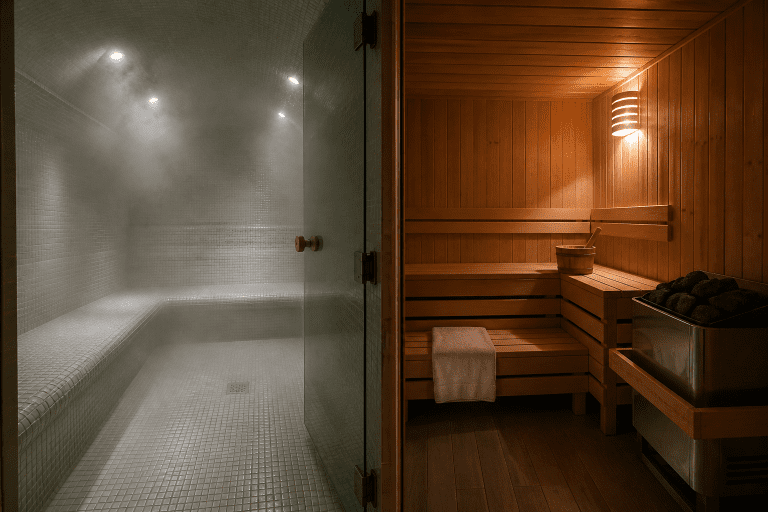
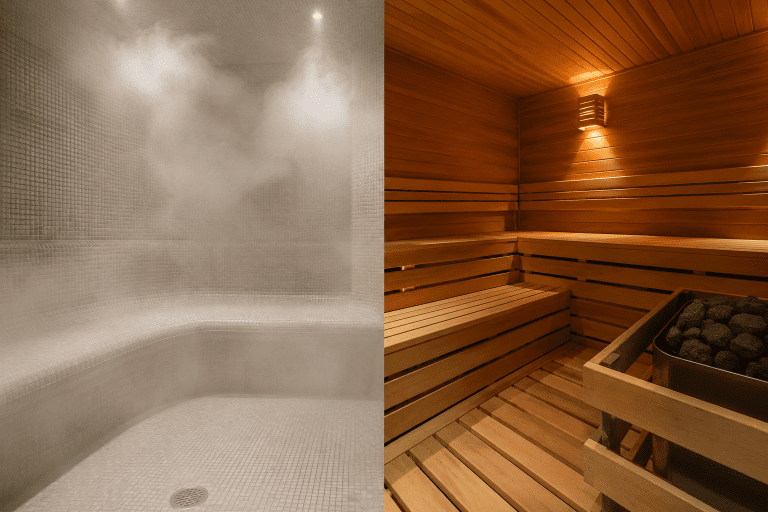
On pure footprint, the sauna vs steam room small spaces comparison is closer than most people assume. A 4×4 sauna and a 3×4 steam shower aren’t dramatically different in floor area. The meaningful differences are about construction type, not square footage.
If your small space is already tiled — a bathroom, a corner of a wet room, an existing shower enclosure — a steam conversion makes more practical sense. For a full breakdown of which build is genuinely harder to pull off, see Steam Room vs Sauna Installation. You’re working with a surface that’s already water-resistant, and the generator can be installed nearby without touching the enclosure itself.
If your small space is a converted room — a basement corner, a spare bedroom section, a garage partition — a prefab sauna is almost always simpler. You’re installing modular panels into a dry space, wiring a circuit, and you’re done. No waterproofing membrane, no ceiling slope work, no steam-rated door.
The sauna vs steam room small spaces decision ultimately comes down to what your space already is, not which option is better in the abstract.
Which heats up faster in a small space? A steam generator in a properly sealed small enclosure reaches comfortable temperature in roughly 5–10 minutes. A sauna heater in a compact space typically takes 15–30 minutes. If session spontaneity matters to you, steam wins this comparison clearly. See our full Steam Room vs Sauna Heat Up Time comparison for the details.
Comparison Table
| Factor | Sauna (Small Space) | Steam Room (Small Space) |
|---|---|---|
| Minimum footprint | ~4×4 ft interior | ~3×3 ft enclosure |
| Construction type | Dry — modular panels | Wet — full waterproof enclosure |
| Heat-up time | 15–30 minutes | 5–10 minutes |
| Ongoing maintenance | Low | Medium-high |
| Electrical requirement | Dedicated 240V circuit | 240V or 120V (generator dependent) |
| Post-session skin effect | Mild drying | Noticeable hydration with regular use |
| Condensation management | Ventilation only | Sloped ceiling required |
| Average installation cost | $1,500–$3,500 | $1,800–$5,000+ |
| Smell/sensory experience | Warm cedar/wood scent | Neutral or eucalyptus-optional |
| How you feel walking out | Deeply relaxed, slightly drained | Energised, skin feels conditioned |
Helpful Gear for Small Space Builds
Sauna backrest -In a compact sauna, your back sits closer to the wall than in a commercial space. Without support, you end up hunching forward or cutting the session short. This wooden S-shape backrest keeps your spine off the hot wall and lets you actually relax into the heat. Natural pinewood, slip-resistant, fits barrel and infrared saunas.
Sauna thermometer and hygrometer -In a compact space, temperature and humidity fluctuate more noticeably than in a larger room. Knowing your exact conditions lets you get the most from each session without guessing. This combo unit covers both sauna (temperature only) and steam room (temperature and humidity).
FAQs
Is a steam room actually worth it if my shower is already small? If your existing enclosure is under 35 square feet and already tiled, a steam conversion is one of the most practical wellness upgrades you can make to a small bathroom. The generator is remote-mounted, so no floor space is lost. The ceiling slope work is the main added complication — and it’s genuinely worth doing correctly. A steam room in a small shower feels noticeably more effective than a large one because the steam concentrates faster. The sauna vs steam room small spaces cost equation works in steam’s favour here when you already have the enclosure.
Can a sauna actually fit in a spare bedroom or basement corner? Yes — reliably. Prefab kits in 4×4 and 4×6 configurations are specifically designed for residential installs in non-dedicated spaces. The main requirements are ceiling height (at least 7 feet), a dry environment, adequate ventilation (two small vents), and a 240V dedicated circuit. If you’re considering this, the Steam Room Health Benefits and Steam vs Sauna posts in this cluster cover the wellness outcomes in more detail if that’s driving the decision.
Will I actually use it, or will it just sit there? This is the real question. The honest answer is that frequency follows ease of access. A steam room built into your existing shower means zero setup — you turn the generator on before you undress and it’s ready by the time you step in. A sauna with a 20-minute warm-up requires planning. If your lifestyle is unpredictable, steam wins on usability. If you’re the type to schedule sessions and stick to them, a sauna’s deeper heat is worth the warm-up time. Both produce real results — consistency is the variable that determines outcome, not which option you chose.
You can read more about cold exposure pairings and session structure in our Cold Plunge vs Cold Shower post if you’re thinking about contrast therapy alongside your build.”
The honest rule: build for the space you have, not the option that sounds better on paper.
Summary Snapshot
- Small sauna: minimum 4×4 ft, dry build, 240V circuit, $1,500–$3,500 installed
- Small steam room: can use an existing shower enclosure, requires full waterproofing and sloped ceiling, $1,800–$5,000+
- Steam heats faster (5–10 min vs 15–30 min)
- Sauna requires less ongoing maintenance
- Steam room built into an existing tiled shower is the most space-efficient option overall
- Sauna built into a dry converted room is simpler and lower-risk for non-tiled spaces
- Both work — the right answer is determined by what your space already is
Final Verdict
For the sauna vs steam room small spaces decision, there is no universal winner — but there is a logical framework. If you have a tiled enclosure already, convert it to a steam room. If you have a dry room to convert, build a prefab sauna. The construction requirements are what make the decision, not the wellness outcomes, which are comparable between the two.
What I’d add from genuine experience: the steam room is harder to build correctly in a small space, but when it’s done right, it’s exceptional. The fact that the steam concentrates in a compact enclosure means you feel it faster and the skin effect builds more noticeably than in a commercial-sized space.
If you do choose the sauna vs steam room small spaces route and go sauna, don’t underestimate the mat — in a small enclosure the bench and wall proximity makes protection mandatory, not optional. For more on how the two compare across health benefits and session experience, Steam vs Sauna series covers that ground in detail. If you want to understand cold exposure as a complement to either build, the Steam Room Health Benefits post is the natural next read.
The sauna vs steam room small spaces answer is almost always in your walls.