Wall Mounted vs Floor Sauna Heaters: Which Is Better?
Wall mounted vs floor sauna heaters — that’s the question that trips up more first-time sauna buyers than almost any other decision in the setup process.
And honestly? It makes sense that it’s confusing. Both types heat your sauna. Both have loyal fans. But they behave differently, install differently, cost differently, and suit different sauna builds. Getting this wrong doesn’t just cost money — it can make your sauna feel uncomfortable every single session.
As an Amazon Associate, Sunrise & Vitalize earns from qualifying purchases. If you buy through an affiliate link, we may earn a small commission at no extra cost to you.
Quick Snapshot
- Wall-mounted heaters can save floor space but still need safety clearances.
- Floor-standing heaters need room for their footprint and clearances.
- Stone capacity varies by model, not just mounting style.
- Heat-up time and steam depend on power, stones and room construction.
- This comparison covers electric heaters; wood-burning models have different requirements.
- Choose using the manufacturer’s room-volume range and your sauna layout.
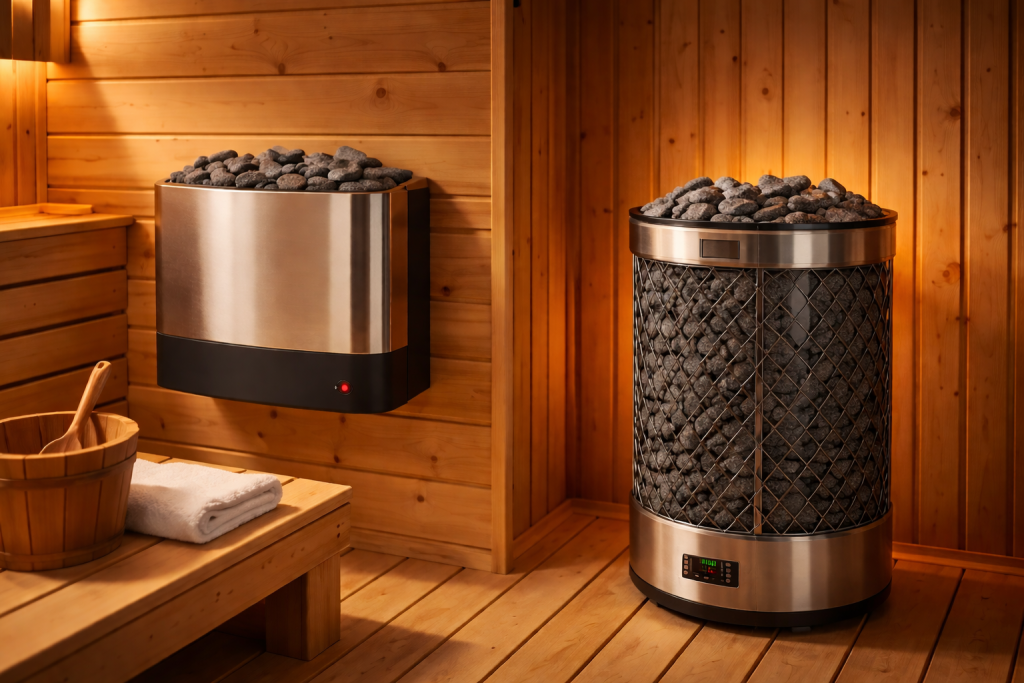
Table of Contents
- What’s Actually the Difference?
- Cost Reality
- Installation Friction
- Maintenance
- Pros and Cons
- Head-to-Head Comparison
- Comparison Table
- Helpful Gear
- FAQ
- Final Verdict
What’s Actually the Difference?
At first glance, wall mounted and floor sauna heaters do the same job — they heat the room. But the way they do it, where they sit in the room, and how that affects your experience are all meaningfully different.
Wall Mounted Sauna Heaters
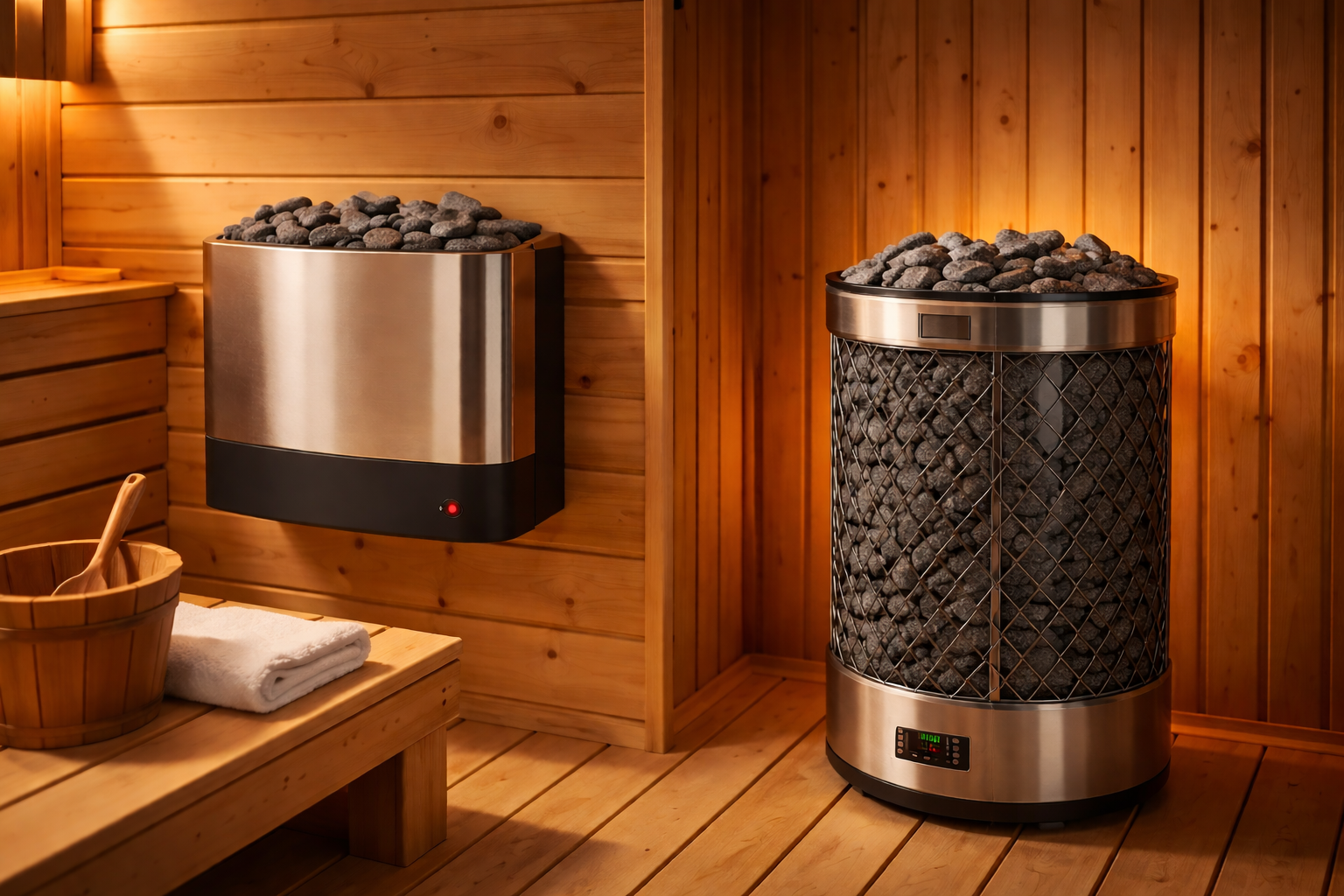
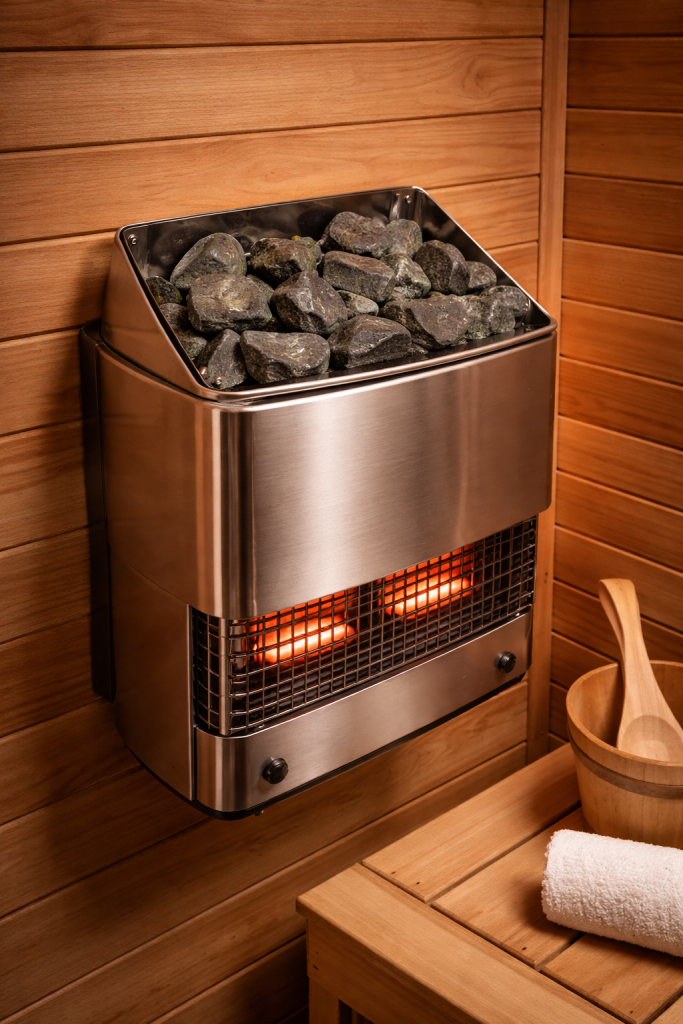
A wall-mounted heater attaches to a suitable wall using the manufacturer’s mounting system. It can help preserve usable floor space in a compact sauna, but its required clearances still affect where benches and walkways can go. Use the exact model’s installation diagram for mounting height and wall support.
Stone capacity varies considerably. Some wall-mounted heaters have compact stone compartments, while others hold much larger loads. Check the actual stone capacity rather than assuming that every wall-mounted heater heats faster or produces less steam.
Floor Standing Sauna Heaters
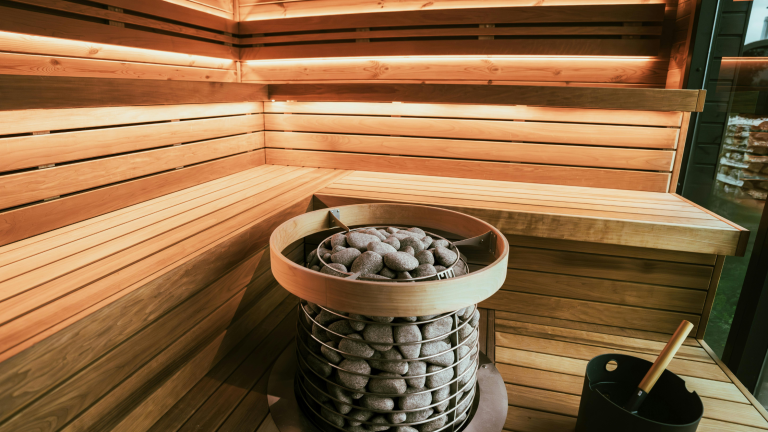
A floor-standing heater rests on a base or legs. Its footprint, clearances and any protective railing need to fit the room without obstructing access or crowding the benches.
Many floor-standing designs offer substantial stone capacity, but this isn’t exclusive to floor models. Compare the specific heater’s stone load, power rating and approved room-volume range.
What Does “Better Heat” Actually Mean Here?
What is the difference between wall mounted and floor sauna heaters in terms of heat quality?
A larger stone load can store more heat and support repeated water additions, but it may also take longer to heat. Heater power, stone arrangement, ventilation and room construction all affect performance. For löyly—the humid heat created by adding water to hot stones—compare individual models rather than declaring a winner by mounting style.
Cost Reality
Prices vary widely within both categories, so compare like with like.
Wall Mounted Heater Costs
Compare the complete package price, including any separate controller, required stones and mounting accessories. A lower advertised heater price may exclude items needed for installation. Get an electrical quote before buying.
Floor Standing Heater Costs
Floor-standing heaters also vary widely in price. Compare models with similar power and control features, then include stones, any required protective railing and installation. Mounting style alone doesn’t establish which option costs less.
Hidden Cost: Rocks
Check whether stones are included and how much the heater requires. Buy the stone type, size and quantity specified by the manufacturer; don’t substitute ordinary landscaping rocks.
Installation Friction
This is where the two types genuinely diverge in practical terms.
Wall Mounted Installation
Before mounting, confirm that the wall can support the heater and its full stone load. Follow the exact installation diagram for bracket position, mounting height, clearances and sensor placement. Don’t use a generic distance from the floor or ceiling. Have a licensed electrician handle the electrical installation.
Floor Standing Installation
Confirm the approved floor position, required clearances and any anchoring or protective-railing instructions. Plan the electrical connection with your installer before finalizing the bench layout. A floor-standing heater isn’t automatically simpler to install.
Permit Note
Ask your electrician or local building department which permits and inspections apply. The installation must follow the heater’s instructions and applicable local electrical requirements.
Maintenance
Neither type is high-maintenance, but there are differences worth knowing.
Wall Mounted Heater Maintenance
Inspect and rearrange the stones at the interval specified in the heater manual, replacing broken or deteriorating stones and removing accumulated debris.
Floor Standing Heater Maintenance
- Inspect and rearrange stones according to the heater manual, replacing damaged stones and removing debris.
- Clean beneath and around the base — debris accumulates under floor units
- If a protective railing is fitted, check that it remains secure.
- Check the floor contact points for moisture damage, especially in humid sauna environments
Follow the manufacturer’s maintenance schedule. Have a qualified electrician investigate electrical faults; don’t open or tighten electrical connections yourself.
Pros and Cons
Wall Mounted Heaters — Pros
• Can preserve usable floor space
• Can suit compact layouts when clearances allow
• Available with different stone capacities and control options
Wall Mounted Heaters — Cons
• Requires suitable wall support for the loaded heater
• Mounting and sensor positions must follow the manual
• Still needs clearances and any specified protective railing
Floor Standing Heaters — Pros
• Doesn’t rely on wall brackets to carry the heater’s weight
• Available in designs with substantial stone capacity
• Can suit layouts planned around its footprint
Floor Standing Heaters — Cons
• Occupies floor space
• Clearances and any protective railing increase the space needed
• Can be awkward to fit around existing benches
Head-to-Head Comparison
Which heater is better for a small home sauna?
A wall-mounted heater can be practical when floor space is limited, but check its complete clearance envelope. A compact floor-standing model may also fit. Choose a heater approved for the room’s adjusted volume, then check the bench and walkway layout.
Which heater is better for a traditional sauna experience?
Look for suitable stone capacity and a design approved for adding water to the stones. Both wall-mounted and floor-standing models can provide a traditional löyly experience.
Does placement affect which type you should choose?
Yes. Wall support, bench positions, walkways, ceiling height, ventilation and required clearances all matter. A high ceiling doesn’t automatically favor a floor-standing heater, and a barrel sauna doesn’t automatically favor a wall-mounted one.
Comparison Table
| Feature | Wall-mounted | Floor-standing |
|---|---|---|
| Support | Suitable wall and mounting system | Suitable floor/base; follow anchoring instructions |
| Space | Heater projection plus clearances | Footprint plus clearances |
| Stone capacity | Model-dependent | Model-dependent |
| Heat-up time | Depends on power, stones and room | Depends on power, stones and room |
| Steam/löyly | Depends on heater design and stone load | Depends on heater design and stone load |
| Protective railing | Follow manufacturer instructions | Follow manufacturer instructions |
| Room size | Manufacturer’s approved volume range | Manufacturer’s approved volume range |
| Total cost | Include controls, stones and installation | Include controls, stones and installation |
| Retrofit constraint | Wall support and bench clearances | Floor space and bench clearances |
Helpful Gear
Whether you go wall mounted or floor standing, a few accessories make a real difference in the day-to-day sauna experience.
1. Sauna Stones Choose stones approved for your heater, in the manufacturer’s specified size and quantity.
2. Sauna Ladle and Bucket Set Choose accessories intended for sauna use. Add water only as permitted by the heater manual.
3. Sauna Thermometer/Hygrometer: Helps you monitor temperature and humidity during your sessions. Follow the heater manual for heater and sensor placement.
If you’re considering cold exposure alongside your sauna routine, Cold Plunge vs Cold Shower: Which Is Better for Your Recovery? compares the two options.
FAQ
Can I switch from a floor heater to a wall mounted heater in an existing sauna? Possibly. Check wall support, mounting clearances and the replacement heater’s approved room-volume range. An electrician must confirm that the existing supply, wiring, protection and controls suit the new model. Matching wattage alone isn’t enough.
Do wall mounted sauna heaters need a guard rail? Wall mounting doesn’t remove the risk of contact burns. Follow the manufacturer’s protective-railing instructions and required clearances.
How many watts do I need for my sauna size? Use the manufacturer’s sizing chart or calculator for the specific heater. Include room volume and any adjustments required for glass, masonry or other uninsulated surfaces. A 6 × 6 × 7-foot room is 252 cubic feet, but that figure alone doesn’t establish the correct heater power.
Summary Snapshot
- Wall-mounted heaters need suitable wall support and model-specific clearances.
- Floor-standing heaters need space for their footprint and clearances.
- Stone capacity and heat-up time vary by model.
- Protective-railing guidance applies to both mounting styles.
- Size the heater using the manufacturer’s room-volume guidance.
- Compare the complete installed package before buying.
Final Verdict
Choose the heater that fits your sauna’s adjusted room volume, available space and installation requirements.
A wall-mounted model can be practical for a compact layout, provided the wall supports its loaded weight. A floor-standing model can work well when its footprint and clearances fit comfortably around the benches.
If löyly matters to you, compare stone capacity and heater design. If quick preparation matters more, compare power and expected heat-up performance for your room. Neither mounting style automatically wins.
Before buying, check the exact model’s manual and have a licensed electrician confirm the electrical requirements.
Getting the wattage right for your room size is just as important as choosing the mounting style. 6kW vs 8kW sauna heater covers the sizing decision in detail.
Once you’ve chosen your heater, sauna heater 240V wiring walks through the electrical requirements so you’re prepared before your electrician arrives.